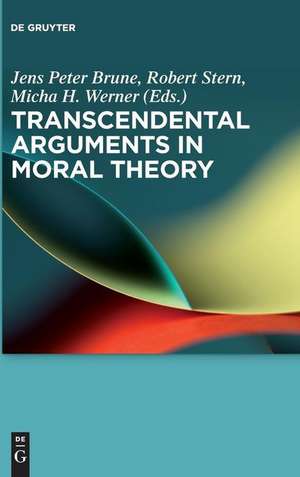
Transcendental Arguments in Moral Theory
Editat de Jens Peter Brune, Micha H. Werner, Robert Sternen Limba Engleză Hardback – 20 mar 2017
| Toate formatele și edițiile | Preț | Express |
|---|---|---|
| Hardback (1) | 897.37 lei 6-8 săpt. | |
| De Gruyter – 20 mar 2017 | 897.37 lei 6-8 săpt. | |
| Electronic book text (1) | 665.36 lei Precomandă | |
| De Gruyter – 19 mar 2017 | 665.36 lei Precomandă |
Preț: 897.37 lei
Preț vechi: 1165.41 lei
-23% Nou
Puncte Express: 1346
Preț estimativ în valută:
158.79€ • 186.45$ • 139.37£
158.79€ • 186.45$ • 139.37£
Carte tipărită la comandă
Livrare economică 27 ianuarie-10 februarie 26
Preluare comenzi: 021 569.72.76
Specificații
ISBN-13: 9783110469806
ISBN-10: 3110469804
Pagini: 366
Dimensiuni: 160 x 236 x 26 mm
Greutate: 0.7 kg
Ediția:1. Auflage
Editura: De Gruyter
ISBN-10: 3110469804
Pagini: 366
Dimensiuni: 160 x 236 x 26 mm
Greutate: 0.7 kg
Ediția:1. Auflage
Editura: De Gruyter
V-ar putea interesa
-
 Moral ClaritySusan NeimanPreț: 119.28 lei
 -
 Free Will and Modern ScienceRichard SwinburnePreț: 249.58 lei
 -
 Utilitarianism and Co-operationDonald H. Regan-34%Preț: 705.87 lei1076.72 lei
 -
 Hume's Theory of JusticeJonathan Harrison-22%Preț: 345.71 lei442.55 lei
 -
 Essays on Ethics and MethodHenry Sidgwick-23%Preț: 345.96 lei450.48 lei
 -
 Transcendental Arguments: Problems and ProspectsRobert Stern-24%Preț: 394.24 lei519.80 lei
 -
 -20%Preț: 422.60 lei526.91 lei
 -
 Self-Improvement: An Essay in Kantian EthicsRobert N. Johnson-11%Preț: 485.16 lei545.12 lei
 -
 Understanding Human AgencyErasmus Mayr-22%Preț: 663.36 lei845.86 lei
 -
 Hegelian MetaphysicsRobert Stern-12%Preț: 364.95 lei415.97 lei
 -
 -14%Preț: 505.73 lei588.06 lei
 -
 Virtue, Rules, and Justice: Kantian AspirationsThomas E. Hill, Jr-18%Preț: 354.81 lei434.14 lei
 -
 Reflections On How We LiveAnnette BaierPreț: 316.09 lei
 -
 Practical Intelligence and the VirtuesDaniel C. RussellPreț: 355.48 lei
 -
 Sidgwickian EthicsDavid Phillips-14%Preț: 629.07 lei731.48 lei
 -
 Moral Responsibility in Collective ContextsTracy Isaacs-7%Preț: 628.23 lei676.15 lei
 -
 Ethical TheoryRuss Shafer-Landau-19%Preț: 464.54 lei573.50 lei
Notă biografică
Jens Peter Brune and Micha H. Werner, Greifswald University, Germany; Robert Stern, University of Sheffield, Great Britain.
Descriere
Descriere de la o altă ediție sau format:
Since Barry Stroud's classic paper in 1968, the general discussion on transcendental arguments tends to focus on examples from theoretical philosophy. It also tends to be pessimistic, or at least extremely reluctant, about the potential of this kind of arguments. Nevertheless, transcendental reasoning continues to play a prominent role in some recent approaches to moral philosophy. Moreover, some authors argue that transcendental arguments may be more promising in moral philosophy than they are in theoretical contexts.
Against this background, the current volume focuses on transcendental arguments in practical philosophy. Experts from different countries and branches of philosophy share their views about whether there are actually differences between “theoretical” and “practical” uses of transcendental arguments. They examine and compare different versions of transcendental arguments in moral philosophy, explain their structure, and assess their respective problems and promises.
This book offers all those interested in ethics, meta-ethics, or epistemology a more comprehensive understanding of transcendental arguments. It also provides them with new insights into uses of transcendental reasoning in moral philosophy.
Since Barry Stroud's classic paper in 1968, the general discussion on transcendental arguments tends to focus on examples from theoretical philosophy. It also tends to be pessimistic, or at least extremely reluctant, about the potential of this kind of arguments. Nevertheless, transcendental reasoning continues to play a prominent role in some recent approaches to moral philosophy. Moreover, some authors argue that transcendental arguments may be more promising in moral philosophy than they are in theoretical contexts.
Against this background, the current volume focuses on transcendental arguments in practical philosophy. Experts from different countries and branches of philosophy share their views about whether there are actually differences between “theoretical” and “practical” uses of transcendental arguments. They examine and compare different versions of transcendental arguments in moral philosophy, explain their structure, and assess their respective problems and promises.
This book offers all those interested in ethics, meta-ethics, or epistemology a more comprehensive understanding of transcendental arguments. It also provides them with new insights into uses of transcendental reasoning in moral philosophy.