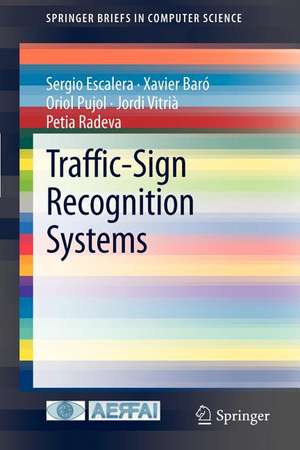
Traffic-Sign Recognition Systems: SpringerBriefs in Computer Science
Autor Sergio Escalera, Xavier Baró, Oriol Pujol, Jordi Vitrià, Petia Radevaen Limba Engleză Paperback – 23 sep 2011
Din seria SpringerBriefs in Computer Science
- 20%
 Preț: 334.13 lei
 - 20%
 Preț: 315.57 lei
 -
 Preț: 448.42 lei
 - 20%
 Preț: 324.81 lei
 -
 Preț: 394.76 lei
 - 20%
 Preț: 282.99 lei
 - 20%
 Preț: 335.59 lei
 -
 Preț: 477.41 lei
 - 20%
 Preț: 364.93 lei
 - 20%
 Preț: 311.04 lei
 - 20%
 Preț: 309.78 lei
 -
 Preț: 379.07 lei
 - 20%
 Preț: 311.84 lei
 - 20%
 Preț: 338.72 lei
 - 20%
 Preț: 323.75 lei
 - 20%
 Preț: 310.23 lei
 - 20%
 Preț: 321.60 lei
 - 20%
 Preț: 325.87 lei
 - 47%
 Preț: 251.63 lei
 - 20%
 Preț: 309.30 lei
 - 20%
 Preț: 311.50 lei
 -
 Preț: 392.17 lei
 -
 Preț: 359.92 lei
 - 20%
 Preț: 309.93 lei
 - 20%
 Preț: 311.50 lei
 - 20%
 Preț: 333.12 lei
 - 20%
 Preț: 310.73 lei
 - 20%
 Preț: 310.73 lei
 -
 Preț: 361.22 lei
 - 20%
 Preț: 311.84 lei
 - 20%
 Preț: 310.56 lei
 - 20%
 Preț: 310.73 lei
 - 20%
 Preț: 311.84 lei
 - 20%
 Preț: 311.04 lei
 - 20%
 Preț: 309.93 lei
 - 20%
 Preț: 311.18 lei
 - 20%
 Preț: 310.23 lei
 - 20%
 Preț: 311.04 lei
 - 20%
 Preț: 323.94 lei
 - 20%
 Preț: 311.18 lei
 - 20%
 Preț: 309.78 lei
 - 20%
 Preț: 321.39 lei
 - 20%
 Preț: 325.21 lei
 - 20%
 Preț: 310.73 lei
 - 20%
 Preț: 312.17 lei
 -
 Preț: 362.51 lei
 - 20%
 Preț: 312.17 lei
 - 20%
 Preț: 235.15 lei
 - 20%
 Preț: 325.43 lei
 - 20%
 Preț: 309.61 lei
Preț: 324.60 lei
Preț vechi: 405.75 lei
-20%
Puncte Express: 487
Carte tipărită la comandă
Livrare economică 05-19 decembrie
Livrare prin curier în România Termenul estimat este afișat lângă disponibilitate.
Transport gratuit de la 400.00 lei Plată online sau ramburs, în funcție de opțiunile comenzii.
Retur gratuit în 14 zile Comandă securizată și suport în română.
Specificații
ISBN-13: 9781447122449
ISBN-10: 1447122445
Pagini: 104
Ilustrații: VI, 96 p. 34 illus.
Dimensiuni: 155 x 235 x 7 mm
Greutate: 0.17 kg
Ediția:2011
Editura: Springer
Colecția SpringerBriefs in Computer Science
Seria SpringerBriefs in Computer Science
Locul publicării:London, United Kingdom
ISBN-10: 1447122445
Pagini: 104
Ilustrații: VI, 96 p. 34 illus.
Dimensiuni: 155 x 235 x 7 mm
Greutate: 0.17 kg
Ediția:2011
Editura: Springer
Colecția SpringerBriefs in Computer Science
Seria SpringerBriefs in Computer Science
Locul publicării:London, United Kingdom
V-ar putea interesa
-
 The Official DSA Theory Test for Drivers of Large Vehicles: 2013 EditionThe Driving Standards AgencyPreț: 123.33 lei
 -
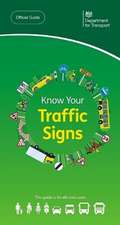 Know your traffic signsDepartment for TransportPreț: 47.86 lei
 -
 The Official DVSA Theory Test for Car Drivers - 2025Driver and Vehicle Standards AgencyyPreț: 155.83 lei
 -
 Roadcraft - the Police Drivers HandbookThe Police FoundationPreț: 207.05 lei
 -
 Manual of Neurological SignsJohn G. Morris-5%Preț: 1251.19 lei1317.04 lei
 -
 -18%Preț: 35.80 lei43.52 lei
 -
 -18%Preț: 35.85 lei43.59 lei
 -
 Obstetric Imaging: Fetal Diagnosis and CareJoshua A. Copel-28%Preț: 1751.36 lei2417.89 leiRecomandat
 -
 Computer Architecture: A Quantitative ApproachJohn L. Hennessy-39%Preț: 539.22 lei882.55 lei
 -
 Computer Vision: Object Detection In Adversarial VisionMrinal Kanti Bhowmik-18%Preț: 1141.38 lei1391.93 lei
 -
 -20%Preț: 1184.08 lei1480.10 lei
 -
 Traffic Sign Conspicuity: Selected AnalysesAntoine Bricker-27%Preț: 998.71 lei1361.89 lei
 -
 Motor Vehicle and Road User Studies for CCEA GCSEEamonn McPolinPreț: 176.39 lei
 -
 Grader Reader Workbook: Ready to ScoreMark BaileyPreț: 58.01 lei
 -
 Preț: 434.53 lei
 -
 Computer Vision and GraphicsLeszek J. Chmielewski-20%Preț: 1163.48 lei1454.34 lei
 -
 Advances in Human Activity Detection and Recognition (HADR) SystemsSantosh Kumar Tripathy-20%Preț: 255.41 lei319.27 lei
 -
 Computer Analysis of Images and PatternsModesto Castrillón-Santana-20%Preț: 327.69 lei409.62 lei
 -
 Cognitively Inspired Video Text ProcessingPalaiahnakote Shivakumara-20%Preț: 1162.06 lei1452.57 lei
 -
 Computer Vision, Pattern Recognition, Image Processing, and GraphicsSantanu Chaudhury-20%Preț: 644.26 lei805.32 lei
Public țintă
ResearchCuprins
Introduction.- Background on Traffic Sign Detection and Recognition.- Traffic Sign Detection.- Traffic Sign Categorization.- Traffic Sign Detection and Recognition System.- Conclusions.
Textul de pe ultima copertă
This work presents a full generic approach to the detection and recognition of traffic signs. The approach, originally developed for a mobile mapping application, is based on the latest computer vision methods for object detection, and on powerful methods for multiclass classification. The challenge was to robustly detect a set of different sign classes in real time, and to classify each detected sign into a large, extensible set of classes. To address this challenge, several state-of-the-art methods were developed that can be used for different recognition problems. Following an introduction to the problems of traffic sign detection and categorization, the text focuses on the problem of detection, and presents recent developments in this field. The text then surveys a specific methodology for the problem of traffic sign categorization – Error-Correcting Output Codes – and presents several algorithms, performing experimental validation on a mobile mapping application. The work ends with a discussion on future lines of research, and continuing challenges for traffic sign recognition.
Caracteristici
Presents a full generic approach to the detection and recognition of traffic signs, based on state-of-the-art computer vision methods for object detection, and on powerful methods for multiclass classification Surveys a specific methodology for the problem of traffic sign categorization: Error-Correcting Output Codes Includes experimental validation results performed on a mobile mapping application Includes supplementary material: sn.pub/extras
Notă biografică
Jun Wan received a B.S. degree from the China University of Geosciences, Beijing, China, in 2008, and a Ph.D. degree from the Institute of Information Science, Beijing Jiaotong University, Beijing, China, in 2015. Since January 2015, he has been a Faculty Member with the National Laboratory of Pattern Recognition (NLPR), Institute of Automation, Chinese Academy of Science (CASIA), China, where he currently serves as an Associate Professor. He is an IEEE Senior Member and a director of Chalearn Challenges. He has published more than 50 research papers and has been guest editor at TPAMI, MVA, and Entropy. His main research interests include computer vision, machine learning, especially for face and pedestrian analysis (such as attribute analysis, face anti-spoofing detection), gesture and sign language recognition. He has published papers in top journals and conferences, such as JMLR, T-PAMI, T-IP, T-MM, T-CYB, TOMM, PR, CVIU, CVPR, AAAI, and IJCAI. He has served as the reviewer on several journals and conferences, such as JMLR, T-PAMI, T-IP, T-MM, T-SMC, PR, CVPR, ICCV, ECCV, AAAI, and ICRA.
Guodong Guo received a B.E. degree in automation from Tsinghua University, Beijing, China, and a Ph.D. degree in computer science from University of Wisconsin, Madison, WI. He is currently the Deputy Head of the Institute of Deep Learning, Baidu Research, and also an Associate Professor with the Department of Computer Science and Electrical Engineering, West Virginia University (WVU). In the past, he visited and worked in several places, including INRIA, Sophia Antipolis, France; Ritsumeikan University, Kyoto, Japan; and Microsoft Research, Beijing, China; He authored a book, Face, Expression, and Iris Recognition Using Learning-based Approaches (2008), co-edited two books, Support Vector Machines Applications (2014) and Mobile Biometrics (2017), and published over 100 technical papers. He is an Associate Editor of IEEE Transactions on Affective Computing, Journal of Visual Communication and Image Representation, and serves on the editorial board of IET Biometrics. His research interests include computer vision, biometrics, machine learning, and multimedia. He received the North Carolina State Award for Excellence in Innovation in 2008, Outstanding Researcher (2017-2018, 2013-2014) at CEMR, WVU, and New Researcher of the Year (2010-2011) at CEMR, WVU. He was selected the "People's Hero of the Week" by BSJB under Minority Media and Telecommunications Council (MMTC) in 2013. Two of his papers were selected as "The Best of FG'13" and "The Best of FG'15", respectively.
Sergio Escalera (www.sergioescalera.com) obtained a P.h.D. degree on multi-class visual categorization systems at Computer Vision Center, UAB. He obtained the 2008 best Thesis award on Computer Science at Universitat Autonoma de Barcelona. He is ICREA Academia. He leads the Human Pose Recovery and Behavior Analysis Group at UB, CVC, and the Barcelona Graduate School of Mathematics. Heis Full Professor at the Department of Mathematics and Informatics, Universitat de Barcelona. He is an adjunct professor at Universitat Oberta de Catalunya, Aalborg University, and Dalhousie University. He has been visiting professor at TU Delft and Aalborg Universities. He is also a member of the Computer Vision Center at UAB. He is series editor of The Springer Series on Challenges in Machine Learning. He is a member and fellow of the European Laboratory of Intelligent Systems ELLIS. He is vice-president of ChaLearn Challenges in Machine Learning, leading ChaLearn Looking at People events. He is a co-creator of Codalab open source platform for challenges organization. He is Chair of IAPR TC-12: Multimedia and visual information systems. His research interests include: statistical pattern recognition, affective computing, and human pose recovery and behavior understanding, including multi-modal data analysis, with special interest in characterizing people: personality and psychological