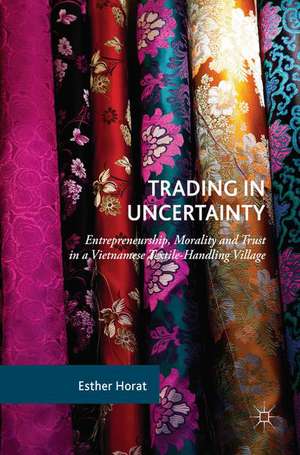
Trading in Uncertainty
Autor Esther Horaten Limba Engleză Hardback – 12 iul 2017
This book is an ethnographic case study, based on first hand observation, of family businesses in the northern Vietnamese village of Ninh Hiệp along the Red River Delta, which became a major hub for textiles in the wake of the country’s shift towards market socialism. The author explores how the traders experience, negotiate and react to a marketization process that is markedly shaped by the state’s morally ambivalent governance, and which can be thus characterised as an admixture of socialist and neoliberal ideologies.
How are traders shaping the political economy of Vietnam? How has the labour force changed as textile-handling has become an increasingly profitable undertaking? Horat explores the relationships between traders and local authorities, as well as changing ideas of masculinity and femininity. Focusing on the redevelopment of the market landscape and the increasing share of private ownership that have given rise to great uncertainty, this book provides a we
ll-timed inquiry into current debates of economic development in a uniquely shaped market environment. How are traders shaping the political economy of Vietnam? How has the labour force changed as textile-handling has become an increasingly profitable undertaking? Horat explores the relationships between traders and local authorities, as well as changing ideas of masculinity and femininity. Focusing on the redevelopment of the market landscape and the increasing share of private ownership that have given rise to great uncertainty, this book provides a we
Preț: 750.39 lei
Preț vechi: 915.12 lei
-18%
Puncte Express: 1126
Carte tipărită la comandă
Livrare economică 23 noiembrie-07 decembrie
Livrare prin curier în România Termenul estimat este afișat lângă disponibilitate.
Transport gratuit pentru acest produs Plată online sau ramburs, în funcție de opțiunile comenzii.
Retur gratuit în 14 zile Comandă securizată și suport în română.
Specificații
ISBN-13: 9783319556475
ISBN-10: 3319556479
Pagini: 256
Ilustrații: XV, 239 p. 7 illus. in color.
Dimensiuni: 153 x 216 x 19 mm
Greutate: 0.41 kg
Ediția:1st edition 2017
Editura: Springer
Locul publicării:Cham, Switzerland
ISBN-10: 3319556479
Pagini: 256
Ilustrații: XV, 239 p. 7 illus. in color.
Dimensiuni: 153 x 216 x 19 mm
Greutate: 0.41 kg
Ediția:1st edition 2017
Editura: Springer
Locul publicării:Cham, Switzerland
V-ar putea interesa
-
 Economics: A Very Short IntroductionPartha Dasgupta-19%Preț: 57.70 lei71.46 lei
 -
 -20%Preț: 349.48 lei434.68 lei
 -
 How to make an IMPACTJon MoonPreț: 281.43 lei
 -
 Preț: 106.53 lei
 -
 -15%Preț: 460.89 lei542.22 lei
 -
 Game Theory for Applied EconomistsRobert S Gibbons-19%Preț: 459.12 lei566.81 lei
 -
 Companion to Urban EconomicsArnott-8%Preț: 535.43 lei582.00 lei
 -
 Spatial Statistics and ModelingCarlo Gaetan-18%Preț: 1114.35 lei1358.96 lei
 -
 Preț: 118.74 lei
 -
 The Return of Depression EconomicsPaul Krugman-32%Preț: 62.97 lei92.20 lei
 -
 The Reformation in EconomicsPhilip PilkingtonPreț: 359.55 lei
 -
 New Introduction to Multiple Time Series AnalysisHelmut Lütkepohl-18%Preț: 878.32 lei1071.12 lei
 -
 Don't Worry About MicroDominik HecknerPreț: 319.17 lei
 -
 Handbook of New Institutional EconomicsClaude Ménard-18%Preț: 728.59 lei888.52 lei
 -
 Economic DynamicsGiancarlo Gandolfo-18%Preț: 977.31 lei1191.84 lei
 -
 -15%Preț: 574.50 lei675.88 lei
Cuprins
Chapter 1. Introduction: Neoliberal Governance and Market Socialism.- Chapter 2. The Village in the Market.- Chapter 3. Trading in Uncertainty.- Chapter 4. Building Families, Building Businesses.- Chapter 5. The Gendering of Market Trade.- Chapter 6. Trust and Entrepreneurialism.- Chapter 7. Spatial Organisation of Trade.- Chapter 8. Morality and the Making of a Community.- Chapter 9. Conclusion.
Textul de pe ultima copertă
This book is an ethnographic case study, based on first hand observation, of family businesses in the northern Vietnamese village of Ninh Hiệp along the Red River Delta, which became a major hub for textiles in the wake of the country’s shift towards market socialism. The author explores how the traders experience, negotiate and react to a marketization process that is markedly shaped by the state’s morally ambivalent governance, and which can be thus characterised as an admixture of socialist and neoliberal ideologies.
How are traders shaping the political economy of Vietnam? How has the labour force changed as textile-handling has become an increasingly profitable undertaking? Horat explores the relationships between traders and local authorities, as well as changing ideas of masculinity and femininity. Focusing on the redevelopment of the market landscape and the increasing share of private ownership that have given rise to great uncertainty, this book
provides a well-timed inquiry into current debates of economic development in a uniquely shaped market environment.Esther Horat is Lecturer and Researcher at the University of Zurich, Switzerland. She wrote her doctoral thesis at the Max Planck Institute for Social Anthropology in Halle/Saale, Germany, as well as at the University of Zurich, Switzerland.
How are traders shaping the political economy of Vietnam? How has the labour force changed as textile-handling has become an increasingly profitable undertaking? Horat explores the relationships between traders and local authorities, as well as changing ideas of masculinity and femininity. Focusing on the redevelopment of the market landscape and the increasing share of private ownership that have given rise to great uncertainty, this book
provides a well-timed inquiry into current debates of economic development in a uniquely shaped market environment.Esther Horat is Lecturer and Researcher at the University of Zurich, Switzerland. She wrote her doctoral thesis at the Max Planck Institute for Social Anthropology in Halle/Saale, Germany, as well as at the University of Zurich, Switzerland.
Caracteristici
Takes an economic anthropological approach to Vietnam's textile trading and local economies Provides in-depth ethnographic analysis of economic life in a Vietnamese village Trade and traders are not looked at through a primarily economic angle, but as enmeshed in the political, social and moral context of contemporary Vietnam Captures the complexities and diversities of family businesses in Vietnam Highlights the shifting notions of gender in small-scale trade in Vietnam Includes supplementary material: sn.pub/extras