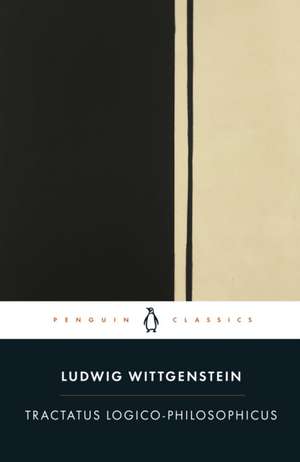
Tractatus Logico-Philosophicus
Autor Ludwig Wittgenstein Traducere de Alexander Boothen Limba Engleză Paperback – 28 noi 2024
'The final philosopher to perform the most profound surgery on philosophy ... concise yet exceptionally clear' Ai Weiwei
Widely regarded as one of the most influential philosophical works of the twentieth century, Ludwig Wittgenstein's Tractatus Logico-Philosophicus is a succinct yet wide-ranging exploration of language and logic; of science and mysticism; of what can be said, and what can only be shown. Its austere beauty - along with its famous 'picture theory' of meaning - has inspired generations of thinkers, artists, novelists and musicians. In a series of short, bold statements, Wittgenstein seeks to define the limits of meaningful expression. Originally published in the early 1920s, it is the only book-length work the renowned philosopher published in his lifetime.
In this thrilling new translation, accompanied by a lively introduction by Jan Zwicky, Alexander Booth displays an extraordinary sensitivity to the subtle influence on Wittgenstein's gem-like prose - at once specialist and, often, remarkably plain-spoken - of his background in mechanical engineering, while at the same time highlighting the underlying poetry of this seminal text.
Preț: 70.88 lei
Puncte Express: 106
Carte disponibilă
Livrare economică 07-21 noiembrie
Livrare express 24-30 octombrie pentru 15.52 lei
Livrare prin curier în România Termenul estimat este afișat lângă disponibilitate.
Transport gratuit de la 400.00 lei Plată online sau ramburs, în funcție de opțiunile comenzii.
Retur gratuit în 14 zile Comandă securizată și suport în română.
Specificații
ISBN-13: 9780241484173
ISBN-10: 0241484170
Pagini: 144
Dimensiuni: 122 x 193 x 12 mm
Greutate: 0.12 kg
Editura: Penguin Books
Colecția Penguin Classics
Locul publicării:London, United Kingdom
ISBN-10: 0241484170
Pagini: 144
Dimensiuni: 122 x 193 x 12 mm
Greutate: 0.12 kg
Editura: Penguin Books
Colecția Penguin Classics
Locul publicării:London, United Kingdom
V-ar putea interesa
-
 The Awakening of IntelligenceJiddu KrishnamurtiPreț: 127.91 lei
 -
 Being and TimeMartin HeideggerPreț: 144.10 lei
 -
 The Blank SlateSteven Pinker-28%Preț: 78.74 lei109.00 lei
 -
 Games People PlayEric Berne-26%Preț: 62.47 lei84.96 lei
 -
 Irrational ManWilliam BarrettPreț: 100.30 lei
 -
 The Language of ChangePaul WatzlawickPreț: 114.66 lei
 -
 Letter to a PriestSimone WeilPreț: 199.34 lei
 -
 On DialogueDavid BohmPreț: 230.67 lei
 -
 Sketch for a Theory of the EmotionsJean-Paul SartrePreț: 270.63 lei
 -
 The Undiscovered SelfCarl Gustav JungPreț: 215.61 lei
 -
 -7%Preț: 358.82 lei384.90 lei
 -
 Hegel Freedom Truth History 2eStephen HoulgatePreț: 316.62 lei
 -
 Urban ShamanSerge Kahili King-19%Preț: 69.55 lei86.04 lei
 -
 Cracking the Coding InterviewGayle Laakmann Mcdowell-20%Preț: 342.69 lei428.36 lei
 -
 Php, Mysql, & JavaScript All-In-One for DummiesRichard Blum-20%Preț: 263.63 lei329.54 lei
 -
 -20%Preț: 255.72 lei319.66 lei
 -
 Power Up Your BrainDavid PerlmutterPreț: 112.67 lei
 -
 Postautonomous Ego DevelopmentSusanne Cook-GreuterPreț: 168.69 lei
 -
 Javascript: The Definitive GuideDavid Flanagan-20%Preț: 405.85 lei507.31 lei
 -
 In an Unspoken VoicePeter A. Levine-22%Preț: 126.02 lei160.59 lei
 -
 Cutting Through Spiritual MaterialismChögyam Trungpa-18%Preț: 100.50 lei122.92 lei
 -
 Thinking in SystemsDonella MeadowsPreț: 122.73 lei
 -
 Scattered MindsGabor Maté-19%Preț: 75.42 lei93.34 lei
 -
 Full-Stack React Projects - Second EditionShama Hoque-20%Preț: 318.86 lei398.58 lei
Notă biografică
Ludwig Josef Johann Wittgenstein was born in Vienna in 1889 to a wealthy industrialist family and pursued an education in mechanical engineering before going on to study, and later to teach at the University of Cambridge, where he lived until his death in 1951. He is regarded by many as the greatest philosopher of the twentieth century, and his two major works, the Tractatus Logico-Philosophicus (1921) and Philosophical Investigations (published posthumously in 1953), are two of the most influential works within the history of the analytic tradition.
Descriere
Descriere de la o altă ediție sau format:
'what can be said at all can be said clearly; and of what one cannot talk, about that one must be silent'Wittgenstein's Tractatus Logico-Philosophicus, first published in German in 1921 and in English translation in 1922, is one of the most influential philosophical texts of the twentieth century. It played a fundamental role in the development of analytic philosophy, and its philosophical ideas and implications have been fiercely debated ever since. This new translation improves on the two main earlier translations, taking advantage of the scholarship over the last century that has deepened our understanding of both the Tractatus and Wittgenstein's philosophy more generally, scholarship that has also involved discussion of the difficulties in translating the original German text and the issues of interpretation that arise.Michael Beaney's translation is accompanied by two introductory essays, the first explaining the background to Wittgenstein's work, its main ideas and their subsequent development and influence, and some of the central debates, and the second providing an account of the history of the text and the two earlier translations. It is accompanied by detailed notes, explaining key points of translation and interpretation, a glossary, chronology, and other editorial material designed to help the reader understand the Tractatus and its place in the history of philosophy.
'what can be said at all can be said clearly; and of what one cannot talk, about that one must be silent'Wittgenstein's Tractatus Logico-Philosophicus, first published in German in 1921 and in English translation in 1922, is one of the most influential philosophical texts of the twentieth century. It played a fundamental role in the development of analytic philosophy, and its philosophical ideas and implications have been fiercely debated ever since. This new translation improves on the two main earlier translations, taking advantage of the scholarship over the last century that has deepened our understanding of both the Tractatus and Wittgenstein's philosophy more generally, scholarship that has also involved discussion of the difficulties in translating the original German text and the issues of interpretation that arise.Michael Beaney's translation is accompanied by two introductory essays, the first explaining the background to Wittgenstein's work, its main ideas and their subsequent development and influence, and some of the central debates, and the second providing an account of the history of the text and the two earlier translations. It is accompanied by detailed notes, explaining key points of translation and interpretation, a glossary, chronology, and other editorial material designed to help the reader understand the Tractatus and its place in the history of philosophy.
Recenzii
Paradox is a powerful source of philosophical intrigue. And these two new editions attest to the status of the Tractatus as perhaps the philosophical classic of the twentieth century, inspiring not only philosophers of both "analytic" and "continental" stripes, but also writers, logicians and film-makers.
Cuprins
- Preface
- Introduction
- A Note on the Text
- Select Bibliography
- Chronology of Ludwig Wittgenstein
- Tractatus Logico-Philosophicus
- Explanatory Notes
- Appendix: The Tree Structure of the Main Propositions of the Tractatus
- Glossary