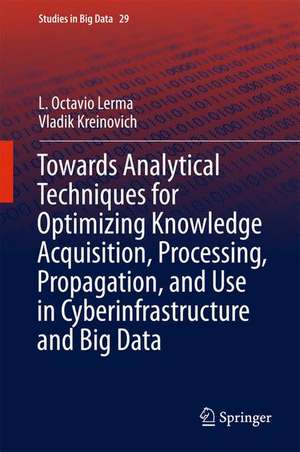
Towards Analytical Techniques for Optimizing Knowledge Acquisition, Processing, Propagation, and Use in Cyberinfrastructure and Big Data: Studies in Big Data, cartea 29
Autor L. Octavio Lerma, Vladik Kreinovichen Limba Engleză Hardback – sep 2017
The need for such methods stems from the fact that, when we have to decide where to place sensors, or which algorithm to use for processing the data—we mostly rely on experts’ opinions. As a result, the selected knowledge-related methods are often far from ideal. To make better selections, it is necessary to first create easy-to-use models of knowledge-related processes. This is especially important for big data, where traditional numerical methods are unsuitable.
The book offers a valuable guide for everyone interested in big data applications: students looking for an overview of related analytical techniques, practitioners interested in applying optimization techniques, and researchers seeking to improve and expand on these techniques.
Din seria Studies in Big Data
- 20%
 Preț: 966.30 lei
 - 20%
 Preț: 671.45 lei
 - 18%
 Preț: 1038.28 lei
 - 20%
 Preț: 1208.06 lei
 - 20%
 Preț: 1023.73 lei
 - 20%
 Preț: 1676.16 lei
 - 20%
 Preț: 1202.10 lei
 - 20%
 Preț: 1523.35 lei
 - 20%
 Preț: 1222.48 lei
 - 20%
 Preț: 1213.74 lei
 - 20%
 Preț: 1200.85 lei
 - 20%
 Preț: 1094.69 lei
 - 20%
 Preț: 1019.01 lei
 - 20%
 Preț: 1210.28 lei
 - 18%
 Preț: 1158.51 lei
 - 18%
 Preț: 1142.03 lei
 - 20%
 Preț: 1024.96 lei
 - 15%
 Preț: 659.55 lei
 - 24%
 Preț: 836.13 lei
 - 24%
 Preț: 902.25 lei
 - 20%
 Preț: 676.02 lei
 - 20%
 Preț: 679.34 lei
 - 20%
 Preț: 927.75 lei
 - 20%
 Preț: 1045.95 lei
 - 20%
 Preț: 1615.47 lei
 - 18%
 Preț: 725.05 lei
 - 20%
 Preț: 1051.73 lei
 - 20%
 Preț: 1165.44 lei
 - 20%
 Preț: 982.28 lei
 - 20%
 Preț: 1115.43 lei
 - 20%
 Preț: 1809.50 lei
 - 20%
 Preț: 344.91 lei
 - 20%
 Preț: 1043.84 lei
 - 20%
 Preț: 972.87 lei
 - 20%
 Preț: 1138.32 lei
 - 20%
 Preț: 1030.02 lei
Preț: 785.05 lei
Preț vechi: 981.31 lei
-20%
Puncte Express: 1178
Carte tipărită la comandă
Livrare economică 30 noiembrie-14 decembrie
Livrare prin curier în România Termenul estimat este afișat lângă disponibilitate.
Transport gratuit pentru acest produs Plată online sau ramburs, în funcție de opțiunile comenzii.
Retur gratuit în 14 zile Comandă securizată și suport în română.
Specificații
ISBN-13: 9783319613482
ISBN-10: 3319613480
Pagini: 152
Ilustrații: VIII, 141 p.
Dimensiuni: 160 x 241 x 14 mm
Greutate: 0.35 kg
Ediția:1st edition 2018
Editura: Springer
Colecția Studies in Big Data
Seria Studies in Big Data
Locul publicării:Cham, Switzerland
ISBN-10: 3319613480
Pagini: 152
Ilustrații: VIII, 141 p.
Dimensiuni: 160 x 241 x 14 mm
Greutate: 0.35 kg
Ediția:1st edition 2018
Editura: Springer
Colecția Studies in Big Data
Seria Studies in Big Data
Locul publicării:Cham, Switzerland
Cuprins
Introduction.- Data Acquisition: Towards Optimal Use of Sensors.- Data and Knowledge Processing.- Knowledge Propagation and Resulting Knowledge Enhancement.- Knowledge Use.- Conclusions.
Textul de pe ultima copertă
This book describes analytical techniques for optimizing knowledge acquisition, processing, and propagation, especially in the contexts of cyber-infrastructure and big data. Further, it presents easy-to-use analytical models of knowledge-related processes and their applications.
The need for such methods stems from the fact that, when we have to decide where to place sensors, or which algorithm to use for processing the data—we mostly rely on experts’ opinions. As a result, the selected knowledge-related methods are often far from ideal. To make better selections, it is necessary to first create easy-to-use models of knowledge-related processes. This is especially important for big data, where traditional numerical methods are unsuitable.
The book offers a valuable guide for everyone interested in big data applications: students looking for an overview of related analytical techniques, practitioners interested in applying optimization techniques, and researchers seeking to improve and expand on these techniques.
The need for such methods stems from the fact that, when we have to decide where to place sensors, or which algorithm to use for processing the data—we mostly rely on experts’ opinions. As a result, the selected knowledge-related methods are often far from ideal. To make better selections, it is necessary to first create easy-to-use models of knowledge-related processes. This is especially important for big data, where traditional numerical methods are unsuitable.
The book offers a valuable guide for everyone interested in big data applications: students looking for an overview of related analytical techniques, practitioners interested in applying optimization techniques, and researchers seeking to improve and expand on these techniques.
Caracteristici
Develops analytical models for knowledge-related processes, from knowledge acquisition to knowledge processing and knowledge propagation Provides various case studies explaining how the corresponding models can be used Allows easier optimization and application by not depending on detailed numerical simulation Includes supplementary material: sn.pub/extras