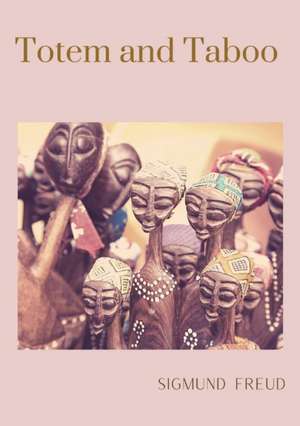
Totem and Taboo
Autor Sigmund Freud Traducere de James Stracheyen Limba Engleză Paperback – 14 oct 2020
- Totem and Taboo: Resemblances Between the Mental Lives of Savages and Neurotics, or Totem and Taboo: Some Points of Agreement between the Mental Lives of Savages and Neurotics, (German: Totem und Tabu: Einige bereinstimmungen im Seelenleben der Wilden und der Neurotiker) is a 1913 book by Sigmund Freud, the founder of psychoanalysis, in which the author applies his work to the fields of archaeology, anthropology, and the study of religion. It is a collection of four essays inspired by the work of Wilhelm Wundt and Carl Jung and first published in the journal Imago (1912-13): "The Horror of Incest", "Taboo and Emotional Ambivalence", "Animism, Magic and the Omnipotence of Thoughts", and "The Return of Totemism in Childhood".
- Though Totem and Taboo has been seen as one of the classics of anthropology, comparable to Edward Burnett Tylor's Primitive Culture (1871) and Sir James George Frazer's The Golden Bough (1890), the work is now considered discredited by anthropologists. The cultural anthropologist Alfred L. Kroeber was an early critic of Totem and Taboo, publishing a critique of the work in 1920. Some authors have seen redeeming value in the work.Freud, who had a longstanding interest in social anthropology and was devoted to the study of archaeology and prehistory, wrote that the work of Wilhelm Wundt and Carl Jung provided him with his "first stimulus" to write the essays included in Totem and Taboo. The work was translated twice into English, first by Abraham Brill and later by James Strachey. Freud was influenced by the work of James George Frazer, including The Golden Bough (1890)."The Horror of Incest" concerns incest taboos adopted by societies believing in totemism.Freud examines the system of Totemism among the Australian Aborigines. Every clan has a totem (usually an animal, sometimes a plant or force of nature) and people are not allowed to marry those with the same totem as themselves. Freud examines this practice as preventing against incest. The totem is passed down hereditarily, either through the father or the mother. The relationship of father is also not just his father, but every man in the clan that, hypothetically, could have been his father. He relates this to the idea of young children calling all of their parents' friends as aunts and uncles. There are also further marriage classes, sometimes as many as eight, that group the totems together, and therefore limit a man's choice of partners. He also talks about the widespread practices amongst the cultures of the Pacific Islands and Africa of avoidance.
Preț: 111.33 lei
Puncte Express: 167
Carte disponibilă
Livrare economică 16-30 noiembrie
Livrare prin curier în România Termenul estimat este afișat lângă disponibilitate.
Transport gratuit de la 400.00 lei Plată online sau ramburs, în funcție de opțiunile comenzii.
Retur gratuit în 14 zile Comandă securizată și suport în română.
Specificații
ISBN-13: 9782382743430
ISBN-10: 2382743433
Pagini: 122
Dimensiuni: 148 x 210 x 8 mm
Greutate: 0.14 kg
Editura: Les Prairies Numeriques
ISBN-10: 2382743433
Pagini: 122
Dimensiuni: 148 x 210 x 8 mm
Greutate: 0.14 kg
Editura: Les Prairies Numeriques
V-ar putea interesa
-
 Great Ideas Civilization and Its DiscontentsSigmund Freud-20%Preț: 45.43 lei56.47 lei
 -
 Mass PsychologySigmund Freud-18%Preț: 87.97 lei107.49 lei
 -
 On Murder, Mourning and MelancholiaSigmund Freud-19%Preț: 75.55 lei93.23 lei
 -
 The UnconsciousSigmund Freud-20%Preț: 56.65 lei70.83 lei
 -
 Modern Classics Psychology of LoveSigmund Freud-18%Preț: 76.49 lei93.76 lei
 -
 Frosh, S: Brief Introduction to Psychoanalytic TheoryStephen Frosh-26%Preț: 189.69 lei256.92 lei
 -
 Psychology and ReligionCarl Gustav JungPreț: 130.40 lei
 -
 The Golden BoughJames George Frazer-14%Preț: 71.08 lei83.09 lei
 -
 -19%Preț: 23.11 lei28.46 lei
 -
 The Basic Writings of Sigmund FreudSigmund FreudPreț: 171.78 lei
 -
 Love's LabourStephen GroszPreț: 120.69 lei
 -
 TotemismClaude Levi-StraussPreț: 120.56 lei
 -
 Group Psychology and the Analysis of the EgoSigmund FreudPreț: 38.08 lei
 -
 First WritingsJacques LacanPreț: 161.26 lei
 -
 Freud¿s Beasty Boys: Sex, Violence and MasculinityOxana TimofeevaPreț: 126.36 lei
 -
 Dream PsychologySigmund FreudPreț: 40.46 lei
 -
 Modern Man in Search of a SoulC. G. JungPreț: 82.97 lei
 -
 Introducing FreudRichard AppignanesiPreț: 63.27 lei
 -
 Preț: 383.99 lei
 -
 Preț: 137.51 lei
Notă biografică
The founder of psychoanalysis, Sigmund Freud (1856-1939) ranks among the most important figures in Western psychology. Freud is responsible for the theories of parapraxis (Freudian slips), dreams as wish fulfillment, the Oedipus complex, repression, the unconscious mind, and other ground-breaking concepts.
Textul de pe ultima copertă
In this brilliant exploratory attempt to extend the analysis of the individual psyche to society and culture, Freud laid the lines for much of his late thought, and made a major contribution to the psychology of religion. Primitive societies and the individual, he found, mutually illuminate each other, and the psychology of primitive races bears marked resemblances to the psychology of neurotics. Basing his investigations on the finding of anthropologists, Freud came to the conclusion that totemism and its accompanying restriction of exogamy derive form the savage's dread of incest, and that taboo customs parallel closely the symptoms of compulsion neurosis. The killing of the 'primal father' and the consequent sense of guilt are seen as determining events both in the misty tribal pre-history of mankind, and in the suppressed wishes of individual men. Both totemism and taboo are thus held to have their roots in the Oedipus complex, which lies at the basis of all neurosis, and, as Freud argues, is also the origin of religion, ethics, society, and art.
Recenzii
'With - Totem and Tabo Freud invented evolutionary psychology.'
'Freud has told us that for him all natural science, medicine, and psychotherapy were a lifelong journey round and back to the early passion of his youth for the history of mankind, for the origins of religion and morality - an interest which at the height of his career broke out to such magnificent effect in - Totem and Taboo.' - Thomas Mann
'Relations between social anthropology and psychology are still ill-defined and unstable. But in any resolution of them the work of psychoanalysts must be taken very seriously into account. It is very useful, then, to have this new translation of the pioneer work.' - Nature
'Freud had a strong element of the artist in his composition. Nearly all his work was well translated into English, with one glaring exception: - Totem and Taboo. Now, at last . . . justice has been done . . . The book itself is one of the most fascinating and characteristic, and also of the most speculative, in the whole Freudian canon.'
'Freud has told us that for him all natural science, medicine, and psychotherapy were a lifelong journey round and back to the early passion of his youth for the history of mankind, for the origins of religion and morality - an interest which at the height of his career broke out to such magnificent effect in - Totem and Taboo.' - Thomas Mann
'Relations between social anthropology and psychology are still ill-defined and unstable. But in any resolution of them the work of psychoanalysts must be taken very seriously into account. It is very useful, then, to have this new translation of the pioneer work.' - Nature
'Freud had a strong element of the artist in his composition. Nearly all his work was well translated into English, with one glaring exception: - Totem and Taboo. Now, at last . . . justice has been done . . . The book itself is one of the most fascinating and characteristic, and also of the most speculative, in the whole Freudian canon.'
Cuprins
Chapter 1 The Horror of Incest; Chapter 2 Taboo and Emotional Ambivalence; Chapter 3 Animism, Magic and the Omnipotence of Thoughts; Chapter 4 The Return of Totemism in Childhood;
Descriere
Descriere de la o altă ediție sau format:
If you don't know your incest taboo from your Oedipal complex, and you want to understand more about the culture we're living in, then Totem and Taboo is the book to read.
If you don't know your incest taboo from your Oedipal complex, and you want to understand more about the culture we're living in, then Totem and Taboo is the book to read.