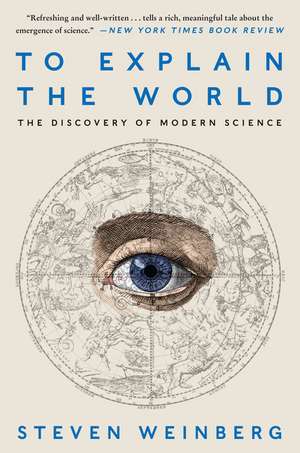
To Explain the World: The Discovery of Modern Science
Autor Steven Weinbergen Limba Engleză Paperback – 8 feb 2016
In this rich, irreverent, and compelling history, Nobel Prize-winning physicist Steven Weinberg takes us across centuries from ancient Miletus to medieval Baghdad and Oxford, from Plato’s Academy and the Museum of Alexandria to the cathedral school of Chartres and the Royal Society of London. He shows that the scientists of ancient and medieval times not only did not understand what we understand about the world—they did not understand what there is to understand, or how to understand it. Yet over the centuries, through the struggle to solve such mysteries as the curious backward movement of the planets and the rise and fall of the tides, the modern discipline of science eventually emerged. Along the way, Weinberg examines historic clashes and collaborations between science and the competing spheres of religion, technology, poetry, mathematics, and philosophy.
An illuminating exploration of the way we consider and analyze the world around us, To Explain the World is a sweeping, ambitious account of how difficult it was to discover the goals and methods of modern science, and the impact of this discovery on human knowledge and development.
| Toate formatele și edițiile | Preț | Express |
|---|---|---|
| Paperback (2) | 61.92 lei 24-30 zile | +28.91 lei 4-10 zile |
| Penguin Books – feb 2016 | 61.92 lei 24-30 zile | +28.91 lei 4-10 zile |
| HarperCollins Publishers – 8 feb 2016 | 101.34 lei 3-5 săpt. |
Preț: 101.34 lei
Nou
17.93€ • 21.03$ • 15.75£
Carte disponibilă
Livrare economică 19 ianuarie-02 februarie 26
Specificații
ISBN-10: 0062346660
Pagini: 432
Dimensiuni: 135 x 203 x 25 mm
Greutate: 0.32 kg
Editura: HarperCollins Publishers
Colecția HarperPerennial
V-ar putea interesa
-
 Preț: 108.28 lei
 -
 Descartes' ErrorAntonio Damasio-21%Preț: 70.67 lei88.99 lei
 -
 The Tell-Tale BrainV. S. Ramachandran-19%Preț: 62.72 lei77.06 lei
 -
 A Brief Tour of Human ConsciousnessV. S. RamachandranPreț: 125.17 lei
 -
 The Black CloudFred HoylePreț: 68.24 lei
 -
 Preț: 134.10 lei
 -
 Preț: 129.94 lei
 -
 Preț: 127.97 lei
 -
 The Black Hole WarLeonard Susskind-26%Preț: 85.90 lei116.69 lei
 -
 Critique Of Pure ReasonImmanuel Kant-27%Preț: 76.48 lei104.18 lei
 -
 Preț: 170.70 lei
 -
 Preț: 76.26 lei
 -
 Preț: 157.31 lei
 -
 Facing Up – Science and its Cultural AdversariesSteven WeinbergPreț: 307.04 lei
 -
 Third Thoughts – The Universe We Still Don′t KnowSteven WeinbergPreț: 126.58 lei
 -
 Preț: 98.30 lei
 -
 A Brief History of TimeStephen Hawking-21%Preț: 59.90 lei75.35 lei
 -
 Lectures on AstrophysicsSteven WeinbergPreț: 346.74 lei
 -
 AstroNuts Mission Two: The Water PlanetJon Scieszka-10%Preț: 71.07 lei78.75 lei
 -
 Shermer, M: Believing BrainMichael Shermer-27%Preț: 75.75 lei103.74 lei
 -
 -20%Preț: 60.10 lei75.46 lei
 -
 From Eternity to HereSean CarrollPreț: 90.52 lei
Textul de pe ultima copertă
“Refreshing and well-written . . . tells a rich, meaningful tale about the emergence of science.”—New York Times Book Review
“A masterful journey through humankind’s scientific coming-of-age . . . a delightful celebration of our passionate drive for understanding.”—Brian Greene
In this rich, irreverent, and compelling history, Nobel Prize–winning physicist Steven Weinberg takes us across centuries, from ancient Miletus to medieval Baghdad and Oxford, from Plato’s Academy and the Museum of Alexandria to the cathedral school of Chartres and the Royal Society of London. He shows that the scientists of ancient and medieval times not only did not understand what we now know about the world but also did not understand what there is to understand, nor how to understand it.
Yet over the centuries, through the struggle to solve such mysteries as the curious backward movement of the planets or the rise and fall of the tides, the modern discipline of science eventually emerged. Along the way, Weinberg examines historic clashes and collaborations between science and the competing spheres of religion, technology, poetry, mathematics, and philosophy.
To Explain the World is an illuminating exploration of how we have come to consider and analyze the world around us.
“A thoughtful history.”—The New Yorker
Recenzii
Descriere
A masterful commentary on the history of science from the Greeks to modern times, by Nobel Prize-winning physicist Steven Weinberg—a thought-provoking and important book by one of the most distinguished scientists and intellectuals of our time.
In this rich, irreverent, and compelling history, Nobel Prize-winning physicist Steven Weinberg takes us across centuries from ancient Miletus to medieval Baghdad and Oxford, from Plato’s Academy and the Museum of Alexandria to the cathedral school of Chartres and the Royal Society of London. He shows that the scientists of ancient and medieval times not only did not understand what we understand about the world—they did not understand what there is to understand, or how to understand it. Yet over the centuries, through the struggle to solve such mysteries as the curious backward movement of the planets and the rise and fall of the tides, the modern discipline of science eventually emerged. Along the way, Weinberg examines historic clashes and collaborations between science and the competing spheres of religion, technology, poetry, mathematics, and philosophy.
An illuminating exploration of the way we consider and analyze the world around us, To Explain the World is a sweeping, ambitious account of how difficult it was to discover the goals and methods of modern science, and the impact of this discovery on human knowledge and development.
Notă biografică
Steven Weinberg is a theoretical physicist and the winner of the Nobel Prize in Physics, the National Medal of Science, the Lewis Thomas Prize for the Scientist as Poet, and numerous honorary degrees and other awards. He is a member of the National Academy of Science, the Royal Society of London, the American Philosophical Society, and other academies. A longtime contributor to the New York Review of Books, he is also the author of The First Three Minutes, Dreams of a Final Theory, Facing Up, and Lake Views, as well as leading treatises on theoretical physics. He holds the Josey Regental Chair in Science at the University of Texas at Austin.