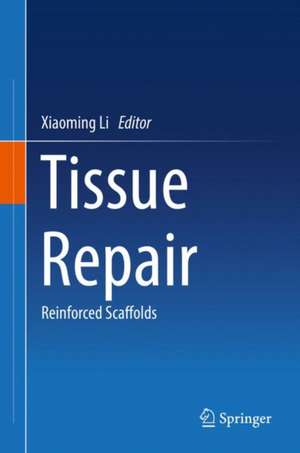
Tissue Repair : Reinforced Scaffolds
Editat de Xiaoming Lien Limba Engleză Hardback – 26 iun 2017
Publicat în format Hardback de Springer, Tissue Repair: Reinforced Scaffolds reprezintă o resursă tehnică de o precizie clinică riguroasă, organizată sistematic pentru a facilita înțelegerea biomecanicii suporturilor artificiale. Volumul este structurat pe secțiuni logice ce pornesc de la procesele de fabricare și proprietățile materialelor, până la aplicații specifice în regenerarea țesuturilor. Recomandăm acest titlu cercetătorilor care urmăresc optimizarea matricelor prin integrarea fibrelor și tuburilor, un domeniu critic pentru atingerea rezistenței mecanice necesare în aplicațiile medicale in vivo.
Descoperim aici o analiză detaliată a factorilor care influențează bioactivitatea și biodegradabilitatea, elemente esențiale pentru succesul oricărui implant. Acolo unde Handbook of Tissue Engineering Scaffolds: Volume One de Masoud Mozafari oferă o revizuire enciclopedică a aplicării compozitelor pe diverse organe, acest volum aprofundează mecanismele specifice de ranforsare structurală și modul în care alegerea fibrelor dictează răspunsul biologic. În contextul operei editorului Xiaoming Li, lucrarea completează cercetările sale anterioare din Decellularized Materials, făcând tranziția de la materialele naturale derivate la structurile sintetice sau hibride proiectate ingineresc.
Progresia capitolelor este gândită să asigure o bază teoretică solidă în prima parte, dedicată fabricării, urmată de o evaluare tehnică a proprietăților mecanice, coordonată de experți de la Queen's University Belfast. Această structură permite cititorului să navigheze de la selecția matricelor potențiale la implementarea lor în studii de caz concrete, oferind o perspectivă aplicată asupra modului în care ingineria materialelor întâlnește necesitățile clinice ale medicinii regenerative contemporane.
Preț: 1061.10 lei
Preț vechi: 1116.95 lei
-5%
Carte disponibilă
Livrare economică 19 octombrie-02 noiembrie
Specificații
ISBN-10: 9811035539
Pagini: 200
Ilustrații: VII, 304 p. 107 illus., 62 illus. in color.
Dimensiuni: 155 x 235 mm
Greutate: 0.66 kg
Ediția:1st ed. 2017
Editura: Springer Nature Singapore
Colecția Springer
Locul publicării:Singapore, Singapore
V-ar putea interesa
-
 An Introduction to Clinical ResearchPiers Page-17%Preț: 353.52 lei424.45 lei
 -
 The Frailty ModelLuc Duchateau-15%Preț: 651.53 lei766.50 lei
 -
 Bioconductor Case StudiesFlorian Hahne-15%Preț: 702.45 lei826.42 lei
 -
 -5%Preț: 520.08 lei547.45 lei
 -
 Design and Analysis Healthvan Belle-8%Preț: 423.48 lei460.29 lei
 -
 Strategic Pricing for Medical Technologies: A Practical Guide to Pricing Medical Devices & DiagnosticsMR Christopher D. Provines-5%Preț: 307.69 lei323.89 lei
 -
 Research Skills for Medical StudentsAnn K. Allen-5%Preț: 580.33 lei610.88 lei
 -
 The SAGE Handbook of Qualitative Methods in Health ResearchIvy BourgeaultPreț: 528.14 lei
 -
 Bone-Implant Interface in Orthopedic SurgeryTheofilos Karachalios-5%Preț: 1099.83 lei1157.72 lei
 -
 Preț: 361.70 lei
 -
 Testing TreatmentsHazel Thornton-16%Preț: 60.88 lei72.31 lei
 -
 Pharmacological Basis of Acute CareYoo Kuen Chan-5%Preț: 788.38 lei829.87 lei
 -
 -5%Preț: 848.73 lei893.39 lei
 -
 Radiation ProteomicsDariusz Leszczynski-5%Preț: 693.02 lei729.49 lei
 -
 -5%Preț: 1081.08 lei1137.98 lei
De ce să citești această carte
Această lucrare se adresează specialiștilor în biomateriale și studenților la inginerie medicală care doresc să stăpânească tehnicile de ranforsare a matricelor tisulare. Cititorul câștigă o înțelegere profundă a modului în care microstructura fibrelor influențează performanța clinică a implanturilor. Este un instrument esențial pentru proiectarea unor soluții de regenerare care să reziste solicitărilor mecanice reale ale corpului uman.
Despre autor
Xiaoming Li este un cercetător proeminent și profesor la Universitatea Beihang din China, specializat în biomateriale și inginerie tisulară. Activitatea sa editorială este vastă, acoperind subiecte complexe de la materiale decelularizate la patologii specifice precum carcinomul cu celule scuamoase. Prin contribuțiile sale în publicații de prestigiu precum cele de la Springer, Li facilitează dialogul academic între centrele de cercetare din Asia și Europa, aducând în prim-plan inovațiile în nanotehnologie și regenerare tisulară aplicate în medicina modernă.
Descriere scurtă
Cuprins
Chapter author: Dr. Xiaoming Li, et al., Beihang University, China
To describe the background, structure, logicality and main content of this book.
Part I: FABRICATION AND MATERIAL PROPERTIES
Chapter 2. The potential matrix and reinforcement materials for the preparation of the scaffolds reinforced by fibers or tubes for tissue repair
Chapter author: Dr. Xiaoming Li, et al., Beihang University, China
To discuss all the potential matrix and reinforcement materials, and the general design and preparation methods of the scaffolds reinforced by fibers or tubes for tissue repair.
Chapter 3. The mechanical properties of the scaffolds reinforced by fibers or tubes for tissue repair
Chapter author: Dr. Nicholas Dunne, et al., Queen's University of Belfast, UK
To elaborate the reinforcement mechanisms of the fibers or tubes in the scaffold, the efforts to get the homogeneous structure and composition throughout the reinforced scaffolds, the processing techniques to improve adhesive strength between the matrix and the fibers or tubes, etc.
Chapter 4. The biodegradability of the scaffolds reinforced by fibers or tubes for tissue repair
Chapter author: Dr. Katerina E. Aifantis, et al., University of Arizona, USA
To expatiate how the fiber/tube addition affects the degradation rate, structure and mechanical property change of the scaffolds during the degradation in vitro and in vivo, and how the interactions between the matrix and the fibers or tubes affect the biodegradability of the scaffolds.
Chapter 5. The biocompatibility of the scaffolds reinforced by fibers or tubes for tissue repair
Chapter author: Dr. Yanfeng Luo, et al, Chongqing University, China
To set forth how the fiber/tube addition affects the interactions between the scaffolds with biomacromolecules, cells and tissues in vitro and in vivo, and how the interactions between the matrix and the fibers or tubes affect these performances of the scaffolds.
Part II: TISSUE REPAIR APPLICATIONS
Chapter 6. The potential tissues and their properties
Chapter author: Dr. Xiangdong Kong, et al., Zhejiang
Sci-Tech University, China
To discuss all the potential tissues and their structures and properties, which could be repaired with the scaffolds reinforced by fibers or tubes.
Chapter 7. Scaffolds reinforced by fibers or tubes for hard tissue repair
Chapter author: Dr. Xiaoming Li, et al, Beihang University, China
To state special design and fabrication of novel scaffolds reinforced by fibers or tubes for hard tissue repair, and how the fiber/tube addition affects the special functions in vitro and in vivo to repair hard tissues.
Chapter 8. Scaffolds reinforced by fibers or tubes for soft tissue repair
Chapter author: Dr. Bao-Qing Pei, et al, Beihang University, China
To state special design and fabrication of novel scaffolds reinforced by fibers or tubes for soft tissue repair, and how the fiber/tube addition affects the special functions in vitro and in vivo to repair soft tissues.
Notă biografică
Caracteristici
Highlights essential advances in both fabrication and application
Features several case studies and concrete examples