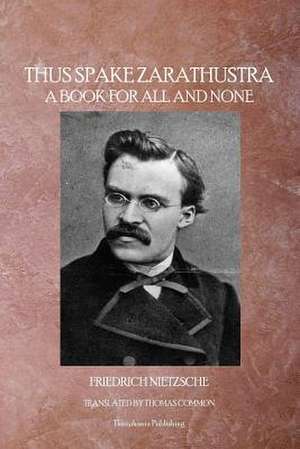
Thus Spake Zarathustra
Autor Friedrich Wilhelm Nietzscheen Limba Engleză Paperback
Preț: 151.83 lei
Puncte Express: 228
Carte tipărită la comandă
Livrare economică 03-17 decembrie
Livrare prin curier în România Termenul estimat este afișat lângă disponibilitate.
Transport gratuit de la 400.00 lei Plată online sau ramburs, în funcție de opțiunile comenzii.
Retur gratuit în 14 zile Comandă securizată și suport în română.
Specificații
ISBN-13: 9781770830875
ISBN-10: 1770830871
Pagini: 332
Dimensiuni: 152 x 229 x 18 mm
Greutate: 0.45 kg
Editura: Theophania Publishing
ISBN-10: 1770830871
Pagini: 332
Dimensiuni: 152 x 229 x 18 mm
Greutate: 0.45 kg
Editura: Theophania Publishing
V-ar putea interesa
-
 The Tao of PsychologyJean Shinoda BolenPreț: 74.01 lei
 -
 The Perennial PhilosophyAldous HuxleyPreț: 105.16 lei
 -
 In Search of Lost Time, Vol 4Marcel Proust-16%Preț: 69.26 lei82.03 lei
 -
 Brave New WorldAldous HuxleyPreț: 58.71 lei
 -
 MythologiesRoland Barthes-38%Preț: 57.30 lei92.03 lei
 -
 Postwar: A History of Europe Since 1945Tony Judt-15%Preț: 107.57 lei127.06 lei
 -
 The Age Of UnreasonCharles B. HandyPreț: 90.63 lei
 -
 -36%Preț: 59.06 lei93.00 lei
 -
 The Tibetan Book of the DeadGraham Coleman-35%Preț: 79.86 lei123.52 lei
 -
 The Revenge of GaiaJames Lovelock-19%Preț: 64.07 lei78.93 lei
 -
 HerzogSaul Bellow-25%Preț: 59.98 lei79.75 lei
 -
 The Call of the WildJack LondonPreț: 92.81 lei
 -
 -18%Preț: 65.59 lei79.75 lei
 -
 On the Origin of SpeciesCharles Darwin-16%Preț: 55.40 lei66.33 lei
 -
 Beyond Good and Evil: Prelude to a Philosophy of the FutureFriedrich Nietzsche-19%Preț: 63.41 lei78.47 lei
 -
 Preț: 50.22 lei
 -
 -18%Preț: 986.57 lei1203.13 lei
 -
 Things Fall ApartChinua AchebePreț: 148.67 lei
 -
 The Shock of the NewRobert Hughes-17%Preț: 238.67 lei286.84 lei
 -
 The Charterhouse of ParmaStendhalPreț: 125.11 lei
 -
 FlowMihaly Csikszentmihalyi-38%Preț: 86.60 lei140.67 lei
 -
 The Story of ArtE. H. Gombrich-17%Preț: 252.87 lei306.45 lei
 -
 Everything ForeverGevin GiorbranPreț: 166.53 lei
 -
 Net of BeingAlex Grey-15%Preț: 249.79 lei292.70 lei
 -
 RepublicPlatoPreț: 57.38 lei
 -
 The Count of Monte CristoAlexandre Dumas-26%Preț: 146.72 lei199.46 lei
 -
 The Portrait Of A LadyHenry James-15%Preț: 95.65 lei112.84 lei
 -
 -17%Preț: 90.70 lei109.62 lei
Notă biografică
Friedrich Nietzsche, (born October 15, 1844, Röcken, Saxony, Prussia [Germany]-died August 25, 1900, Weimar, Thuringian States), German classical scholar, philosopher, and critic of culture, who became one of the most influential of all modern thinkers. His attempts to unmask the motives that underlie traditional Western religion, morality, and philosophy deeply affected generations of theologians, philosophers, psychologists, poets, novelists, and playwrights. He thought through the consequences of the triumph of the Enlightenment's secularism, expressed in his observation that "God is dead," in a way that determined the agenda for many of Europe's most-celebrated intellectuals after his death. Although he was an ardent foe of nationalism, anti-Semitism, and power politics, his name was later invoked by fascists to advance the very things he loathed.