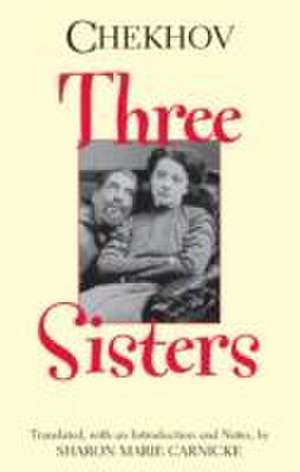
Three Sisters
Autor Anton Chekhov Traducere de Sharon Marie Carnickeen Limba Engleză Hardback – 15 mar 2014
First published in her Chekhov: Four Plays and Three Jokes, Sharon Marie Carnicke's eye-opening translation of Three Sisters appears in this edition with a new Introduction that expands upon her discussion in Four Plays & Three Jokes of Chekov's innovative dramaturgy--especially as seen in this subtle melodrama turned inside out.
Preț: 231.24 lei
Preț vechi: 278.83 lei
-17%
Puncte Express: 347
Preț estimativ în valută:
40.86€ • 46.97$ • 35.48£
40.86€ • 46.97$ • 35.48£
Carte disponibilă
Livrare economică 22 aprilie-06 mai
Specificații
ISBN-13: 9781624661211
ISBN-10: 1624661211
Pagini: 136
Dimensiuni: 140 x 216 x 13 mm
Greutate: 0.31 kg
Editura: Hackett Publishing Company,Inc
Colecția Hackett Publishing Company, Inc.
Locul publicării:United States
ISBN-10: 1624661211
Pagini: 136
Dimensiuni: 140 x 216 x 13 mm
Greutate: 0.31 kg
Editura: Hackett Publishing Company,Inc
Colecția Hackett Publishing Company, Inc.
Locul publicării:United States
V-ar putea interesa
-
 The Plays of Anton ChekhovAnton ChekhovPreț: 100.43 lei
 -
 PlaysAnton Chekhov-26%Preț: 56.44 lei76.19 lei
 -
 Death of a SalesmanArthur Miller-29%Preț: 47.63 lei67.31 lei
 -
 Preț: 51.26 lei
 -
 OresteiaAeschylus-19%Preț: 50.36 lei62.34 lei
 -
 Preț: 163.97 lei
 -
 The Soviet Theater: A Documentary HistoryLaurence Senelick-27%Preț: 769.44 lei1054.03 lei
 -
 Serf Actor: The Life and Art of Mikhail ShchepkinLaurence Senelick-41%Preț: 452.41 lei767.19 lei
 -
 Lovesick: Modernist Plays of Same-Sex Love, 1894-1925Laurence SenelickPreț: 383.13 lei
 -
 Anton Chekhov: Selected StoriesAnton Chekhov-30%Preț: 33.50 lei47.71 lei
 -
 The Chekhov Theatre: A Century of the Plays in PerformanceLaurence SenelickPreț: 435.53 lei
 -
 Jacques Offenbach and the Making of Modern CultureLaurence Senelick-14%Preț: 813.17 lei945.55 lei
 -
 Rosencrantz and Guildenstern Are DeadTom StoppardPreț: 74.01 lei
 -
 Young ChekhovAnton ChekhovPreț: 119.60 lei
 -
 Four Plays and Three JokesAnton Chekhov-10%Preț: 100.27 lei111.90 lei
 -
 Dead SoulsLaurence SenelickPreț: 79.73 lei
 -
 Adapting Chekhov in the 21st Century: Seven Contemporary PlaysFrances Babbage-16%Preț: 177.27 lei212.01 lei
 -
 Uncle VanyaAnton Pavlovich ChekhovPreț: 42.62 lei
 -
 The SeagullAnton ChekhovPreț: 25.92 lei
 -
 IvanovAnton ChekhovPreț: 31.07 lei
 -
 Uncle VanyaAnton ChekhovPreț: 30.27 lei
 -
 The Cherry OrchardAnton ChekhovPreț: 30.24 lei
 -
 The Three Theban PlaysSophoclesPreț: 45.74 lei
 -
 Preț: 345.94 lei
 -
 3 Sisters on Hope StreetAnton ChekhovPreț: 76.10 lei
 -
 An Inspector Calls: Annotation-Friendly EditionJ. B. PriestleyPreț: 83.49 lei
Cuprins
Introduction
Timeline
Inua Ellams
Social and Political Context
The Berlin Conference (1884-1885)
Indirect Rule/Administration
The Formation of Nigeria
The Nigeria Civil War/Biafra War
Ethnicity
Anton Chekhov
Adaptations
Post-colonialism/post-colonial theatre/neo-colonialism
Commentary
Structure/Time
Fate and Duty
Tradition vs Modernity
Symbolism
Main Characters
Critical Reception
Glossary
Selected texts on the Biafran War
Texts Cited
Three Sisters: After Chekhov
Notes
Timeline
Inua Ellams
Social and Political Context
The Berlin Conference (1884-1885)
Indirect Rule/Administration
The Formation of Nigeria
The Nigeria Civil War/Biafra War
Ethnicity
Anton Chekhov
Adaptations
Post-colonialism/post-colonial theatre/neo-colonialism
Commentary
Structure/Time
Fate and Duty
Tradition vs Modernity
Symbolism
Main Characters
Critical Reception
Glossary
Selected texts on the Biafran War
Texts Cited
Three Sisters: After Chekhov
Notes
Recenzii
A punky, funny, furious takedown of the cult of the classic... the piece never denies that Chekhov still speaks to us, it also questions its existence... loud, rude, provocative and, yes, messy - that's all part of its glorious defiance. Don't go expecting the pretty, predictable or polite. But do go. ????
A gloriously playful evening, stuffed with musical richness. If you know the original you will note how the company both honour its structure and smash it... it understands that each generation must take what they need from a play and that it must speak not to the past but to the millions of Olgas, Irinas and Mashas of today. Otherwise, why bother? ????
Less a take on the play than a music and movement-fuelled examination of why plays like this continue to be staged... some of the basic features of Chekhov's play remain, but RashDash push at its edges and mess with its mechanics... RashDash incisively skewers the privileged ennui of Chekhov's characters and the limited horizons the playwright imagined for his female protagonists. If the classics aren't for everyone, RashDash ask, then what are they for? ????
'Funny, furious - loud, rude, provocative and messy.'
A gloriously playful evening, stuffed with musical richness. If you know the original you will note how the company both honour its structure and smash it... it understands that each generation must take what they need from a play and that it must speak not to the past but to the millions of Olgas, Irinas and Mashas of today. Otherwise, why bother? ????
Less a take on the play than a music and movement-fuelled examination of why plays like this continue to be staged... some of the basic features of Chekhov's play remain, but RashDash push at its edges and mess with its mechanics... RashDash incisively skewers the privileged ennui of Chekhov's characters and the limited horizons the playwright imagined for his female protagonists. If the classics aren't for everyone, RashDash ask, then what are they for? ????
'Funny, furious - loud, rude, provocative and messy.'
Notă biografică
Tracy Letts was awarded the 2008 Pulitzer Prize for Drama and Tony Award for Best Play for August: Osage County which premiered at Steppenwolf Theatre in 2007 and later played on Broadway, at London’s National Theatre, and at theatres around the United States and internationally. In 2013, August: Osage County became a feature film starring Meryl Streep and Julia Roberts. Other writing credits include Man from Nebraska, Killer Joe, Bug and Superior Donuts. He has been an ensemble member at Steppenwolf Theatre Company since 2002. As an actor, he was awarded a 2013 Tony Award for Best Actor in a Play for his performance in Who's Afraid of Virginia Woolf?. His screen acting credits include a starring role on Homeland/