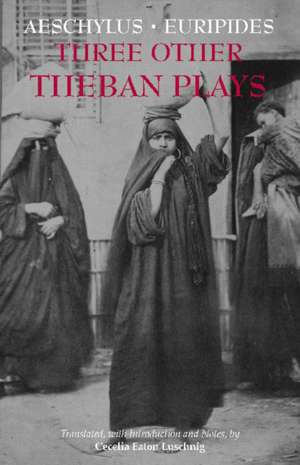
Three Other Theban Plays: Aeschylus' Seven Against Thebes; Euripides' Suppliants; Euripides' Phoenician Women
Autor Aeschylus, Euripides Traducere de Cecelia Eaton Luschnigen Limba Engleză Paperback – mar 2016
Though now associated mainly with Sophocles' Theban Plays and Euripides' Bacchae, the theme of Thebes and its royalty was a favorite of ancient Greek poets, one explored in a now lost epic cycle, as well as several other surviving tragedies. With a rich Introduction that sets three of these plays within the larger contexts of Theban legend and of Greek tragedy in performance, Cecelia Eaton Luschnig’s annotated translation of Aeschylus' Seven Against Thebes, Euripides' Suppliants, and Euripides' Phoenician Women offers a brilliant constellation of less familiar Theban plays—those dealing with the war between Oedipus’ sons, its casualties, and survivors.
Preț: 108.38 lei
Puncte Express: 163
Carte indisponibilă temporar
Doresc să fiu notificat când acest titlu va fi disponibil:
Se trimite...
Specificații
ISBN-13: 9781624664717
ISBN-10: 1624664717
Pagini: 336
Dimensiuni: 140 x 216 mm
Greutate: 0.32 kg
Editura: Hackett Publishing Company,Inc
Colecția Hackett Publishing Company, Inc.
Locul publicării:United States
ISBN-10: 1624664717
Pagini: 336
Dimensiuni: 140 x 216 mm
Greutate: 0.32 kg
Editura: Hackett Publishing Company,Inc
Colecția Hackett Publishing Company, Inc.
Locul publicării:United States
V-ar putea interesa
-
 Women on the Edge: Four Plays by EuripidesRuby BlondellPreț: 485.41 lei
 -
 The Persae of AeschylusAeschylusPreț: 424.75 lei
 -
 Preț: 231.35 lei
 -
 FragmentsAeschylusPreț: 233.04 lei
 -
 The Modern Stage and Other Worlds (Routledge Revivals)Austin E. QuigleyPreț: 282.51 lei
 -
 O, Sweet MasterMartha FullerPreț: 177.34 lei
 -
 I Wish I Had An OrangeK V LoucksPreț: 214.81 lei
 -
 NevaGuillermo CalderónPreț: 102.33 lei
 -
 Ion, Helen, OrestesEuripides-14%Preț: 100.94 lei117.88 lei
 -
 SlopePamela CarterPreț: 71.16 lei
 -
 Escaped AloneCaryl ChurchillPreț: 77.32 lei
 -
 Die MarzipanlieseFriedrich HalmPreț: 56.78 lei
 -
 Das Haus an der VeronabrückeFriedrich HalmPreț: 79.03 lei
 -
 Klassiche Dramen Und Ihre Statten: MagdeburgRobert Kohlrausch-19%Preț: 421.37 lei520.21 lei
 -
 Ein WochenendspielÖdön von HorváthPreț: 58.49 lei
 -
 Die kleinen VerwandtenLudwig ThomaPreț: 54.19 lei
 -
 Lottchens GeburtstagLudwig ThomaPreț: 54.19 lei
 -
 Erster KlasseLudwig ThomaPreț: 57.17 lei
 -
 Die EhreHermann SudermannPreț: 46.86 lei
 -
 Der Bettler von SyrakusHermann SudermannPreț: 110.71 lei
 -
 MagdalenaLudwig ThomaPreț: 72.54 lei
 -
 Kaiser und GaliläerHenrik IbsenPreț: 254.80 lei
 -
 Dalmatinische ReiseHermann BahrPreț: 98.43 lei
 -
 Das KonzertHermann BahrPreț: 244.18 lei
Recenzii
"Luschnig's goal is to offer translations that are both readable and speakable and in this she has succeeded admirably. Both the tragedy expert and the novice will enjoy reading these translations; the stage actor will enjoy speaking these lines. . . . Three Other Theban Plays offers a reliable, thorough resource to its primary audience of students. Undergraduates are likely to find these translations more accessible than those in the similarly targeted University of Chicago Greek tragedy translations and will certainly find this edition, as a whole, more supportive of their efforts to contextualize and interpret these plays."
—Adriana Brook, Lawrence University, in Bryn Mawr Classical Review
—Adriana Brook, Lawrence University, in Bryn Mawr Classical Review