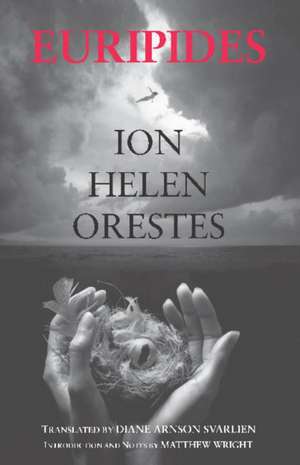
Ion, Helen, Orestes
Autor Euripides Traducere de Diane Arnson Svarlien Introducere și note de Matthew Wrighten Limba Engleză Paperback – iun 2016
An acclaimed translator of Euripidean tragedy in its earlier and more familiar modes, Diane Arnson Svarlien now turns to three plays that showcase the special qualities of Euripides’ late dramatic art. Like her earlier volumes, Ion, Helen, Orestes offers modern, accurate, accessible, and stageworthy versions that preserve the metrical and musical form of the originals. Matthew Wright’s Introduction and notes offer illuminating guidance to first-time readers of Euripides, while pointing up the appeal of this distinctive grouping of plays.
Preț: 100.94 lei
Preț vechi: 117.88 lei
-14%
Puncte Express: 151
Carte disponibilă
Livrare economică 14-28 noiembrie
Livrare prin curier în România Termenul estimat este afișat lângă disponibilitate.
Transport gratuit de la 400.00 lei Plată online sau ramburs, în funcție de opțiunile comenzii.
Retur gratuit în 14 zile Comandă securizată și suport în română.
Specificații
ISBN-13: 9781624664809
ISBN-10: 1624664806
Pagini: 368
Ilustrații: 2
Dimensiuni: 140 x 216 x 20 mm
Greutate: 0.43 kg
Editura: Hackett Publishing Company,Inc
Colecția Hackett Publishing Company, Inc.
Locul publicării:United States
ISBN-10: 1624664806
Pagini: 368
Ilustrații: 2
Dimensiuni: 140 x 216 x 20 mm
Greutate: 0.43 kg
Editura: Hackett Publishing Company,Inc
Colecția Hackett Publishing Company, Inc.
Locul publicării:United States
V-ar putea interesa
-
 -33%Preț: 1597.70 lei2381.75 lei
 -
 Grand National NightDorothy ChristiePreț: 103.50 lei
 -
 Kidnapped at ChristmasWillis HallPreț: 111.85 lei
 -
 Preț: 232.87 lei
 -
 Preț: 233.22 lei
 -
 Terror in JerrodK Merton ClaarPreț: 160.51 lei
 -
 -17%Preț: 313.90 lei379.80 lei
 -
 6 Essential QuestionsPriscila UppalPreț: 120.04 lei
 -
 The Spalding SuiteInua Ellams-22%Preț: 70.70 lei90.43 lei
 -
 TharkBen TraversPreț: 85.33 lei
 -
 EventideBarney Norris-46%Preț: 59.09 lei108.66 lei
 -
 Future ConditionalTamsin Oglesby-22%Preț: 71.56 lei91.25 lei
 -
 Mayenburg: Three PlaysMarius von Mayenburg-17%Preț: 142.89 lei171.23 lei
 -
 MartyrMarius von Mayenburg-17%Preț: 84.93 lei102.29 lei
 -
 The Preston BillAndy Smith-17%Preț: 85.11 lei102.40 lei
 -
 LiteratiJustin FlemingPreț: 107.94 lei
 -
 Back at the DojoLally KatzPreț: 106.85 lei
 -
 Boy Out of the CountryFelix NobisPreț: 106.85 lei
 -
 Tales of a City by the SeaSamah SabawiPreț: 104.80 lei
 -
 Privacy Enhancing TechnologiesEmiliano De Cristofaro-20%Preț: 305.21 lei381.51 lei
Recenzii
"Diane Arnson Svarlien's lively and accessible translations give an excellent sense of Euripides' poetic resources, from his artful blend of conversational idiom and high style, to his powerful displays of rhetoric and emotion, to the expressive rhythms and images of his songs. They are sure to delight readers and listeners alike. Moreover, they have been shaped by judicious use of the best and latest scholarship. The plays in this volume will surprise readers used to tragedy on the Aristotelian pattern and stimulate reflection about what tragedy is and what it is for."
—John Gibert, Department of Classics, University of Colorado, Boulder
—John Gibert, Department of Classics, University of Colorado, Boulder