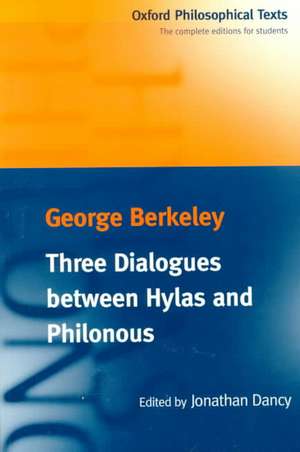
Three Dialogues Between Hylas and Philonous: Oxford Philosophical Texts
Autor George Berkeley Editat de Jonathan Dancyen Limba Engleză Paperback – 29 ian 1998


Preț: 278.79 lei
Preț vechi: 326.68 lei
-15%
Puncte Express: 418
Carte tipărită la comandă
Livrare economică 11-16 iunie
Specificații
ISBN-13: 9780198751496
ISBN-10: 0198751494
Pagini: 192
Ilustrații: glossary, endnotes, bibliography
Dimensiuni: 155 x 234 x 12 mm
Greutate: 0.29 kg
Ediția:Revised
Editura: OUP OXFORD
Colecția OUP Oxford
Seria Oxford Philosophical Texts
Locul publicării:Oxford, United Kingdom
ISBN-10: 0198751494
Pagini: 192
Ilustrații: glossary, endnotes, bibliography
Dimensiuni: 155 x 234 x 12 mm
Greutate: 0.29 kg
Ediția:Revised
Editura: OUP OXFORD
Colecția OUP Oxford
Seria Oxford Philosophical Texts
Locul publicării:Oxford, United Kingdom
V-ar putea interesa
Recenzii
This is a new critical edition of Berkeley’s 1734 (third edition, first 1713) Three Dialogues, a text that is deservedly one of the most challenging and beloved classics of modern philosophy. The heart of the work is the dispute between materialism and idealism, two fundamentally opposed positions that are embodied by Hylas and Philonous, the characters in this philosophical drama. The book is packed with brilliant arguments and counter-arguments of an extraordinarily sophisticated nature. Amid all this philosophical swordplay one would think that there could be scant room for the characters to develop any sort of personality. Yet in Berkeley’s hands, and with his literary gifts, the interlocutors are both vivid and funny.
The dialogue deals with some of the most important perennial problems of philosophy, including: the materialism-idealism dispute, skepticism in rationalist and empiricist epistemology, the conflict over apriorism and aposteriorism, rationalism versus empiricism, the existence and nature of God, the philosophy of science, philosophy of mathematics, abstract general ideas, the role of perception in human knowledge, and the metaphysics of causation.
This edition combines a usefully annotated version of Berkeley’s complete original text with a substantial critical introduction, a chronology of events in Berkeley’s life and career, and supplementary annotated appendices of original sources from thinkers relevant to Berkeley’s work.
“Among the most welcome and distinctive features of this new edition are the editor’s substantial and informative introduction, and also a helpful set of appendices, including passages from Locke that define Berkeley’s main target, a substantial correspondence with Samuel Johnson, and a set of interpretations and convergences in other eighteenth-century writings. Highly recommended for use in upper-level courses.” — Ernest Sosa, Board of Governors Professor, Rutgers University
“A very welcome addition to Berkeley studies is Dale Jacquette’s new edition of Berkeley’s Three Dialogues. Professor Jacquette’s introduction and annotations are extremely helpful, as is his inclusion of Berkeley’s letters to his American correspondent Samuel Johnson. … This book would be quite useful for general courses in Early Modern Philosophy, more advanced courses in Empiricism, and certainly for one devoted just to Berkeley.” — Richard Brook, Professor Emeritus, Bloomsburg University
The dialogue deals with some of the most important perennial problems of philosophy, including: the materialism-idealism dispute, skepticism in rationalist and empiricist epistemology, the conflict over apriorism and aposteriorism, rationalism versus empiricism, the existence and nature of God, the philosophy of science, philosophy of mathematics, abstract general ideas, the role of perception in human knowledge, and the metaphysics of causation.
This edition combines a usefully annotated version of Berkeley’s complete original text with a substantial critical introduction, a chronology of events in Berkeley’s life and career, and supplementary annotated appendices of original sources from thinkers relevant to Berkeley’s work.
“Among the most welcome and distinctive features of this new edition are the editor’s substantial and informative introduction, and also a helpful set of appendices, including passages from Locke that define Berkeley’s main target, a substantial correspondence with Samuel Johnson, and a set of interpretations and convergences in other eighteenth-century writings. Highly recommended for use in upper-level courses.” — Ernest Sosa, Board of Governors Professor, Rutgers University
“A very welcome addition to Berkeley studies is Dale Jacquette’s new edition of Berkeley’s Three Dialogues. Professor Jacquette’s introduction and annotations are extremely helpful, as is his inclusion of Berkeley’s letters to his American correspondent Samuel Johnson. … This book would be quite useful for general courses in Early Modern Philosophy, more advanced courses in Empiricism, and certainly for one devoted just to Berkeley.” — Richard Brook, Professor Emeritus, Bloomsburg University
Cuprins
Introduction
1. Why Study the Dialogues?
2. Perception, Action, and the World
2.1 Ideas vs Things
2.2. Berkeley’s Concern with Skepticism
2.3 The Move to Phenominalism
2.4 Phenomenalism and Common Sense
3. Berkeley’s Alternatives
3.1 Discontinuous Realism
3.2 Continuous Realism
3.3 Unsupported Phenomenalism
3.4 Theistic Phenomenalism
3.5 Interpreting Berkeley
4. Berkeley’s Life and Work
5. A Note on the Text
Selected Bibliography
The Dialogues
Preface
The First Dialogue
The Second Dialogue The Third Dialogue
1. Why Study the Dialogues?
2. Perception, Action, and the World
2.1 Ideas vs Things
2.2. Berkeley’s Concern with Skepticism
2.3 The Move to Phenominalism
2.4 Phenomenalism and Common Sense
3. Berkeley’s Alternatives
3.1 Discontinuous Realism
3.2 Continuous Realism
3.3 Unsupported Phenomenalism
3.4 Theistic Phenomenalism
3.5 Interpreting Berkeley
4. Berkeley’s Life and Work
5. A Note on the Text
Selected Bibliography
The Dialogues
Preface
The First Dialogue
The Second Dialogue The Third Dialogue
Notă biografică
David Hilbert is a professor of Philosophy at the University of Illinois at Chicago. John Perry is professor emeritus in Philosophy at Stanford.