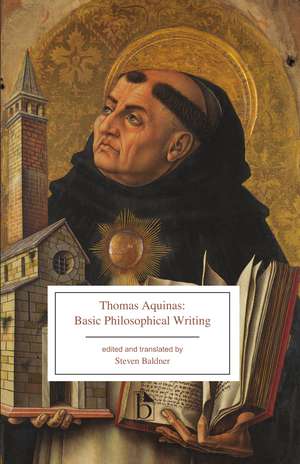
Thomas Aquinas: Basic Philosophical Writing: From the Summa Theologiae and The Principles of Nature
Autor Thomas Aquinas Editat de Steven Baldneren Limba Engleză Paperback – 7 noi 2018
Notăm cu interes acest companion esențial pentru studiul filozofiei medievale, conceput special pentru a facilita accesul studenților la universul dens al gândirii tomiste. Volumul funcționează ca o antologie riguroasă, selectând segmente cheie din Summa Theologiae și The Principles of Nature pentru a oferi o imagine de ansamblu asupra pilonilor metafizici și etici ai autorului. Reținem că prioritatea editorului Steven Baldner a fost dublă: pe de o parte, să permită textului original să se exprime fără constrângeri convenționale inutile, iar pe de altă parte, să modernizeze terminologia tehnică pentru a fi inteligibilă publicului de astăzi.
Structura este organizată tematic, debutând cu analiza cauzalității și a materiei în capitolul despre principiile naturii, continuând cu secțiuni despre proprietățile divinității și terminând cu o explorare a naturii umane — de la unitatea suflet-corp până la mecanismele voinței și cunoașterii. Această progresie reflectă fidel arhitectura din Summa Theologica, dar într-un format mult mai concentrat și manevrabil. În comparație cu edițiile anterioare, precum Basic Writings of St. Thomas Aquinas: (Volume 1), această lucrare pune un accent deosebit pe contextul comparativ. Prezența anexelor care pun în dialog argumentele lui Aquinas cu cele ale lui Anselm sau Ockham transformă volumul dintr-o simplă culegere de texte într-un instrument critic de lucru. Credem că această abordare face din lucrare un punct de plecare ideal pentru oricine dorește să înțeleagă fundamentul legii naturale și al eticii virtuții fără a parcurge mii de pagini de comentarii scolastice.
Preț: 161.58 lei
Carte disponibilă
Livrare economică 07-21 septembrie
Livrare express 21-27 august pentru 25.03 lei
Specificații
ISBN-10: 1554813727
Pagini: 240
Dimensiuni: 140 x 216 x 12 mm
Greutate: 0.33 kg
Editura: BROADVIEW PR
Colecția Broadview Press
Locul publicării:Peterborough, Canada
De ce să citești această carte
Recomandăm acest volum studenților și pasionaților de filozofie care caută o introducere clară și bine structurată în opera lui Thomas Aquinas. Câștigul major este accesibilitatea: traducerile noi elimină barierele de limbaj arhaic, păstrând însă rigoarea logică. Este un instrument de studiu excelent datorită anexelor comparative care ajută la plasarea tomismului în marea istorie a ideilor occidentale.
Despre autor
Thomas Aquinas (1225-1274), figură centrală a scolasticii, a studiat la Universitatea din Napoli înainte de a se alătura ordinului dominican în 1244. Sub îndrumarea lui Albert cel Mare, a dezvoltat o carieră prodigioasă de profesor și teolog, fiind canonizat în 1323. Opera sa reprezintă o sinteză monumentală între filozofia aristotelică și dogma creștină, influențând decisiv cursul gândirii europene. Lucrări precum Summa Theologica sau The Treatise on Human Nature rămân repere fundamentale pentru etică, metafizică și drept natural, definind modul în care înțelegem relația dintre rațiune și credință.
Descriere
Recenzii
“Steven Baldner has put together an excellent introduction to the philosophical thought of Thomas Aquinas. He succeeds both in helping first-time readers past the challenges of Thomas’s technical language and in providing a substantial offering of his thought. With a very readable and informative introduction to Thomas’s life and works, Baldner prepares the way for a presentation of key philosophical writings. To aid the first-time reader, Baldner has provided a lively translation (free but accurate) and a student-friendly editing of the texts to assure maximum ease and accuracy of comprehension. This book will do a lot to bring the brilliance of Thomas Aquinas to a new generation of readers. Well done!” — Montague Brown, St. Anselm College
“The need for a new volume of selections from the works of Aquinas could easily be doubted, but reviewing Steven Baldner’s Basic Philosophical Writing quiets one’s skepticism in this regard. This judgment is owing to a number of student-friendly features, most importantly the very readable biography and the introduction, which pulls together the various texts into a manageable whole. Other notable properties of this volume are the brief lexicon of technical terms used by Aquinas; a ‘cast of characters,’ namely, short entries on the philosophers and theologians whose work Aquinas refers to; and a selection of ‘contrasting texts,’ for example, both Descartes and Anselm on proving God’s existence.” — Mary Catherine Sommers, University of St. Thomas
“Baldner’s volume is a worthy addition to the already burgeoning market of edited collections of Aquinas’s writings. The fluency of Baldner’s translation, the accessible formatting of the selections from the Summa Theologiae, his excellent introductory material, and useful appendices make this volume an invaluable resource for those encountering the thought of St. Thomas for the first time.” — Fr. Justin Gable, Teaching Philosophy
Cuprins
Introduction
Thomas Aquinas: A Brief Chronology
A Note on the Texts
Basic Philosophical Writing
Chapter 1: The Principles of Nature
- Section 1: The Three Principles
- Section 2: Privation and Matter
- Section 3: The Four Causes
- Section 4: Relations among the Four Causes
- Section 5: The Modes of the Causes
- Section 6: The Predication of Terms
- A. Theology and Philosophy
- B. The Existence of God
- C. Properties of God
- D. Analogy: Language about God
- A. Soul and Body
- B. Will and Choice
- C. Knowledge
- A. The Goal: Happiness
- B. Voluntary Actions
- C. The Moral Goodness of Human Acts
- D. Habits and Virtues
- E. Law and Natural Law
Appendix B: Bonaventure Argues that God’s Existence Is Indubitable: From Bonaventure, Commentaria in Quattuor Libros Sententiarum Magistri Petri Lombardi (1251–54)
Appendix C: Scotus’s Proof of the Existence of God: From John Duns Scotus, Ordinatio (1300–08)
Appendix D: Ockham’s Proof of God’s Existence: From William of Ockham, Questiones in Libros Physicorum Aristotelis (before 1324)
Appendix E: Ontological Argument for the Existence of God: From René Descartes, Meditations on First Philosophy (1641)
Appendix F: Scotus on the Immortality of the Soul: From John Duns Scotus, Ordinatio or Opus oxoniense (1300–08)
Appendix G: Ockham on the Human Soul: From William of Ockham, Quodlibeta Septem (1324–25)
Appendix H: Scotus on the Sinful Will: From John Duns Scotus, Lectura (1298–99)
Appendix I: Ockham on the Freedom of the Will: From William of Ockham, Ordinatio (1317–18)
Select Bibliography
Analytical Index of Thomas’s Texts, Chapters 1–4
Alphabetical Index