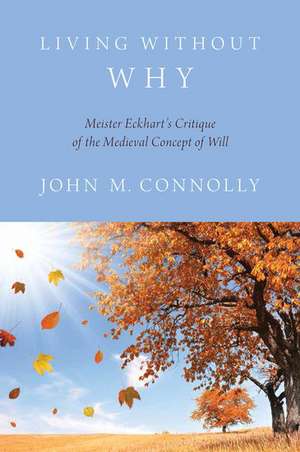
Living Without Why: Meister Eckhart's Critique of the Medieval Concept of Will
Autor John M. Connollyen Limba Engleză Hardback – 21 aug 2014
Preț: 626.56 lei
Preț vechi: 909.36 lei
-31%
Puncte Express: 940
Carte tipărită la comandă
Livrare economică 04-09 decembrie
Livrare prin curier în România Termenul estimat este afișat lângă disponibilitate.
Transport gratuit pentru acest produs Plată online sau ramburs, în funcție de opțiunile comenzii.
Retur gratuit în 14 zile Comandă securizată și suport în română.
Specificații
ISBN-13: 9780199359783
ISBN-10: 0199359784
Pagini: 256
Dimensiuni: 157 x 236 x 25 mm
Greutate: 0.48 kg
Editura: Oxford University Press
Colecția OUP USA
Locul publicării:New York, United States
ISBN-10: 0199359784
Pagini: 256
Dimensiuni: 157 x 236 x 25 mm
Greutate: 0.48 kg
Editura: Oxford University Press
Colecția OUP USA
Locul publicării:New York, United States
V-ar putea interesa
-
 -19%Preț: 115.94 lei142.36 lei
 -
 Oxford Studies in Medieval Philosophy, Volume 2Robert Pasnau-21%Preț: 264.06 lei333.30 lei
 -
 -21%Preț: 285.75 lei360.88 lei
 -
 Approaches to IntentionalityWilliam Lyons-19%Preț: 329.29 lei407.86 lei
 -
 -17%Preț: 109.01 lei131.69 lei
 -
 -29%Preț: 490.11 lei686.27 lei
 -
 Aspects of ReasonPaul Grice-29%Preț: 368.89 lei517.50 lei
 -
 Aquinas on BeingAnthony Kenny-29%Preț: 389.30 lei545.74 lei
 -
 Selected Philosophical WritingsThomas Aquinas-17%Preț: 72.84 lei87.61 lei
 -
 Francis Bacon: The Major WorksFrancis Bacon-15%Preț: 88.60 lei104.60 lei
 -
 Joint Ventures: Mindreading, Mirroring, and Embodied CognitionAlvin I. Goldman-31%Preț: 598.51 lei865.20 lei
 -
 -30%Preț: 558.22 lei800.93 lei
 -
 On Being AuthenticCharles GuignonPreț: 235.02 lei
 -
 Human Nature: Fact and Fiction: Literature, Science and Human NatureRobin Headlam Wells-42%Preț: 114.46 lei196.26 lei
 -
 The Political Philosophy of Niccolò MachiavelliFilippo Del Lucchese-17%Preț: 176.65 lei211.57 lei
 -
 Spinoza and PoliticsÉtienne BalibarPreț: 112.55 lei
Recenzii
Connolly offers a fair and scholarly treatment of one of medieval Europe's most controversial philosophers, who challenged the very authority of the Catholic Church. This work is well written, if synoptic at times, and leads the reader through a rich historical, theological and philosophical journey through the medieval conception of the will as it developed from Aristotle and the classical Greek philosophers, all the way to Meister Eckhart and beyond. Moreover, it generally does a good job of analyzing the almost indiscernible and more obvious variations amongst the philosophies being addressed. Connolly's specialty in Eckhartian studies is apparent through his scholarly treatment of a plethora of medieval thinkers, and his mastery over the primary sources in their original medieval High German.
Connolly's book, by highlighting the importance of the end of man in Eckhart's thought and by putting it in its philosophical and theological context, is always illuminating in its treatment of the great mystic.
All in all, this is a very welcome and careful study. It will shed much light on a neglected person and a neglected topic.
As John Connolly states in the preface to this book, he is 'fascinated' by Meister Eckhart's advice to 'live without why (or will)'. And it is this palpable fascination pulsing off the book's pages that at once helps to illuminate the philosophical underpinnings of the Eckhartian concept, as it infectiously draws the reader deeper into the riches of this text. As a scholar of Christian spirituality, and someone also smitten by the Meister's treatment of sunder warumbe, but not a trained philosopher, I find this book to be nothing short of a boon.
This book is a signal contribution to ancient and medieval philosophy. By putting Eckhart into conversation with his predecessors (i.e., Aristotle, Augustine, and Aquinas), Connolly does a fine job in identifying where Eckhart makes an original-and still viable-contribution to moral thought in general. This is a remarkable work, the product of long and careful thought, as well as being clearly presented.
It would appear that Connolly has written the right book at the right moment. Through his work, the English-speaking world can become finally acquainted with the academic discussion of the last decades concerning Eckhart and can furthermore have an original and text grounded interpretation of a relevant section of his philosophical thought.
Connolly's book, by highlighting the importance of the end of man in Eckhart's thought and by putting it in its philosophical and theological context, is always illuminating in its treatment of the great mystic.
All in all, this is a very welcome and careful study. It will shed much light on a neglected person and a neglected topic.
As John Connolly states in the preface to this book, he is 'fascinated' by Meister Eckhart's advice to 'live without why (or will)'. And it is this palpable fascination pulsing off the book's pages that at once helps to illuminate the philosophical underpinnings of the Eckhartian concept, as it infectiously draws the reader deeper into the riches of this text. As a scholar of Christian spirituality, and someone also smitten by the Meister's treatment of sunder warumbe, but not a trained philosopher, I find this book to be nothing short of a boon.
This book is a signal contribution to ancient and medieval philosophy. By putting Eckhart into conversation with his predecessors (i.e., Aristotle, Augustine, and Aquinas), Connolly does a fine job in identifying where Eckhart makes an original-and still viable-contribution to moral thought in general. This is a remarkable work, the product of long and careful thought, as well as being clearly presented.
It would appear that Connolly has written the right book at the right moment. Through his work, the English-speaking world can become finally acquainted with the academic discussion of the last decades concerning Eckhart and can furthermore have an original and text grounded interpretation of a relevant section of his philosophical thought.
Notă biografică
John M. Connolly is Sophia Smith Professor of Philosophy at Smith College. His research is currently focused on medieval philosophy, especially Meister Eckhart. He has also worked in philosophy of mind, Wittgenstein, contemporary German philosophy, philosophical hermeneutics, and issues of academic freedom and tolerance. Connolly has taught courses in all of these areas and also in the history of philosophy. In addition he spent ten years in college administration as dean, provost, and acting president of Smith College.