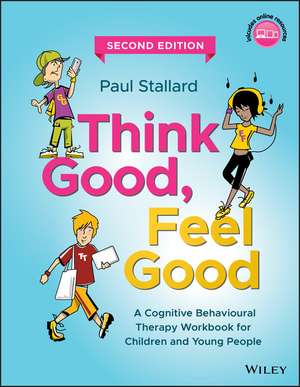
Think Good, Feel Good
Autor Paul Stallarden Limba Engleză Paperback – 11 ian 2019
Ceea ce aduce nou această a doua ediție a lucrării Think Good, Feel Good este o recalibrare a fundamentelor terapiei cognitiv-comportamentale prin prisma celor mai recente evoluții din domeniu. Reținem în mod deosebit integrarea metodelor din „al treilea val” al CBT — mindfulness, terapia prin acceptare și angajament (ACT) și terapia bazată pe compasiune — într-un format care rămâne eminamente practic. Structura cărții este concepută pentru a facilita intervenția directă, oferind un set extins de fișe de lucru și exerciții menite să ajute tinerii să identifice „capcanele de gândire” și să își gestioneze stările afective. Subliniem faptul că textul nu se limitează la teorie, ci este un instrument de lucru clinic, materialele fiind validate prin experiența autorului în serviciile de sănătate mentală. Think Good, Feel Good completează perspectiva oferită de Clinical Practice of Cognitive Therapy with Children and Adolescents, Second Edition de Robert D. Friedberg, adăugând o componentă mult mai aplicată, axată pe materiale descărcabile și exerciții structurate, spre deosebire de abordarea mai teoretică și de formulare de caz a lui Friedberg. În contextul operei lui Paul Stallard, lucrarea reprezintă nucleul metodologic, fiind susținută de Anxiety, care explorează specific tulburările anxioase, și de A Clinician's Guide to CBT for Children to Young Adults, care oferă cadrul didactic necesar profesioniștilor pentru implementarea acestor resurse. Stilul este direct și accesibil, evitând jargonul inutil pentru a rămâne relevant atât pentru psihologii clinicieni, cât și pentru consilierii școlari sau asistenții sociali.
Preț: 276.26 lei
Carte disponibilă
Livrare economică 16-30 noiembrie
Livrare express 31 octombrie-06 noiembrie pentru 69.90 lei
Specificații
ISBN-10: 1119395283
Pagini: 240
Dimensiuni: 215 x 279 x 20 mm
Greutate: 0.69 kg
Ediția:2nd edition
Editura: Wiley
Locul publicării:Chichester, United Kingdom
V-ar putea interesa
-
 Action and InteractionShaun Gallagher-21%Preț: 188.03 lei238.92 lei
-
 Performing Time: Synchrony and Temporal Flow in Music and DanceClemens Wöllner-19%Preț: 405.04 lei499.64 lei
-
 The Oxford Handbook of Empirical AestheticsMarcos Nadal-30%Preț: 910.95 lei1309.08 lei
-
 -18%Preț: 247.19 lei302.65 lei
-
 MindwiseNicholas EpleyPreț: 101.83 lei
-
 -15%Preț: 428.50 lei504.12 lei
-
 MindwareRichard E. NisbettPreț: 131.75 lei
-
 The Creative Mind: Myths and MechanismsMargaret A. BodenPreț: 382.67 lei
-
 Speaking, Writing and CommunicatingKara D. Federmeier-31%Preț: 593.53 lei864.58 lei
-
 New Directions in Addiction ScienceKara D. Federmeier-30%Preț: 639.87 lei909.27 lei
-
 The Alex StudiesIrene Maxine PepperbergPreț: 260.21 lei
-
 The Elegant Self, A Radical Approach to Personal Evolution for Greater Influence in LifeRobert Lundin McNamaraPreț: 243.35 lei
-
 Thinking Good, Feeling BetterPaul StallardPreț: 246.18 lei
-
 -5%Preț: 327.27 lei344.50 lei
-
 iDisorderLarry D. RosenPreț: 113.36 lei
-
 The Evolution of Consciousness: Representing the Present MomentProfessor Paula Droege-28%Preț: 207.60 lei288.50 lei
-
 The Learning BrainSarah-Jayne BlakemorePreț: 270.32 lei
-
 -32%Preț: 552.10 lei816.93 lei
-
 Practicing Cognitive Therapy: A Guide to InterventionsRobert L. Leahy-31%Preț: 798.06 lei1162.44 lei
-
 Overcoming Resistance in Cognitive TherapyRobert L. Leahy-5%Preț: 567.14 lei596.99 lei
-
 -5%Preț: 387.69 lei408.09 lei
-
 Preț: 185.66 lei
-
 Break FreeTanya J. Peterson-5%Preț: 87.40 lei92.00 lei
-
 Spy the LieMike FloydPreț: 78.92 lei
-
 Mindful LearningCraig HassedPreț: 87.71 lei
-
 Das kleine Handbuch kognitiver IrrtümerGuido WenskiPreț: 144.03 lei
Public țintă
The target audience for this book will be the same as for the original Think Good Feel Good – professionals working with children and young adolescents.These will include members of specialist Child and Adolescent Mental Health Services (CAMHS) and Adult Mental Health Services such as:
- Child and Adolescent Psychiatrists,
- Clinical Psychologists,
- Occupational Therapists,
- Family Therapists,
- Community Psychiatric Nurses
- Child Psychotherapists
- Improving Access to Psychological Therapists (IAPT) CBT therapists. and Evidence Based Therapists
- community nurses,
- counsellors,
- school nurses,
- social workers,
- practice counsellors,
- educational psychologists
- paediatricians
De ce să citești această carte
Această ediție este esențială pentru specialiștii care lucrează cu copii și adolescenți, oferind instrumente gata de utilizat în cabinet. Cititorul câștigă acces la o metodologie actualizată care include mindfulness și ACT, transformând concepte psihologice abstracte în activități concrete. Este o resursă indispensabilă pentru oricine dorește să structureze ședințele de terapie folosind materiale testate clinic și adaptate nevoilor de dezvoltare ale tinerilor.
Despre autor
Dr. Paul Stallard este un nume de referință în psihologia clinică, absolvind Universitatea din Birmingham în 1980. În prezent, ocupă funcția de profesor de sănătate mentală a copilului și familiei la Universitatea din Bath. Cu o carieră dedicată studiului efectelor traumei și bolilor cronice asupra copiilor, acesta a publicat peste 70 de lucrări de specialitate. Expertiza sa clinică, acumulată în departamente de psihiatrie infantilă, este reflectată în abordarea pragmatică a manualelor sale, care au devenit standarde în formarea terapeuților CBT din întreaga lume.
Descriere
Newly updated edition of the highly successful core text for using cognitive behaviour therapy with children and young people
The previous edition of Think Good, Feel Good was an exciting, practical resource that pioneered the way mental health professionals approached Cognitive Behaviour Therapy with children and young people. This new edition continues the work started by clinical psychologist Paul Stallard, and provides a range of flexible and highly appealing materials that can be used to structure and facilitate work with young people. In addition to covering the core elements used in CBT programmes, it incorporates ideas from the third wave CBT therapies of mindfulness, compassion focused therapy and acceptance and commitment therapy. It also includes a practical series of exercises and worksheets that introduce specific concepts and techniques.
Developed by the author and used extensively in clinical practice, Think Good, Feel Good, Second Edition: A CBT Workbook for Children and Young People starts by introducing readers to the origin, basic theory, and rationale behind CBT and explains how the workbook should be used. Chapters cover elements of CBT including identifying thinking traps; core beliefs; controlling feelings; changing behaviour; and more.
- Written by an experienced professional with all clinically tested material
- Fully updated to reflect recent developments in clinical practice
- Wide range of downloadable materials
- Includes ideas for third wave CBT, Mindfulness, Compassion Focused Therapy and Acceptance and Commitment Therapy
Think Good, Feel Good, Second Edition: A CBT Workbook for Children and Young People is a "must have" resource for clinical psychologists, child and adolescent psychiatrists, community psychiatric nurses, educational psychologists, and occupational therapists. It is also a valuable resource for those who work with young people including social workers, school nurses, practice counsellors, teachers and health visitors.
Notă biografică
Cuprins
About the Author xi
Acknowledgement xiii
Online Resources xv
1 Cognitive Behaviour Therapy: Theoretical Origins, Rationale, and Techniques 1
The Foundations of Cognitive Behaviour Therapy 1
First Wave: Behaviour Therapy 2
Second Wave: Cognitive Therapy 2
Third Wave: Acceptance, Compassion, and Mindfulness 4
Core Characteristics of Cognitive Behaviour Therapy 5
The Goal of Cognitive Behaviour Therapy 6
The Core Components of Cognitive Behaviour Therapy 7
2 Cognitive Behaviour Therapy with Children and Young People 13
Cognitive Behaviour Therapy with Children 13
Adapting CBT for Children and Young People 14
Facilitating Engagement in CBT 17
Common Problems when Undertaking CBT with Children 21
3 Think Good, Feel Good: an Overview of Materials 27
Be Kind to Yourself 28
Here and Now 28
Thoughts, Feelings, and What You Do 29
Automatic Thoughts 30
Thinking Traps 30
Balanced Thinking 31
Core Beliefs 32
Controlling your Thoughts 32
How you Feel 33
Controlling your Feelings 34
Changing your Behaviour 35
Learning to Problem-Solve 36
4 Be Kind to Yourself 37
Eight Ways to be Kind to Yourself 38
5 Here and Now 49
Do you really Notice What You Do? 49
Focus 50
Focus on your Breathing 52
Focus on your Eating 53
Focus on an Activity 54
Focus on an Object 55
Step Back from your Thoughts 55
Thought Spotting 56
Step Back from your Feelings 57
Let them Float Away 58
6 Thoughts, Feelings, and What You Do 65
Thoughts, Feelings, and What You Do 65
How does it Work? 66
What you Think 67
Core Beliefs 68
Beliefs and Predictions 68
Unhelpful Beliefs and Predictions 69
Core Beliefs are Strong and Fixed 69
Important Events 70
Automatic Thoughts 70
How You Feel 71
What You Do 71
Stop! 72
Putting It All Together 74
7 Automatic Thoughts 81
Me, What I Do, and My Future 81
Why do I Listen to my Automatic Thoughts? 83
The Negative Trap 84
'Hot' Thoughts 85
8 Thinking Traps 97
Negative Filter 97
Blowing Things Up 98
Predicting Failure 99
Being Down on Yourself 100
Setting Yourself to Fail 101
9 Balanced Thinking 107
What is the Evidence? 107
So How Does it Work? 109
The 'Four Cs' 111
So How Does it Work? 112
How would you help a Friend? 114
10 Core Beliefs 119
Finding Core Beliefs 120
Challenging Core Beliefs 121
Talk with Someone 123
11 Controlling Your Thoughts 131
Step Back from your Thoughts 131
Refocus your Attention 132
Distraction 132
Coping Self-Talk 134
Positive Self-Talk 135
Thought Stopping 136
Turn the Volume Down 137
Limit the Time you Worry 137
Test Them 138
Throw Them Away 139
12 How You Feel 151
What Feelings Do I Have? 152
Feelings and What You Do 154
Feelings and What You Think 154
Putting it Together 155
13 Controlling Your Feelings 167
Learn to Relax 168
Physical Exercise 170
4-5-6 Breathing 171
Your Calming Place 171
Relaxing Activities 172
Stop the Build-Up 173
14 Changing Your Behaviour 181
Being Busy is Helpful 182
Have More Fun 182
Map How You Feel and What You Do 184
Small Steps 185
Face Your Fears 186
Dump Your Habits 187
Remember to Reward Yourself 190
15 Learning to Solve Problems 201
Why do Problems Happen? 201
Learn to Stop and Think 203
Identify Different Solutions 203
Think Through the Consequences 204
Remind Yourself What to Do 206
Practice getting it Right 207
Plan to be Successful 208
Talk yourself Through It 209
References 217
Index 221