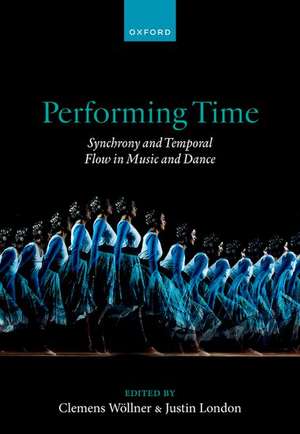
Performing Time: Synchrony and Temporal Flow in Music and Dance
Editat de Clemens Wöllner, Justin Londonen Limba Engleză Hardback – 20 iul 2023
Preț: 405.04 lei
Preț vechi: 499.64 lei
-19%
Puncte Express: 608
Carte disponibilă
Livrare economică 30 octombrie-10 noiembrie
Livrare express 17-23 octombrie pentru 154.76 lei
Livrare prin curier în România Termenul estimat este afișat lângă disponibilitate.
Transport gratuit pentru acest produs Plată online sau ramburs, în funcție de opțiunile comenzii.
Retur gratuit în 14 zile Comandă securizată și suport în română.
Specificații
ISBN-13: 9780192896254
ISBN-10: 0192896253
Pagini: 432
Dimensiuni: 176 x 257 x 25 mm
Greutate: 1.02 kg
Editura: OUP OXFORD
Colecția OUP Oxford
Locul publicării:Oxford, United Kingdom
ISBN-10: 0192896253
Pagini: 432
Dimensiuni: 176 x 257 x 25 mm
Greutate: 1.02 kg
Editura: OUP OXFORD
Colecția OUP Oxford
Locul publicării:Oxford, United Kingdom
V-ar putea interesa
-
 Eye Movements: A Window on Mind and BrainRoger PG van Gompel-27%Preț: 675.49 lei928.74 lei
 -
 Handbook of Motivation and Cognition Across CulturesRichard Sorrentino-32%Preț: 855.52 lei1267.29 lei
 -
 Perceptual Coherence: Hearing and seeingStephen Handel-28%Preț: 530.91 lei737.35 lei
 -
 Neuroeconomics: A guide to the new science of making choicesPeter Politser-28%Preț: 375.48 lei523.29 lei
 -
 The Essential TuringB. J. Copeland-32%Preț: 941.27 lei1391.39 lei
 -
 Hearing in TimeJustin London-21%Preț: 391.81 lei498.37 lei
 -
 Perspectives in CreativityIrving TaylorPreț: 469.07 lei
 -
 Supervision of Sandplay TherapyHarriet S. Friedman-18%Preț: 896.33 lei1093.07 lei
 -
 Inside IntuitionEugene Sadler-Smith-15%Preț: 527.36 lei620.42 lei
 -
 -5%Preț: 415.86 lei437.75 lei
 -
 Blueprints for ThinkingSarah L. Friedman-5%Preț: 410.47 lei432.07 lei
 -
 ColoursBarry MaundPreț: 315.83 lei
 -
 Artificial DreamsH R EkbiaPreț: 335.79 lei
 -
 MemoryRichard F. ThompsonPreț: 292.09 lei
 -
 -15%Preț: 458.46 lei539.37 lei
 -
 The Power of ConcentrationTheron Q. DumontPreț: 60.92 lei
 -
 Preț: 262.65 lei
 -
 How We Think (New Edition)John DeweyPreț: 131.57 lei
 -
 The Creative Process in the Individual (New Edition)Thomas TrowardPreț: 94.78 lei
 -
 Research Focus on Cognitive DisordersValerie N Plishe-27%Preț: 1466.17 lei1998.79 lei
 -
 Unfolding TimeDarla CrispinPreț: 325.04 lei
Recenzii
Wöllner and London present a significant contribution to the study of time in music and dance. This volume is likely to become an essential reference for anyone interested in the temporal aspects of performance and perception, from cognitive scientists to musicologists, and dancers to philosophers. Performing Time exemplifies the rich potential of truly interdisciplinary scholarship in the arts and sciences, offering a comprehensive resource that will undoubtedly inspire future research and deepen our understanding of how we experience and create time through music and dance.
Notă biografică
Clemens Wöllner is Professor of Systematic Musicology at the University of Music, Freiburg, Germany. He has published widely on timing in perception and performance, expressiveness, attention and movement in music and beyond. His long-term research project “Slow Motion: Transformation of Musical Time in Perception and Performance” has been awarded a grant from the European Union. He is President of the German Society for Music Psychology, and serves in the boards of leading journals in the field.Justin London is the Andrew W. Mellon Professor of Music, Cognitive Science, and the Humanities at Carleton College (USA). He received his Ph.D. from the University of Pennsylvania where he worked with Leonard Meyer. His research interests include rhythm and timing in non-western music, beat and tempo perception, sensorimotor synchronization and joint action, and musical aesthetics. He has served as President of the Society for Music Theory (2007-2009) and President of the Society for Music Perception and Cognition (2016-2018).