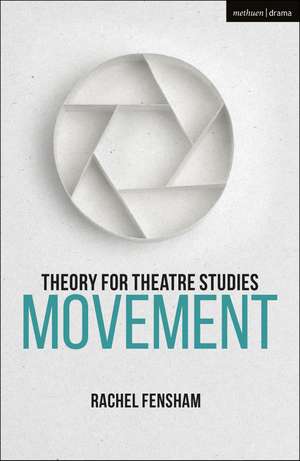
Theory for Theatre Studies: Movement: Theory for Theatre Studies
Autor Rachel Fensham Kim Solga, Susan Bennetten Limba Engleză Paperback – 25 feb 2021
Part of the Theory for Theatre Studies series which introduces core theoretical concepts that underpin the discipline, Movement provides the first overview of relevant critical theory for students and researchers in theatre and performance studies. Exploring areas such as vitality, plasticity, gesture, effort and rhythm, it opens up the study of theatrical production, live art, and intercultural performance to socio-political conceptions of movement as both practice and concept. It covers movement training systems and considers how they have been utilized in key works of the 20th and 21st centuries. The final section traces the convergence of movement in theatre with other media and digital technologies.
A wide range of in-depth case studies helps to equip readers to explore new methodologies and approaches to movement as a performance concept. These include analysis of Satoshi Miyagi's production of Sophocles' Antigone (2017), Thomas Ostermeier's production of Ibsen's Hedda Gabler (2008), the Berliner Ensemble's Mother Courage (1949), The Constant Prince (1965) performed by Ryzsard Cieslak, and the National Theatre's production of War Horse (2007). The final section considers a suite of concepts that shape postdramatic and intermedial theatre from China, Germany-Bangladesh, Australia, the United States, and United Kingdom. The volume is supported by further online resources including video material, questions, and exercises.
Preț: 116.11 lei
Preț vechi: 149.92 lei
-23%
Puncte Express: 174
Carte tipărită la comandă
Livrare economică 06-20 iunie
Livrare express 05-09 mai pentru 52.89 lei
Specificații
ISBN-13: 9781350026360
ISBN-10: 1350026360
Pagini: 208
Dimensiuni: 128 x 196 x 14 mm
Greutate: 0.2 kg
Editura: Bloomsbury Publishing
Colecția Methuen Drama
Seria Theory for Theatre Studies
Locul publicării:London, United Kingdom
ISBN-10: 1350026360
Pagini: 208
Dimensiuni: 128 x 196 x 14 mm
Greutate: 0.2 kg
Editura: Bloomsbury Publishing
Colecția Methuen Drama
Seria Theory for Theatre Studies
Locul publicării:London, United Kingdom
V-ar putea interesa
-
 The Empty SpacePeter Brook-28%Preț: 53.20 lei74.23 lei
 -
 The Body and the Senses in Greek TragedyAfroditi Angelopoulou-31%Preț: 414.75 lei598.75 lei
 -
 Theatre and The BodyMarina Abramovi?-26%Preț: 67.68 lei91.21 lei
 -
 Digital PerformanceSteve DixonPreț: 416.61 lei
 -
 Power MovesSeika BoyePreț: 227.31 lei
 -
 -15%Preț: 404.02 lei475.31 lei
 -
 A Boal Companion: Dialogues on Theatre and Cultural PoliticsJan Cohen-Cruz-5%Preț: 427.81 lei450.32 lei
 -
 -8%Preț: 489.17 lei531.70 lei
 -
 Nagler, A: Source Book in Theatrical HistoryAlois Maria NaglerPreț: 199.22 lei
 -
 Brecht on Theatre: The Development of an AestheticBertolt BrechtPreț: 131.32 lei
 -
 Performance Studies: An IntroductionRichard SchechnerPreț: 426.33 lei
 -
 Theory for Theatre Studies: SpaceKim Solga-22%Preț: 116.84 lei150.43 lei
 -
 Theory for Theatre Studies: EmotionProf. Peta Tait-23%Preț: 103.26 lei133.80 lei
 -
 Theory for Theatre Studies: LightProfessor Dean Wilcox-23%Preț: 109.60 lei141.85 lei
 -
 Movement Training for ActorsJackie Snow-24%Preț: 260.76 lei343.28 lei
 -
 -21%Preț: 139.06 lei176.50 lei
 -
 Theory for Theatre Studies: SoundSusan Bennett-23%Preț: 109.49 lei141.80 lei
 -
 We Are Movement: Unlocking Your Physical IntelligenceWayne McGregor-27%Preț: 85.84 lei117.38 lei
 -
 The Viewpoints BookAnne BogartPreț: 102.97 lei
Cuprins
Series Preface
Acknowledgements
Movement: Introduction
Movement of vital beings: Aristotle
Movement as bodily technique: Mauss
Rhythmic movement: Lefebvre
Case Study: Pina Bausch
This book
SECTION ONE
Movement as History
Movement of the chorus: Ancient Greek theatre
Movement of 'the flower': Noh aesthetics
Case Study #1: Satoshi Miyagi's Antigone (2017)
Gestural movement: Roman rhetoric
Case Study #2: I Am My Own Wife (2003)
Movement as style: The Natyasastra
Case Study #3: Zero Degrees (2005)
Processional movement
Hostility to movement: The anti-theatrical prejudice
Renaissance movement - from the vernacular to the cosmos
Case Study #4: The Tempest (1611, 2016)
Movement of the automaton
Case Study #5: War Horse (2007)
Conclusion
SECTION TWO
Movement Systems and Embodied Action
Holistic Systems: Craig, Delsarte and Dalcroze
Case Study #1: Operation Orfeo (1993)
Movement vitality: Phenomenology
Movement plasticity: Stanislavski and Ibsen
Case Study #2: Hedda Gabler (2005)
Movement mechanics: Meyerhold
Case Study #3, part a: The Constant Prince (1915)
Movement dynamics: Laban
Movement arrangement: Brecht
Case Study #4: Mother Courage and Her Children (1949, 2006)
Movement somatics: Grotowski
Case Study #3, part b: The Constant Prince (1965)
Movement assemblage: Butoh
Movement Sociology: Crowds
Conclusion
SECTION THREE
Movement in Contemporary Theatre
Speed: Attempts on Her Life (1997, 2007)
Slowness: The Artist is Present (2010)
Animation: Blackie Blackie Brown (2018)
Force: World Factory (2014), Made in Bangladesh (2015) and World Factory (2016)
Conclusion
Notes
References
Further Reading
Index
Acknowledgements
Movement: Introduction
Movement of vital beings: Aristotle
Movement as bodily technique: Mauss
Rhythmic movement: Lefebvre
Case Study: Pina Bausch
This book
SECTION ONE
Movement as History
Movement of the chorus: Ancient Greek theatre
Movement of 'the flower': Noh aesthetics
Case Study #1: Satoshi Miyagi's Antigone (2017)
Gestural movement: Roman rhetoric
Case Study #2: I Am My Own Wife (2003)
Movement as style: The Natyasastra
Case Study #3: Zero Degrees (2005)
Processional movement
Hostility to movement: The anti-theatrical prejudice
Renaissance movement - from the vernacular to the cosmos
Case Study #4: The Tempest (1611, 2016)
Movement of the automaton
Case Study #5: War Horse (2007)
Conclusion
SECTION TWO
Movement Systems and Embodied Action
Holistic Systems: Craig, Delsarte and Dalcroze
Case Study #1: Operation Orfeo (1993)
Movement vitality: Phenomenology
Movement plasticity: Stanislavski and Ibsen
Case Study #2: Hedda Gabler (2005)
Movement mechanics: Meyerhold
Case Study #3, part a: The Constant Prince (1915)
Movement dynamics: Laban
Movement arrangement: Brecht
Case Study #4: Mother Courage and Her Children (1949, 2006)
Movement somatics: Grotowski
Case Study #3, part b: The Constant Prince (1965)
Movement assemblage: Butoh
Movement Sociology: Crowds
Conclusion
SECTION THREE
Movement in Contemporary Theatre
Speed: Attempts on Her Life (1997, 2007)
Slowness: The Artist is Present (2010)
Animation: Blackie Blackie Brown (2018)
Force: World Factory (2014), Made in Bangladesh (2015) and World Factory (2016)
Conclusion
Notes
References
Further Reading
Index
Recenzii
This book convincingly demonstrates why a focus on the kinaesthetics of theatre-and theatrical embodiment more generally-is as important as the study of dramatic writing, acting, and scenography. The author writes with considerable erudition about the topic, but in a way that is almost always immediately accessible.