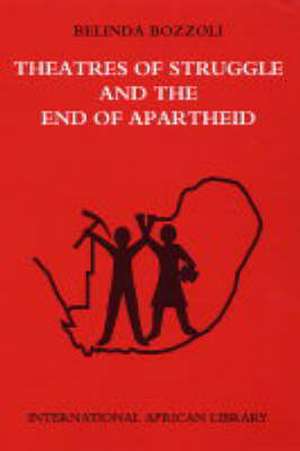
Theatres of Struggle and the End of Apartheid: International African Library
Autor Belinda Bozzolien Limba Engleză Paperback
| Toate formatele și edițiile | Preț | Express |
|---|---|---|
| Paperback (2) | 220.66 lei 6-8 săpt. | |
| Edinburgh University Press – | 220.66 lei 6-8 săpt. | |
| Ohio University Press – 21 iul 2004 | 300.58 lei Precomandă |




Preț: 220.66 lei
Preț vechi: 254.55 lei
-13% Nou
Puncte Express: 331
Preț estimativ în valută:
39.05€ • 45.54$ • 34.28£
39.05€ • 45.54$ • 34.28£
Carte tipărită la comandă
Livrare economică 15-29 ianuarie 26
Preluare comenzi: 021 569.72.76
Specificații
ISBN-13: 9780748619412
ISBN-10: 0748619410
Pagini: 336
Dimensiuni: 156 x 234 x 23 mm
Greutate: 0.51 kg
Editura: Edinburgh University Press
Seria International African Library
ISBN-10: 0748619410
Pagini: 336
Dimensiuni: 156 x 234 x 23 mm
Greutate: 0.51 kg
Editura: Edinburgh University Press
Seria International African Library
Recenzii
“(Bozzoli) draws upon thousands of archived interviews with the actors involved to create a rich and cohesive story that one cannot help but think sets the stage for the horrendously high rate of violence experienced in the country today.” —African Studies Quarterly
Notă biografică
Belinda Bozolli is a professor of sociology and deputy vice-chancellor for research at the University of the Witwatersrand, Johannesburg. She was born in South Africa and educated in Johannesburg and the UK. She was the founding director of the South African History Workshop and has played a leading role in developing critical scholarship in South Africa. She is the author of The Political Nature of a Ruling Class and Women of Phokeng.
Descriere
Descriere de la o altă ediție sau format:
A compelling study of the origins and trajectory of one of the legendary black uprisings against apartheid, Theatres of Struggle and the End of Apartheid draws on insights gained from the literature on collective action and social movements. It delves into the Alexandra Rebellion of 1986 to reveal its inner workings.
Belinda Bozzoli’s aim is to examine how the residents of Alexandra, a poverty-stricken segregated township in Johannesburg, manipulated and overturned the meanings of space, time, and power in their sequestered world.
She explains how they used political theater to convey, stage, and dramatize their struggle and how young and old residents generated differing ideologies and tactics, giving rise to a distinct form of generational politics.
Theatres of Struggle and the End of Apartheid asks the reader to enter into the world of the rebels and to confront the moral complexity and social duress they experienced as they invented new social forms and violently attacked old ones. It is an important study of collective action that will be of great interest to sociologists and to scholars of Africa, particularly to those interested in the antiapartheid struggle.