
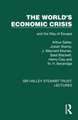
The World's Economic Future: Sir Halley Stewart Trust: Lectures
Autor A. Loveday, B. Ohlin, E. F. Heckscher, J. B. Condliffe, S. de Madariagaen Limba Engleză Paperback – 2 feb 2026
| Toate formatele și edițiile | Preț | Express |
|---|---|---|
| Paperback (1) | 266.50 lei Precomandă | |
| Taylor & Francis Ltd. – 2 feb 2026 | 266.50 lei Precomandă | |
| Hardback (1) | 499.44 lei Precomandă | |
| Taylor & Francis – 15 noi 2024 | 499.44 lei Precomandă |

Preț: 266.50 lei
Precomandă
Puncte Express: 400
Preț estimativ în valută:
47.16€ • 55.30$ • 41.41£
47.16€ • 55.30$ • 41.41£
Carte nepublicată încă
Doresc să fiu notificat când acest titlu va fi disponibil:
Se trimite...
Preluare comenzi: 021 569.72.76
Specificații
ISBN-13: 9781032880747
ISBN-10: 1032880740
Pagini: 130
Dimensiuni: 129 x 198 mm
Greutate: 0.14 kg
Editura: Taylor & Francis Ltd.
Seria Sir Halley Stewart Trust: Lectures
ISBN-10: 1032880740
Pagini: 130
Dimensiuni: 129 x 198 mm
Greutate: 0.14 kg
Editura: Taylor & Francis Ltd.
Seria Sir Halley Stewart Trust: Lectures
Cuprins
Introduction D. H. Robertson 1. Problems of Economic Insecurity A. Loveday 2. The Distribution of Power and Leadership J. B. Condliffe 3. On the Future Economic Organization of Society B. Ohlin 4. Recent Tendencies in Economic Life E. F. Heckscher 5. Mental Settings of our Economic Future S. de Madariaga.
Notă biografică
Alexander Loveday (1888–1962) was a British economist who worked for the League of Nations before serving as Warden of Nuffield College, Oxford from 1950 to 1954. At the time of publication, he was Director at the League of Nations, Economics Intelligence Service.
John B. Condliffe (1891–1981) was a New Zealand economist, university professor and economic consultant. Lauded for the decisive role he played in international NGOs in the interwar period, he was one of New Zealand's best-known international economists. At the time of publication, he was Professor of Commerce at London University.
Bertil Ohlin (1899–1979) was a Swedish economist and political leader who is known as the founder of the modern theory of the dynamics of trade. He established a theory of international trade that is now known as the Heckscher-Ohlin theory. In 1977 he shared the Nobel Prize for Economics with James Meade. At the time of publication, he was Professor of Economics at Stockholm University.
Eli F. Heckscher (1879–1952) was a Swedish political economist and economic historian. He is known for the Heckscher-Ohlin theorem, an influential model of international trade that predicts that capital-abundant countries export capital-intensive goods, while labour-abundant countries export the labour-intensive goods. At the time of publication, he was Professor of Economic History at Stockholm University.
Salvador de Madariaga (1886–1978) was a Spanish diplomat, writer, historian and pacifist. He was nominated for the Nobel Prize in Literature and the Nobel Peace Prize and awarded the Charlemagne Prize in 1973. At the time of publication, he was Late Spanish Representative, League of Nations Council.
John B. Condliffe (1891–1981) was a New Zealand economist, university professor and economic consultant. Lauded for the decisive role he played in international NGOs in the interwar period, he was one of New Zealand's best-known international economists. At the time of publication, he was Professor of Commerce at London University.
Bertil Ohlin (1899–1979) was a Swedish economist and political leader who is known as the founder of the modern theory of the dynamics of trade. He established a theory of international trade that is now known as the Heckscher-Ohlin theory. In 1977 he shared the Nobel Prize for Economics with James Meade. At the time of publication, he was Professor of Economics at Stockholm University.
Eli F. Heckscher (1879–1952) was a Swedish political economist and economic historian. He is known for the Heckscher-Ohlin theorem, an influential model of international trade that predicts that capital-abundant countries export capital-intensive goods, while labour-abundant countries export the labour-intensive goods. At the time of publication, he was Professor of Economic History at Stockholm University.
Salvador de Madariaga (1886–1978) was a Spanish diplomat, writer, historian and pacifist. He was nominated for the Nobel Prize in Literature and the Nobel Peace Prize and awarded the Charlemagne Prize in 1973. At the time of publication, he was Late Spanish Representative, League of Nations Council.