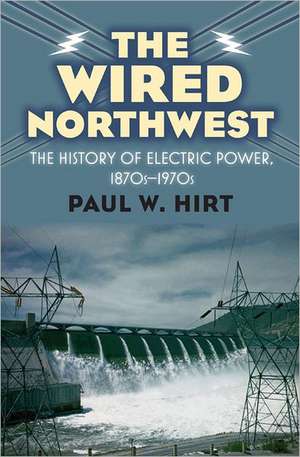
The Wired Northwest: The History of Electric Power, 1870s-1970s
Autor Paul W. Hirten Limba Engleză Hardback – 17 oct 2012
Bazându-ne pe analiza detaliată a arhivelor istorice și a rapoartelor agențiilor federale, remarcăm că The Wired Northwest de Paul W. Hirt reprezintă o sinteză fundamentală pentru înțelegerea infrastructurii energetice nord-americane. Autorul documentează meticulos tranziția de la primele încercări de electrificare din anii 1870 până la sistemul integrat complex de la mijlocul secolului XX, unde hidroenergia a devenit pilonul central al dezvoltării regionale. Subliniem faptul că această lucrare depășește granițele unei simple istorii tehnice, fiind prima cercetare care compară sistematic politicile energetice din SUA cu cele din Columbia Britanică.
Structura narativă evidențiază o luptă continuă pentru echilibru între eficiența tehnologică, profitabilitatea financiară și responsabilitatea socială. Observăm cum construcția marilor baraje pe fluviile Columbia sau Snake nu a fost doar un triumf ingineresc, ci și un punct de coliziune cu drepturile ancestrale ale triburilor indigene și cu ecosistemul fragil al pescuitului de somon. Hirt analizează rolul critic jucat de University Press of Kansas în publicarea acestui studiu ce disecă guvernanța resurselor publice. Ca alternativă la Empowering the West pentru cursurile de istorie economică sau politici publice, acest volum are avantajul unei perspective transfrontaliere și al unei analize critice asupra impactului ecologic pe termen lung. În comparație cu abordarea sistemică din Networks of Power – Electrification in Western Society, 1880–1930 de Hughes, The Wired Northwest pune un accent mai puternic pe dinamica dintre interesul public și entitățile private care au modelat rețeaua electrică modernă.
Preț: 490.63 lei
Carte disponibilă
Livrare economică 29 octombrie-12 noiembrie
Specificații
ISBN-10: 0700618732
Pagini: 461
Dimensiuni: 165 x 241 x 38 mm
Greutate: 0.89 kg
Editura: University Press of Kansas
V-ar putea interesa
-
 Urban Latin America: The Political Condition from Above and BelowAlejandro PortesPreț: 196.50 lei
 -
 Franklin and EleanorHazel RowleyPreț: 150.83 lei
 -
 Preț: 459.65 lei
 -
 RatificationPauline MaierPreț: 144.44 lei
 -
 Seeking Pleasure in the Old WestDavid DaryPreț: 303.64 lei
 -
 Devil's BargainsHal RothmanPreț: 306.36 lei
 -
 Big Sky RiversRobert SchneidersPreț: 484.37 lei
 -
 Hunger for the Wild: America's Obsession with the Untamed WestMichael L. JohnsonPreț: 399.68 lei
 -
 The Treason Trials of Aaron BurrPeter Charles HofferPreț: 233.48 lei
 -
 Kansas City and How It Grew, 1822-2011James R ShortridgePreț: 259.91 lei
 -
 Bright Light City: Las Vegas in Popular CultureLarry GraggPreț: 361.65 lei
 -
 The First Presidential ContestJeffrey L PasleyPreț: 284.75 lei
 -
 Hellhound on his TrailHampton Sides-29%Preț: 76.30 lei106.74 lei
 -
 Howard Zinn on HistoryHoward Zinn-6%Preț: 79.48 lei85.00 lei
 -
 The Chaco War 1932–35: South America’s greatest modern conflictAlejandro De Quesada-33%Preț: 65.71 lei97.49 lei
De ce să citești această carte
Această lucrare este esențială pentru cercetătorii și studenții interesați de istoria tehnologiei și de politicile de mediu. Cititorul câștigă o înțelegere profundă a modului în care deciziile de infrastructură de acum un secol influențează sustenabilitatea rețelelor actuale. Este o recomandare solidă pentru cei care doresc să exploreze tensiunile dintre progresul industrial și drepturile sociale, oferind lecții concrete despre gestionarea resurselor naturale comune.