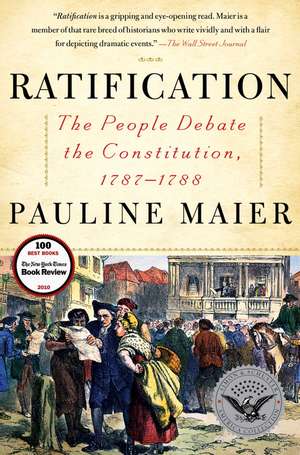
Ratification
Autor Pauline Maieren Limba Engleză Paperback – 7 iun 2011
Bazându-ne pe documentația extensivă oferită de Ratification, observăm o schimbare de paradigmă în istoriografia fondării Statelor Unite. Dacă majoritatea lucrărilor se concentrează pe Convenția de la Philadelphia, Pauline Maier mută reflectorul asupra anului tumultuos în care „Noi, Poporul” a trebuit să decidă validitatea noului document. Reținem că această lucrare nu este doar o cronică politică, ci o istorie socială vibrantă ce surprinde dezbaterile din taverne, cafenele și saloane, unde americani obișnuiți analizau critic fiecare articol constituțional. Structura narativă este una dinamică, acordând o atenție deosebită celor patru state-cheie — Pennsylvania, Massachusetts, Virginia și New York — unde miza a fost maximă. Pauline Maier reușește să integreze vocile unor figuri monumentale precum Washington sau Madison alături de opozanți vehemenți care se temeau pentru libertățile câștigate în război. Alternativă la volumul The Debate on the Constitution pentru cursurile de istorie constituțională sau științe politice, Ratification are avantajul unei perspective unitare și fluide, spre deosebire de caracterul fragmentat al unei antologii de discursuri. În contextul operei autoarei, această carte completează viziunea din American Scripture, unde analiza Declarația de Independență, oferind acum o imagine completă a procesului de cristalizare a identității naționale americane. Stilul este precis, academic, dar accesibil, evitând jargonul excesiv în favoarea detaliului istoric revelator.
Preț: 148.86 lei
Carte disponibilă
Livrare economică 07-21 noiembrie
Specificații
ISBN-10: 0684868555
Pagini: 608
Dimensiuni: 156 x 238 x 42 mm
Greutate: 0.65 kg
Editura: Simon&Schuster
V-ar putea interesa
-
 The DuelJudith St GeorgePreț: 70.75 lei
 -
 Preț: 31.38 lei
 -
 Parting the WatersTaylor BranchPreț: 226.80 lei
 -
 American ScripturePauline MaierPreț: 95.37 lei
 -
 1776David McculloughPreț: 222.91 lei
 -
 1776David McculloughPreț: 125.09 lei
 -
 Savage PeaceAnn HagedornPreț: 231.29 lei
 -
 They Marched Into SunlightDavid MaranissPreț: 138.05 lei
 -
 Sons of ProvidenceCharles RappleyePreț: 146.36 lei
 -
 The American WestDee Brown-17%Preț: 60.93 lei73.38 lei
 -
 America's Greatest BlunderBurton Yale PinesPreț: 199.30 lei
 -
 1864Charles Bracelen FloodPreț: 118.29 lei
 -
 Haiti Will Not Perish: A Recent HistoryMichael Deibert-14%Preț: 200.99 lei233.93 lei
 -
 Preț: 285.61 lei
De ce să citești această carte
Recomandăm această carte oricărui pasionat de istorie politică sau drept constituțional care dorește să înțeleagă că democrația americană nu a fost un rezultat garantat, ci unul negociat aprig. Cititorul câștigă o perspectivă rară asupra modului în care cetățenii obișnuiți pot influența structura fundamentală a unui stat. Este o lecție magistrală despre dezbaterea publică și responsabilitatea civică, semnată de una dintre cele mai respectate voci ale istoriografiei americane.
Despre autor
Pauline Maier (1938–2013) a fost o istorică de renume, profesor la MIT (William R. Kenan, Jr. Professor of American History) și o autoritate recunoscută în studiul Revoluției Americane. Cariera sa de peste 50 de ani a fost marcată de premii prestigioase, printre care George Washington Book Prize, și de o prezență activă în spațiul public prin colaborări cu PBS, History Channel și New York Times. Membră a Academiei Americane de Arte și Științe, Maier a combinat rigoarea academică cu talentul narativ, fiind considerată un istoric revizionist care a adus noi nuanțe interpretative perioadei coloniale târzii și formării Statelor Unite.
Descriere scurtă
Winner of the George Washington Book Prize
When the delegates left the Constitutional Convention in Philadelphia in September 1787, the new Constitution they had written was no more than a proposal. Elected conventions in at least nine of the thirteen states would have to ratify it before it could take effect. There was reason to doubt whether that would happen. The document we revere today as the foundation of our country's laws, the cornerstone of our legal system, was hotly disputed at the time. Some Americans denounced the Constitution for threatening the liberty that Americans had won at great cost in the Revolutionary War. One group of fiercely patriotic opponents even burned the document in a raucous public demonstration on the Fourth of July.
In this splendid new history, Pauline Maier tells the dramatic story of the yearlong battle over ratification that brought such famous founders as Washington, Hamilton, Madison, Jay, and Henry together with less well-known Americans who sometimes eloquently and always passionately expressed their hopes and fears for their new country. Men argued in taverns and coffeehouses; women joined the debate in their parlors; broadsides and newspaper stories advocated various points of view and excoriated others. In small towns and counties across the country people read the document carefully and knew it well. Americans seized the opportunity to play a role in shaping the new nation. Then the ratifying conventions chosen by "We the People" scrutinized and debated the Constitution clause by clause.
Although many books have been written about the Constitutional Convention, this is the first major history of ratification. It draws on a vast new collection of documents and tells the story with masterful attention to detail in a dynamic narrative. Each state's experience was different, and Maier gives each its due even as she focuses on the four critical states of Pennsylvania, Massachusetts, Virginia, and New York, whose approval of the Constitution was crucial to its success.
The New Yorker Gilbert Livingston called his participation in the ratification convention the greatest transaction of his life. The hundreds of delegates to the ratifying conventions took their responsibility seriously, and their careful inspection of the Constitution can tell us much today about a document whose meaning continues to be subject to interpretation. Ratification is the story of the founding drama of our nation, superbly told in a history that transports readers back more than two centuries to reveal the convictions and aspirations on which our country was built.