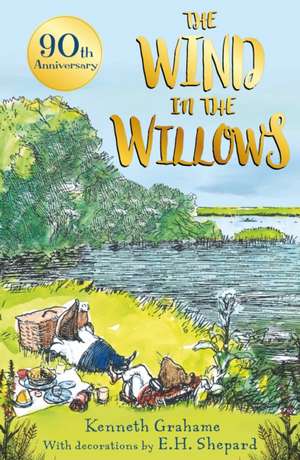
The Wind in the Willows
Autor Kenneth Grahame Ilustrat de E. H. Sheparden Limba Engleză Paperback – apr 2021
Recomandăm această ediție aniversară în format paperback pentru copiii cu vârsta de peste 9 ani, fiind momentul ideal în care lectura individuală începe să prindă contur prin povești complexe. The Wind in the Willows - 90th anniversary gift edition nu este doar o carte de aventuri, ci o poartă către literatura clasică engleză, menținută vie de peste un secol prin farmecul personajelor sale antropomorfe. Ne-a atras atenția în mod deosebit prezența ilustrațiilor originale alb-negru semnate de E. H. Shepard, artistul care i-a dat viață și lui Winnie-the-Pooh, oferind textului o notă de nostalgie și eleganță vizuală. În familia The Wind in the Willows de Kenneth Grahame, regăsită și în colecția Wordsworth Classics, dar cu o temă actuală: importanța loialității și a gestionării consecințelor propriilor acțiuni. Dacă versiunile dramatizate se concentrează pe dinamica dialogului, această ediție integrală permite cititorului să zăbovească asupra descrierilor naturii și asupra atmosferei contemplative de pe malul râului. Povestea începe cu Mole, care își părăsește vizuina pentru a descoperi o lume plină de prieteni precum Ratty și Badger, dar și pericolele din Wild Wood. Ritmul narațiunii alternează între momente de liniște pastorală și episoadele pline de umor și haos provocate de nesăbuitul Mr Toad. Apreciem cum Kenneth Grahame reușește să construiască o critică blândă a exceselor prin personajul Toad, oferind în același timp o lecție despre puterea comunității de a îndrepta lucrurile atunci când Toad Hall este ocupată de nevăstuici.
Preț: 64.55 lei
Carte disponibilă
Livrare economică 31 octombrie-14 noiembrie
Livrare express 20-24 octombrie pentru 21.45 lei
Specificații
ISBN-10: 0755500792
Pagini: 272
Dimensiuni: 131 x 196 x 25 mm
Greutate: 0.25 kg
Editura: HarperCollins Publishers
V-ar putea interesa
-
 Destination: MarsSeymour SimonPreț: 9.99 lei
 -
 Charlotte's WebE. B. WhitePreț: 60.47 lei
 -
 The Secret GardenFrances Hodgson BurnettPreț: 44.79 lei
 -
 -17%Preț: 66.48 lei80.39 lei
 -
 Oxford Reading Tree Word Sparks: Level 12: Mind That Meteor!James ClementsPreț: 64.98 lei
 -
 Preț: 65.42 lei
 -
 AirMonica RoePreț: 96.31 lei
 -
 Alice in WonderlandLewis Carroll-38%Preț: 17.48 lei28.23 lei
 -
 A Christmas CarolCharles DickensPreț: 32.25 lei
 -
 The Secret GardenMary Sebag-MontefiorePreț: 47.03 lei
 -
 Preț: 160.21 lei
 -
 Spin with MeAmi PolonskyPreț: 82.60 lei
 -
 StingersRandy Wayne WhitePreț: 58.87 lei
 -
 I Am GoldenEva ChenPreț: 110.49 lei
 -
 Tom Gates 13: Epic Adventure (kind of)Liz PichonPreț: 58.00 lei
 -
 -55%Preț: 65.96 lei146.41 lei
 -
 The Girl Who Speaks BearSophie AndersonPreț: 72.07 lei
 -
 Preț: 58.67 lei
 -
 Preț: 58.16 lei
 -
 Preț: 58.55 lei
 -
 KS3 Science Workbook (with Answers)Paddy GannonPreț: 102.03 lei
 -
 Collected Short Stories of SakiHector Hugh MunroPreț: 28.01 lei
De ce să citești această carte
Această carte este esențială pentru biblioteca oricărui copil care începe să exploreze romane de aventură mai ample. Cititorul câștigă nu doar o poveste captivantă, ci și un vocabular bogat și o înțelegere profundă a valorilor precum prietenia și cumpătarea. Este o ocazie excelentă pentru părinți de a introduce un text clasic, premiat și recunoscut internațional, într-o ediție grafică deosebită care celebrează 90 de ani de la viziunea artistică a lui Shepard.
Despre autor
Kenneth Grahame (1859–1932) a fost un scriitor scoțian a cărui operă a definit standardele literaturii antropomorfice moderne. Deși a lucrat ca secretar la Banca Angliei, adevărata sa pasiune a fost natura, temă care domină capodopera sa, The Wind in the Willows. Experiențele sale din copilărie de pe malul râului Tamisa și dorința de a-și alina fiul prin povești fantastice au pus bazele unor personaje iconice. Pe lângă aventurile lui Toad și Mole, el este cunoscut și pentru The Reluctant Dragon, ambele lucrări fiind adaptate ulterior de studiouri celebre precum Disney.
Descriere
Textul de pe ultima copertă
The adventures begin when Mole, feeling all the restlessness that springtime brings, abandons his burrow to discover the magic of the great river. With the able assistance of Rat, Mole learns to row and swim, and the chums fill their idyllic days with summertime rambles along the river and cozy fireside feasts on crisp nights. The pair take to the open road with the pleasure-loving Toad, track reclusive Badger to his snug lair, and stand together to reclaim Toad Hall from an invasion of stoats, ferrets, and weasels.
This memorable collection of stories, now available in an inexpensive and unabridged edition, offers a joyful retreat to a rustic world of wonders. Young readers (and listeners) will want to return again and again to the ageless charm of Kenneth Grahame's childhood classic.
Notă biografică
Kenneth Grahame (1859-1932) was born in Edinburgh, but grew up with relatives in Berkshire where he developed his love for the countryside surrounding the upper parts of the River Thames. He was educated at St Edward's in Oxford, but instead of going on to Oxford University he joined the Bank of England, where he rose to become Secretary. He wrote several books including The Golden Age and Dream Days which includes the short story 'The Reluctant Dragon' (later made into a Disney movie). Kenneth Grahame developed the character of Toad in The Wind in the Willows to amuse his young son, Alistair. It was published in 1908 and still remains a best-loved children's classic.
John Burningham (Illustrator)
John Burningham was born in 1936. He studied illustration at the Central School of Art. His first children's book, Borka, was published in 1963, and it was awarded the Kate Greenaway Medal as the best illustrated book of the year. John Burningham collaborated with Ian Fleming on Chitty-Chitty-Bang-Bang, designing the model of the famous car. He lived in London with his wife Helen Oxenbury, also a well-known author and illustrator. John Burningham died on January 4th, 2019.
Recenzii
"It is a book that breaks nearly every rule of modern children's fiction...it wasn't about fairies at the bottom of the garden, but it was about magic - just the right kind of magic. It thrills me still to read it" -- Shirley Hughes The Times "Believe me, my young friend, there is nothing - absolutely nothing - half so much worth doing as simply messing about in boats." But reading about Mole, Ratty, Toad and Badger runs it a close second." -- Michael Morpurgo "People think of it as a children's book, but that's not all it is. What seared my imagination was its surrealism. The rat, the mole and badger could talk, but they could also change size: a badger could crawl down a rat hole, a toad could drive a car. At nine or 10 that fascinated me and that made a deep impression on my career" -- Terry Pratchett Independent on Sunday "A book about the love of friends and the joys of existence" Sunday Times "I loved Toad of Toad Hall and his merry antics, especially with his motor car - poop poop!" -- Kenneth Branagh Daily Express
Extras
The River Bank
The Mole had been working very hard all the morning, spring-cleaning his little home. First with brooms, then with dusters; then on ladders and steps and chairs, with a brush and a pail of whitewash; till he had dust in his throat and eyes, and splashes of whitewash all over his black fur, and an aching back and weary arms. Spring was moving in the air above and in the earth below and around him, penetrating even his dark and lowly little house with its spirit of divine discontent and longing. It was small wonder, then, that he suddenly flung down his brush on the floor, said, “Bother!” and “O blow!” and also “Hang spring-cleaning!” and bolted out of the house without even waiting to put on his coat. Something up above was calling him imperiously, and he made for the steep little tunnel which answered in his case to the gravelled carriage-drive owned by animals whose residences are nearer to the sun and air. So he scraped and scratched and scrabbled and scrooged, and then he scrooged again and scrabbled and scratched and scraped, working busily with his little paws and muttering to himself, “Up we go! Up we go!” till at last, pop! his snout came out into the sunlight and he found himself rolling in the warm grass of a great meadow.
“This is fine!” he said to himself. “This is better than whitewashing!” The sunshine struck hot on his fur, soft breezes caressed his heated brow, and after the seclusion of the cellarage he had lived in so long the carol of happy birds fell on his dulled hearing almost like a shout. Jumping off all his four legs at once, in the joy of living and the delight of spring without its cleaning, he pursued his way across the meadow till he reached the hedge on the further side.
“Hold up!” said an elderly rabbit at the gap. “Sixpence for the privilege of passing by the private road!” He was bowled over in an instant by the impatient and contemptuous Mole, who trotted along the side of the hedge chaffing the other rabbits as they peeped hurriedly from their holes to see what the row was about. “Onion-sauce! Onion-sauce!” he remarked jeeringly, and was gone before they could think of a thoroughly satisfactory reply. Then they all started grumbling at each other. “How stupid you are! Why didn’t you tell him—” “Well, why didn’t you say—” “You might have reminded him—” and so on, in the usual way; but, of course, it was then much too late, as is always the case.
It all seemed too good to be true. Hither and thither through the meadows he rambled busily, along the hedgerows, across the copses, finding everywhere birds building, flowers budding, leaves thrusting—everything happy, and progressive, and occupied. And instead of having an uneasy conscience pricking him and whispering “whitewash!” he somehow could only feel how jolly it was to be the only idle dog among all these busy citizens. After all, the best part of a holiday is perhaps not so much to be resting yourself, as to see all the other fellows busy working.
He thought his happiness was complete when, as he meandered aimlessly along, suddenly he stood by the edge of a full-fed river. Never in his life had he seen a river before—this sleek, sinuous, full-bodied animal, chasing and chuckling, gripping things with a gurgle and leaving them with a laugh, to fling itself on fresh playmates that shook themselves free, and were caught and held again. All was a-shake and a-shiver—glints and gleams and sparkles, rustle and swirl, chatter and bubble. The Mole was bewitched, entranced, fascinated. By the side of the river he trotted as one trots, when very small, by the side of a man who holds one spellbound by exciting stories; and when tired at last, he sat on the bank, while the river still chattered on to him, a babbling procession of the best stories in the world, sent from the heart of the earth to be told at last to the insatiable sea.
As he sat on the grass and looked across the river, a dark hole in the bank opposite, just above the water’s edge, caught his eye, and dreamily he fell to considering what a nice, snug dwelling-place it would make for an animal with few wants and fond of a bijou riverside residence, above flood level and remote from noise and dust. As he gazed, something bright and small seemed to twinkle down in the heart of it, vanished, then twinkled once more like a tiny star. But it could hardly be a star in such an unlikely situation; and it was too glittering and small for a glow-worm. Then, as he looked, it winked at him, and so declared itself to be an eye; and a small face began gradually to grow up round it, like a frame round a picture.
A brown little face, with whiskers.
A grave round face, with the same twinkle in its eye that had first attracted his notice.
Small neat ears and thick silky hair.
It was the Water Rat!
Then the two animals stood and regarded each other cautiously.
“Hullo, Mole!” said the Water Rat.
“Hullo, Rat!” said the Mole.
“Would you like to come over?” enquired the Rat presently.
“Oh, it’s all very well to talk,” said the Mole rather pettishly, he being new to a river and riverside life and its ways.
The Rat said nothing, but stooped and unfastened a rope and hauled on it; then lightly stepped into a little boat which the Mole had not observed. It was painted blue outside and white within, and was just the size for two animals; and the Mole’s whole heart went out to it at once, even though he did not yet fully understand its uses.
The Rat sculled smartly across and made fast. Then he held up his forepaw as the Mole stepped gingerly down. “Lean on that!” he said. “Now then, step lively!” and the Mole to his surprise and rapture found himself actually seated in the stern of a real boat.
“This has been a wonderful day!” said he, as the Rat shoved off and took to the sculls again. “Do you know, I’ve never been in a boat before in all my life.”
“What?” cried the Rat, open-mouthed: “Never been in a—you never—well I—what have you been doing, then?”
“Is it so nice as all that?” asked the Mole shyly, though he was quite prepared to believe it as he leant back in his seat and surveyed the cushions, the oars, the rowlocks, and all the fascinating fittings, and felt the boat sway lightly under him.
“Nice? It’s the only thing,” said the Water Rat solemnly as he leant forward for his stroke. “Believe me, my young friend, there is nothing—absolutely nothing—half so much worth doing as simply messing about in boats. Simply messing,” he went on dreamily: “messing—about—in—boats; messing—”
“Look ahead, Rat!” cried the Mole suddenly.
It was too late. The boat struck the bank full tilt. The dreamer, the joyous oarsman, lay on his back at the bottom of the boat, his heels in the air.
“—about in boats—or with boats,” the Rat went on composedly, picking himself up with a pleasant laugh. “In or out of ’em, it doesn’t matter. Nothing seems really to matter, that’s the charm of it. Whether you get away, or whether you don’t; whether you arrive at your destination or whether you reach somewhere else, or whether you never get anywhere at all, you’re always busy, and you never do anything in particular; and when you’ve done it there’s always something else to do, and you can do it if you like, but you’d much better not. Look here! If you’ve really nothing else on hand this morning, supposing we drop down the river together, and have a long day of it?”
The Mole waggled his toes from sheer happiness, spread his chest with a sigh of full contentment, and leant back blissfully into the soft cushions. “What a day I’m having!” he said. “Let us start at once!”
“Hold hard a minute, then!” said the Rat. He looped the painter through a ring in his landing-stage, climbed up into his hole above, and after a short interval reappeared staggering under a fat wicker luncheon-basket.
“Shove that under your feet,” he observed to the Mole, as he passed it down into the boat. Then he untied the painter and took the sculls again.
“What’s inside it?” asked the Mole, wriggling with curiosity.
“There’s cold chicken inside it,” replied the Rat briefly: “cold tonguecoldhamcoldbeefpickledgherkinssaladfrenchrollscresssand wichespottedmeatgingerbeerlemonadesodawater—”
“O stop, stop!” cried the Mole in ecstasies. “This is too much!”
“Do you really think so?” enquired the Rat seriously. “It’s only what I always take on these little excursions; and the other animals are always telling me that I’m a mean beast and cut it very fine!”
The Mole never heard a word he was saying. Absorbed in the new life he was entering upon, intoxicated with the sparkle, the ripple, the scents and the sounds and the sunlight, he trailed a paw in the water and dreamed long waking dreams. The Water Rat, like the good little fellow he was, sculled steadily on and forbore to disturb him.
“I like your clothes awfully, old chap,” he remarked after some half an hour or so had passed. “I’m going to get a black velvet smoking-suit myself some day, as soon as I can afford it.”
“I beg your pardon,” said the Mole, pulling himself together with an effort. “You must think me very rude; but all this is so new to me. So—this—is—a—River!”
“The River,” corrected the Rat.
“And you really live by the river? What a jolly life!”
“By it and with it and on it and in it,” said the Rat. “It’s brother and sister to me, and aunts, and company, and food and drink, and (naturally) washing. It’s my world, and I don’t want any other. What it hasn’t got is not worth having, and what it doesn’t know is not worth knowing. Lord! the times we’ve had together! Whether in winter or summer, spring or autumn, it’s always got its fun and its excitements. When the floods are on in February, and my cellars and basement are brimming with drink that’s no good to me, and the brown water runs by my best bedroom window; or again when it all drops away and shows patches of mud that smells like plum-cake, and the rushes and weed clog the channels, and I can potter about dry shod over most of the bed of it and find fresh food to eat, and things careless people have dropped out of boats!”
“But isn’t it a bit dull at times?” the Mole ventured to ask. “Just you and the river, and no one else to pass a word with?”
“No one else to—well, I mustn’t be hard on you,” said the Rat with forbearance. “You’re new to it, and of course you don’t know. The bank is so crowded nowadays that many people are moving away altogether. O no, it isn’t what it used to be, at all. Otters, kingfishers, dabchicks, moorhens, all of them about all day long and always wanting you to do something—as if a fellow had no business of his own to attend to!”
“What lies over there?” asked the Mole, waving a paw towards a background of woodland that darkly framed the water-meadows on one side of the river.
“That? O, that’s just the Wild Wood,” said the Rat shortly. “We don’t go there very much, we river-bankers.”
“Aren’t they—aren’t they very nice people in there?” said the Mole a trifle nervously.
“W-e-ll,” replied the Rat, “let me see. The squirrels are all right. And the rabbits—some of ’em, but rabbits are a mixed lot. And then there’s Badger, of course. He lives right in the heart of it; wouldn’t live anywhere else, either, if you paid him to do it. Dear old Badger! Nobody interferes with him. They’d better not,” he added significantly.
“Why, who should interfere with him?” asked the Mole.
“Well, of course—there—are others,” explained the Rat in a hesitating sort of way. “Weasels—and stoats—and foxes—and so on. They’re all right in a way—I’m very good friends with them—pass the time of day when we meet, and all that—but they break out sometimes, there’s no denying it, and then—well, you can’t really trust them, and that’s the fact.”
The Mole knew well that it is quite against animal-etiquette to dwell on possible trouble ahead, or even to allude to it; so he dropped the subject.
“And beyond the Wild Wood again?” he asked; “where it’s all blue and dim, and one sees what may be hills or perhaps they mayn’t, and something like the smoke of towns, or is it only cloud-drift?”
“Beyond the Wild Wood comes the Wide World,” said the Rat. “And that’s something that doesn’t matter, either to you or me. I’ve never been there, and I’m never going, nor you either, if you’ve got any sense at all. Don’t ever refer to it again, please. Now then! Here’s our backwater at last, where we’re going to lunch.”
Leaving the main stream, they now passed into what seemed at first sight like a little landlocked lake. Green turf sloped down to either edge, brown snaky tree-roots gleamed below the surface of the quiet water, while ahead of them the silvery shoulder and foamy tumble of a weir, arm-in-arm with a restless dripping millwheel, that held up in its turn a grey-gabled mill-house, filled the air with a soothing murmur of sound, dull and smothery, yet with little clear voices speaking up cheerfully out of it at intervals. It was so very beautiful that the Mole could only hold up both forepaws and gasp: “O my! O my! O my!”
The Rat brought the boat alongside the bank, made her fast, helped the still awkward Mole safely ashore, and swung out the luncheon-basket. The Mole begged as a favour to be allowed to unpack it all by himself; and the Rat was very pleased to indulge him, and to sprawl at full length on the grass and rest, while his excited friend shook out the table-cloth and spread it, took out all the mysterious packets one by one and arranged their contents in due order, still gasping: “O my! O my!” at each fresh revelation. When all was ready, the Rat said, “Now, pitch in, old fellow!” and the Mole was indeed very glad to obey, for he had started his spring-cleaning at a very early hour that morning, as people will do, and had not paused for bite or sup; and he had been through a very great deal since that distant time which now seemed so many days ago.