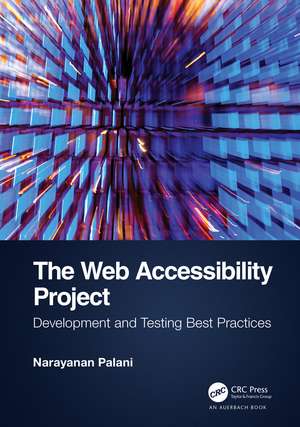
The Web Accessibility Project: Development and Testing Best Practices
Autor Narayanan Palanien Limba Engleză Paperback – 20 iul 2022
Web Content Accessibility Guidelines (WCAG) is a global guide on accessibility recommendations that are developed through the World Wide Web Consortium (W3C) to help organizations to meet minimum standard accessibility guidelines. It has become critical for every organization to focus on implementing the accessibility checks at every stage of their application development to avoid costly mistakes. Meanwhile, the need for front-end engineers and Quality Assurance (QA) test analysts to learn WCAG best practices is immensely important for the growing need to incorporate accessibility-focused inclusive design, development, and extensive accessibility testing, which are essential for most of the customer-facing websites.
In a fast-paced world, incorporating shift left accessibility within development and testing is the new normal. The Web Accessibility Project: Development and Testing Best Practices helps developers address right accessibility attributes to user interface (UI) components. It also helps developers focus on developing manual and automation tests for QA professionals to inject accessibility audit, accessibility functional tests, and accessibility automation tests as part of their Continuous Integration and Continuous Development (CI/CD) models. The book is filled with readily usable best practices to adapt web accessibility early in application development.
By applying the accessibility best practices covered in this book, developers can help their organizations rise to a whole new level of accessibility adherence, innovation, and inclusive design. They will also see greater work satisfaction in their professional lives and a way to help improve digital accessibility for end users.
Preț: 572.75 lei
Preț vechi: 715.94 lei
-20%
Puncte Express: 859
Carte tipărită la comandă
Livrare economică 07-21 decembrie
Livrare prin curier în România Termenul estimat este afișat lângă disponibilitate.
Transport gratuit pentru acest produs Plată online sau ramburs, în funcție de opțiunile comenzii.
Retur gratuit în 14 zile Comandă securizată și suport în română.
Specificații
ISBN-13: 9781032202006
ISBN-10: 1032202009
Pagini: 230
Ilustrații: 81 Line drawings, black and white; 81 Illustrations, black and white
Dimensiuni: 174 x 246 x 12 mm
Greutate: 0.4 kg
Ediția:1
Editura: CRC Press
Colecția Auerbach Publications
ISBN-10: 1032202009
Pagini: 230
Ilustrații: 81 Line drawings, black and white; 81 Illustrations, black and white
Dimensiuni: 174 x 246 x 12 mm
Greutate: 0.4 kg
Ediția:1
Editura: CRC Press
Colecția Auerbach Publications
V-ar putea interesa
-
 HTML and CSSJoe Casabona-20%Preț: 206.50 lei258.13 lei
 -
 Internet & World Wide Web: How to ProgramHarvey Deitel-20%Preț: 641.26 lei801.58 lei
 -
 Web Style Guide, 4th Edition: Foundations of User Experience DesignPatrick J. Lynch-20%Preț: 208.51 lei260.64 lei
 -
 -20%Preț: 363.08 lei453.85 lei
 -
 -20%Preț: 220.69 lei275.87 lei
 -
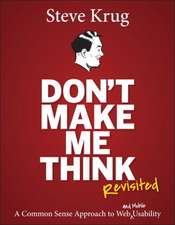 Don't Make Me ThinkSteve Krug-20%Preț: 225.53 lei281.91 lei
 -
 Preț: 259.37 lei
 -
 Lessons Learned in Software Testing - A Context- Driven ApproachBret Pettichord-20%Preț: 259.60 lei324.50 lei
 -
 This Is for EveryoneTim Berners-LeePreț: 124.30 lei
 -
 Preț: 207.88 lei
 -
 Web Coding & Development All-in-One For Dummies, 2nd EditionPaul McFedries-20%Preț: 242.60 lei303.25 lei
 -
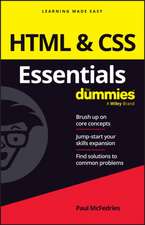 HTML & CSS Essentials For DummiesPaul McFedries-20%Preț: 79.54 lei99.42 lei
 -
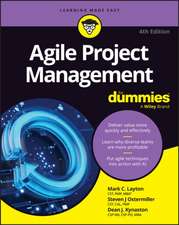 Agile Project Management For DummiesMark C LaytonPreț: 171.30 lei
 -
 Github Copilot Certification Study GuideTom Taulli-20%Preț: 330.54 lei413.16 lei
 -
 Coding For Dummies, All New EditionPaul McFedries-20%Preț: 116.94 lei146.18 lei
 -
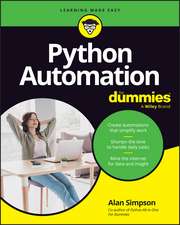 Python Automation For DummiesAlan Simpson-20%Preț: 146.52 lei183.15 lei
 -
 AI-Powered DeveloperNathan B Crocker-20%Preț: 282.74 lei353.42 lei
 -
 -35%Preț: 118.15 lei182.95 lei
 -
 Demystifying DisabilityEmily LadauPreț: 101.50 lei
Notă biografică
Narayanan Palani is a quality engineering lead of major financial institution in United Kingdom and leading group of teams across different countries on test automation, accessibility, performance and security testing interventions. Narayanan has certifications from Microsoft, Scaled Agile, DevOps Institute, International Software Testing Qualifications Board, International Software Quality Institute, with an MS in Software Engineering, Executive MBA and certificate from Harvard Business School Online on Strategy Execution. His online courses are subscribed by at least 3,5000 students across 158 countries worldwide, and he is currently providing video sessions through engineers-hub.teachable.com. Narayanan is the author of book series ‘Software Automation Testing Secrets Revealed’ and receiver of ‘Best Test Manager of the Year’ award from European Software Testing Awards, Year 2019 and his latest contributions resulted in ‘Best Agile Project’ award during 2021 due to the key ‘Accessibility First’ Test approach on web and mobile development.
Cuprins
1. Introduction 2. Web Accessibility Basics Part A. Manual Web Accessibility Development and Testing 3. User Personas of Web Accessibility Project 4. WAVE Evaluation Tool and Accessibility Extension 5. Website Page Title-based Accessibility Development 6. Website Language-based Accessibility Development 7. Website Landmarks-based Accessibility Development 8. Website Headings-based Accessibility Development 9. Website Links-based Accessibility Development 10. Website Navigation-based Accessibility Development 11. Website Tables-based Accessibility Development 12. Website Lists-based Accessibility Development 13. Website Page Media -- Page Break-based Accessibility Development 14. Single Page Application-based Accessibility Development 15. Website Redundant Entry-based Accessibility Development 16. Website Drag and Drop Functionality-based Accessibility Development 17. Website Images-based Accessibility Development Part B. Automated Web Accessibility Development and Testing 18. Cypress JavaScript Test Automation Framework Setup 19. Cypress Accessibility Testing Using Cypress-Audit 20. Cypress Performance Metrics and Accessibility Score 21. Cypress Accessibility Testing Using Keyboard Tests 22. Cypress Accessibility Testing Using Mouse Tests 23. Summary
Descriere
About 15% of the global population has a disability. Accordingly, an increasing number of countries are increasing their legislative efforts to make Web software accessible to all. This book helps developers to determine accessibility attributes for user interface UI components. It also focuses on developing manual and automation tests.