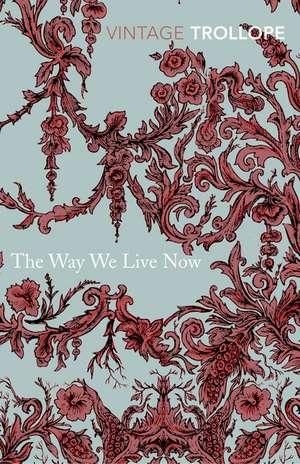
The Way We Live Now
Autor Anthony Trollopeen Limba Engleză Paperback – 5 ian 2012
Găsim în această carte o structură narativă panoramică, un tablou social vast care se ramifică dinspre centrul financiar al Londrei către saloanele aristocrației și dilemele intime ale unor personaje prinse în vârtejul schimbării. The Way We Live Now nu este doar un roman, ci o radiografie a unei epoci marcate de ascensiunea speculei și de erodarea valorilor tradiționale. Putem afirma că forța operei rezidă în capacitatea lui Anthony Trollope de a orchestra zeci de destine sub umbra impunătoare a lui Augustus Melmotte, un personaj a cărui avere fabuloasă și origine incertă oglindesc nesiguranța întregii societăți victoriene târzii. Stilul are ceva din precizia de observator a lui Dinah Birch, fără să fie o imitație — acolo unde studiile critice analizează mecanismele literare, Trollope le pune în mișcare printr-o proză densă, meditativă și profund morală. Față de idilismul regăsit în The Warden sau conflictele de rang din Doctor Thorne, acest roman marchează o trecere către o viziune mai sumbră și mai critică asupra condiției umane. Ritmul este unul așezat, specific marii literaturi clasice, permițând cititorului să pătrundă în mecanismele psihologice ale personajelor, cum este cazul lui Paul Montague, a cărui pendulare între onoare și dorință oferă o contrapondere umană cinismului politic. Merită menționat că, deși scrisă în limba engleză în 1875, satira lui Trollope rămâne surprinzător de actuală prin modul în care descrie mirajul îmbogățirii rapide.
Preț: 73.19 lei
Preț vechi: 98.26 lei
-26%
Carte disponibilă
Livrare economică 13-25 noiembrie
Livrare express 29 octombrie-04 noiembrie pentru 64.41 lei
Specificații
ISBN-10: 0099528665
Pagini: 880
Dimensiuni: 131 x 197 x 43 mm
Greutate: 0.63 kg
Editura: Vintage Publishing
V-ar putea interesa
-
 The House of MirthEdith Wharton-32%Preț: 49.54 lei72.86 lei
 -
 No NameWilkie Collins-22%Preț: 64.06 lei82.16 lei
 -
 Dr. Wortle's SchoolAnthony Trollope-19%Preț: 62.93 lei78.06 lei
 -
 North and SouthElizabeth Gaskell-31%Preț: 51.03 lei73.73 lei
 -
 The Tenant of Wildfell HallAnne Brontë-23%Preț: 62.93 lei81.26 lei
 -
 Wives and DaughtersElizabeth Gaskell-15%Preț: 70.35 lei82.42 lei
 -
 VilletteCharlotte Brontë-22%Preț: 64.39 lei82.25 lei
 -
 The ItalianAnn Radcliffe-16%Preț: 62.25 lei74.15 lei
 -
 Keep the Aspidistra FlyingGeorge Orwell-27%Preț: 52.63 lei71.65 lei
 -
 ShirleyCharlotte Brontë-22%Preț: 64.39 lei82.25 lei
 -
 Anthony Trollope: A Very Short IntroductionDinah Birch-19%Preț: 57.96 lei71.42 lei
 -
 The ItalianAnn RadcliffePreț: 61.41 lei
 -
 Orley FarmAnthony Trollope-16%Preț: 86.92 lei103.55 lei
 -
 The MoonstoneWilkie Collins-14%Preț: 57.95 lei67.67 lei
 -
 Green Tea: and Other Weird StoriesJ. Sheridan Le FanuPreț: 73.76 lei
 -
 A Sicilian RomanceAnn Radcliffe-18%Preț: 52.79 lei64.64 lei
 -
 Can You Forgive Her?Anthony Trollope-15%Preț: 76.30 lei89.65 lei
 -
 The Prime MinisterAnthony Trollope-16%Preț: 81.26 lei96.30 lei
 -
 Framley Parsonage: The Chronicles of BarsetshireAnthony Trollope-16%Preț: 61.98 lei73.96 lei
 -
 Barchester Towers: The Chronicles of BarsetshireAnthony Trollope-15%Preț: 57.05 lei67.13 lei
 -
 Home for a BunnyMargaret Wise Brown-18%Preț: 29.50 lei36.10 lei
 -
 The Way We Live NowTrollope AnthonyPreț: 73.89 lei
 -
 Lud-In-The-MistHope Mirrlees-25%Preț: 59.57 lei79.82 lei
 -
 The WardenAnthony TrollopePreț: 42.04 lei
 -
 An AutobiographyAnthony TrollopePreț: 53.02 lei
 -
 The Pentecost PapersFerdinand Mount-25%Preț: 103.43 lei138.23 lei
 -
 Is He Popenjoy?Anthony TrollopePreț: 70.21 lei
 -
 The Ragged Trousered PhilanthropistsRobert TressellPreț: 28.01 lei
 -
 Trollope, A: The Vicar of BullhamptonAnthony TrollopePreț: 44.94 lei
 -
 Preț: 34.20 lei
De ce să citești această carte
Recomandăm această lectură celor care apreciază proza clasică de mare anvergură. Veți descoperi o critică socială tăioasă, dar elegantă, care explorează cum lăcomia și ambiția pot reconfigura întreaga structură a unei societăți. Este un câștig pentru orice cititor care dorește să înțeleagă complexitatea morală a epocii victoriene dincolo de clișeele romantice, oferind o perspectivă lucidă asupra integrității într-o lume dominată de aparențe.
Despre autor
Anthony Trollope (1815–1882) a fost unul dintre cei mai prolifici și respectați romancieri britanici ai epocii victoriene. Funcționar public de carieră, a reușit să îmbine rigoarea administrativă cu o observație fină a moravurilor sociale. Este cunoscut în special pentru Chronicles of Barsetshire, unde a creat un univers provincial detaliat, dar și pentru romanele sale politice și sociale. Deși reputația sa a cunoscut un declin spre sfârșitul vieții, a fost redescoperit în secolul XX, fiind astăzi considerat un maestru al realismului psihologic și un cronicar neîntrecut al instituțiilor și cutumelor englezești.
Recenzii
Descriere scurtă
Trollope's magnificent and prescient satire about a dishonest financier who buys his way into a corrupt society, and throws it into turmoil.
When the Melmottes arrive in London everyone agrees their manners are wanting, their taste is excerable and their lineage and background decidedly shadowy. But their money is far from revolting, and city society quickly makes allowances for the mysterious financier and his family. Soon hearts, minds and family savings are swept into the whirl of Augustus Melmotte's lavish parties and exciting investment plans - but is it all an elaborate swindle?
Notă biografică
Descriere
The Way We Live Now—regarded by many as Anthony Trollope’s greatest novel—encompasses in its broad scope much of the business, political, social, and literary life of 1870s London. At its centre is the larger-than-life figure of Augustus Melmotte, a financier of uncertain background who rises to great heights over a financial speculation scheme involving plans for a railway in America. “I was instigated by what I conceived to be the commercial profligacy of the age,” Trollope wrote of this novel, and the work remains one of the world’s most ambitious fictionalized critiques of capitalism. It also provides unique insight into the operation of the late-Victorian literary world, into the dynamics of anti-Semitism in the Victorian period, and into a number of other subjects of continuing interest. More than that, it remains among the most readable of Trollope’s many novels.
The Way We Live Now was initially published in serialized form in monthly shilling parts that appeared between February 1874 and September 1875. The full work was first published in book form in 1875, in two volumes. That same year a one-volume edition was published by Harper & Brothers in the United States. Both 1875 publications in book form included the illustrations that Lionel Grimshaw Fawkes had prepared for the publication in serial form; it is the one-volume Harper & Brothers edition that is reproduced here.
This is one of a series from Broadview Press of facsimile reprint editions—editions that provide readers with a direct sense of these works as the Victorians themselves experienced them.