
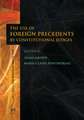
The Use of Foreign Precedents by Constitutional Judges: Hart Studies in Comparative Public Law
Editat de Professor Tania Groppi, Professor Marie-Claire Ponthoreauen Limba Engleză Hardback – 27 mar 2013
| Toate formatele și edițiile | Preț | Express |
|---|---|---|
| Paperback (1) | 288.07 lei 6-8 săpt. | +133.30 lei 6-10 zile |
| Bloomsbury Publishing – 11 iun 2014 | 288.07 lei 6-8 săpt. | +133.30 lei 6-10 zile |
| Hardback (1) | 594.44 lei 6-8 săpt. | |
| Bloomsbury Publishing – 27 mar 2013 | 594.44 lei 6-8 săpt. |
Din seria Hart Studies in Comparative Public Law
- 26%
 Preț: 278.62 lei
 - 22%
 Preț: 314.53 lei
 - 22%
 Preț: 333.02 lei
 -
 Preț: 392.19 lei
 - 27%
 Preț: 397.61 lei
 - 26%
 Preț: 258.77 lei
 - 22%
 Preț: 453.38 lei
 - 25%
 Preț: 234.49 lei
 - 26%
 Preț: 278.62 lei
 - 26%
 Preț: 281.46 lei
 - 31%
 Preț: 359.53 lei
 - 26%
 Preț: 280.51 lei
 - 26%
 Preț: 278.43 lei
 - 26%
 Preț: 233.06 lei
 - 27%
 Preț: 176.89 lei
 - 33%
 Preț: 593.17 lei
 - 34%
 Preț: 926.63 lei
 - 22%
 Preț: 392.05 lei
 - 25%
 Preț: 288.07 lei
 - 26%
 Preț: 259.15 lei
 - 21%
 Preț: 324.59 lei
 - 22%
 Preț: 331.37 lei
 - 25%
 Preț: 243.25 lei
 - 22%
 Preț: 331.37 lei
 - 33%
 Preț: 989.32 lei
 - 26%
 Preț: 279.93 lei
 - 26%
 Preț: 246.62 lei
 - 22%
 Preț: 331.76 lei
 - 26%
 Preț: 271.93 lei
 - 26%
 Preț: 272.33 lei
Preț: 594.44 lei
Preț vechi: 888.50 lei
-33% Nou
Puncte Express: 892
Preț estimativ în valută:
105.21€ • 122.65$ • 92.02£
105.21€ • 122.65$ • 92.02£
Carte tipărită la comandă
Livrare economică 21 ianuarie-04 februarie 26
Preluare comenzi: 021 569.72.76
Specificații
ISBN-13: 9781849462716
ISBN-10: 1849462712
Pagini: 470
Dimensiuni: 171 x 244 x 25 mm
Greutate: 0.98 kg
Ediția:New.
Editura: Bloomsbury Publishing
Colecția Hart Publishing
Seria Hart Studies in Comparative Public Law
Locul publicării:London, United Kingdom
ISBN-10: 1849462712
Pagini: 470
Dimensiuni: 171 x 244 x 25 mm
Greutate: 0.98 kg
Ediția:New.
Editura: Bloomsbury Publishing
Colecția Hart Publishing
Seria Hart Studies in Comparative Public Law
Locul publicării:London, United Kingdom
V-ar putea interesa
-
 -14%Preț: 513.85 lei597.50 lei
 -
 The Free Speech CenturyGeoffrey R. Stone-16%Preț: 148.64 lei177.46 lei
 -
 Constitutional Democracy in Crisis?Mark A. Graber-12%Preț: 314.78 lei359.38 lei
 -
 -34%Preț: 817.14 lei1230.85 lei
 -
 Preț: 106.25 lei
 -
 The Safest Shield: Lectures, Speeches and EssaysLord Igor Judge-30%Preț: 361.33 lei518.57 lei
 -
 -34%Preț: 553.87 lei836.13 lei
 -
 -34%Preț: 556.98 lei838.04 lei
 -
 -34%Preț: 587.31 lei884.09 lei
 -
 -31%Preț: 486.74 lei701.06 lei
 -
 -31%Preț: 486.42 lei700.85 lei
 -
 European Union LawKoen LenaertsPreț: 348.51 lei
 -
 Staatsrecht IIHeinrich LangPreț: 270.80 lei
 -
 Der Artenschutz im BebauungsplanverfahrenEckart ScharmerPreț: 329.12 lei
 -
 BaurechtJulian KrüperPreț: 198.70 lei
 -
 BaugesetzbuchWolfgang Schrödter-15%Preț: 1536.03 lei1807.09 lei
Caracteristici
This book is the result of the study of an international interest group of the International Association of Constitutional Law.The interest group conducted a survey of the use of foreign precedents by Supreme and Constitutional Courts in deciding constitutional cases. The purpose of the survey was to determine - through empirical analysis employing both quantitative and qualitative indicators - to what extent foreign case law is cited.The results of the study give us the best evidence yet of the existence, and extent, of a transnational constitutional dialogue between courts.
Notă biografică
Tania Groppi is Professor of Public Law at the University of Siena.Marie-Claire Ponthoreau is Professor of Constitutional Law and Comparative Law at theUniversity of Bordeaux.
Cuprins
Introduction. The Methodology of the Research: How to Assess the Reality of Transjudicial Communication? Tania Groppi and Marie-Claire PonthoreauPart I 1. Reference to Foreign Precedents by the Australian High Court: A Matter of Method Cheryl Saunders and Adrienne Stone2. Canada: Protecting Rights in a 'Worldwide Rights Culture'. An Empirical Study of the Use of Foreign Precedents by the Supreme Court of Canada (1982-2010) Gianluca Gentili3. India: A 'Critical' Use of Foreign Precedents in Constitutional Adjudication Valentina Rita Scotti4. The Supreme Court of Ireland and the Use of Foreign Precedents: The Value of Constitutional History Cristina Fasone5. Israel: Creating a Constitution-The Use of Foreign Precedents by the Supreme Court (1994-2010) Suzie Navot6. Namibia: The Supreme Court as a Foreign Law Importer Irene Spigno7. South Africa: Teaching an 'Old Dog' New Tricks? An Empirical Studyof the Use of Foreign Precedents by the South African Constitutional Court (1995-2010) Christa RautenbachPart II 8. Austria: Non-cosmopolitan, but Europe-friendly-The Constitutional Court's Comparative Approach Anna Gampervi Contents9. Lifting the Constitutional Curtain? The Use of Foreign Precedent by the German Federal Constitutional Court Stefan Martini10. Hungary: Unsystematic and Incoherent Borrowing of Law. The Use of Foreign Judicial Precedents in the Jurisprudence of the Constitutional Court, 1999-2010 Zoltán Szente11. A Gap between the Apparent and Hidden Attitudes of the Supreme Court of Japan towards Foreign Precedents Akiko Ejima12. Mexico: Struggling for an Open View In Constitutional Adjudication Eduardo Ferrer Mac-Gregor and Rubén Sánchez Gil13. Romania: Analogical Reasoning as a Dialectical Instrument Elena Simina Tanasescu and Stefan Deaconu14. Russia: Foreign Transplants in the Russian Constitution and Invisible Foreign Precedents in Decisions of the Russian Constitutional Court Sergey Belov15. Judges as Discursive Agent: The Use of Foreign Precedents by the Constitutional Court of Taiwan Wen-Chen Chang and Jiunn-Rong Yeh16. United States of America: First Cautious Attempts of Judicial Use of Foreign Precedents in the Supreme Court's Jurisprudence Angioletta SpertiConclusion. The Use of Foreign Precedents by Constitutional Judges: A Limited Practice, An Uncertain Future Tania Groppi and Marie-Claire Ponthoreau
Recenzii
The collected data for each jurisdiction makes for engaging reading. It reveals details of the extent of visible (and sometimes implied) comparative activity that each of the courts displays in its jurisprudence. It also amounts to an assessment of the successes and shortcomings of the use of foreign precedent (in terms of the level of reciprocal influence of well-functioning constitutional systems) by judges that are more or less inhibited by their judicial culture to do so.The editors' concluding chapter conveniently provides the reader with a comparative overview, both of the quantitative and qualitative results of the country reporters, and a tentative perspective on the future of comparative judicial practice in constitutional cases.The purpose and goals of the project are met by the book: we now have a clearer picture of how some of the most prominent constitutional courts deal (or desist from dealing) with comparable judgments in other countries.
The editorial decisions behind the individual reports are explained in the introductory chapter and ensure that each report adopts the same format. Although this is repetitive, the clear advantage is that it makes it easy to compare the approaches taken by different courts. This also highlights the hero of the volume: the empirical data within each report.The volume also provides valuable evidence on other common assumptions about judicial comparativism.The volume nevertheless represents a refreshing approach to complex questions raised in debates about constitutional borrowing, transjudicial communication, or the migration of constitutional ideas. As the editors point out, studies that catalogue the different approaches adopted by constitutional or supreme courts in their use of foreign law remain relatively rare. For this reason, The Use of Foreign Precedents by Constitutional Judges will be essential reading for scholars seeking to refresh the debates about using foreign law.
The work by Groppi and Ponthoreau is the result of a well-structured project and relies on sound methodology, which guarantees that all relevant issues are addressed and empirically verified...The individual chapters are also well written, thoroughly researched and easy to understand thanks to the use of various tables and graphs. (Translated from the original German.)
The editorial decisions behind the individual reports are explained in the introductory chapter and ensure that each report adopts the same format. Although this is repetitive, the clear advantage is that it makes it easy to compare the approaches taken by different courts. This also highlights the hero of the volume: the empirical data within each report.The volume also provides valuable evidence on other common assumptions about judicial comparativism.The volume nevertheless represents a refreshing approach to complex questions raised in debates about constitutional borrowing, transjudicial communication, or the migration of constitutional ideas. As the editors point out, studies that catalogue the different approaches adopted by constitutional or supreme courts in their use of foreign law remain relatively rare. For this reason, The Use of Foreign Precedents by Constitutional Judges will be essential reading for scholars seeking to refresh the debates about using foreign law.
The work by Groppi and Ponthoreau is the result of a well-structured project and relies on sound methodology, which guarantees that all relevant issues are addressed and empirically verified...The individual chapters are also well written, thoroughly researched and easy to understand thanks to the use of various tables and graphs. (Translated from the original German.)
Descriere
In 2007 the International Association of Constitutional Law established an Interest Group to conduct a survey of the use of foreign precedents by Supreme and Constitutional Courts. This results of the survey, presented here, gives us the best evidence yet of the existence, and extent, of a transnational constitutional dialogue between courts.