
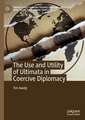
The Use and Utility of Ultimata in Coercive Diplomacy: Twenty-first Century Perspectives on War, Peace, and Human Conflict
Autor Tim Sweijsen Limba Engleză Paperback – 13 mai 2024
| Toate formatele și edițiile | Preț | Express |
|---|---|---|
| Paperback (1) | 863.49 lei 39-44 zile | |
| Springer – 13 mai 2024 | 863.49 lei 39-44 zile | |
| Hardback (1) | 859.03 lei 6-8 săpt. | |
| Springer International Publishing – 13 mai 2023 | 859.03 lei 6-8 săpt. |

Preț: 863.49 lei
Preț vechi: 948.89 lei
-9% Nou
Puncte Express: 1295
Preț estimativ în valută:
152.84€ • 177.97$ • 133.48£
152.84€ • 177.97$ • 133.48£
Carte tipărită la comandă
Livrare economică 19-24 ianuarie 26
Preluare comenzi: 021 569.72.76
Specificații
ISBN-13: 9783031213052
ISBN-10: 303121305X
Pagini: 312
Ilustrații: XV, 293 p. 6 illus.
Dimensiuni: 148 x 210 x 17 mm
Greutate: 0.41 kg
Ediția:2023
Editura: Springer
Seria Twenty-first Century Perspectives on War, Peace, and Human Conflict
Locul publicării:Cham, Switzerland
ISBN-10: 303121305X
Pagini: 312
Ilustrații: XV, 293 p. 6 illus.
Dimensiuni: 148 x 210 x 17 mm
Greutate: 0.41 kg
Ediția:2023
Editura: Springer
Seria Twenty-first Century Perspectives on War, Peace, and Human Conflict
Locul publicării:Cham, Switzerland
Cuprins
Chapter 1: The Use and Utility of Ultimata in Coercive Diplomacy.- Chapter 2: A Genealogy of Ultimata.- Chapter 3: Ultimata in Coercive Diplomacy.- Chapter 4: The Dataset: Data Collection and Coding Procedures.- Chapter 5: Ultimata 1920-2020: A Chronological Survey.- Chapter 6: Ultimata 1920-2020: Patterns and Findings.- Chapter 7: A Typology of Ultimata.- Chapter 8: The Dictate.- Chapter 9: The Conditional War Declaration.- Chapter 10: The Bluff.- Chapter 11: The Brinkmanship Ultimatum.- Chapter 12: Findings and Conclusions.
Notă biografică
Tim Sweijs is the Director of Research at The Hague Centre for Strategic Studies and a Senior Research Fellow at the Netherlands’ War Studies Research Centre. He advises governments and international organisations and has published on international security, contemporary war, coercion, foresight, and defence planning.
Textul de pe ultima copertă
“This nuanced, sophisticated, and pathbreaking study of ultimata from ancient times to the present explores the diverse reasons behind their issuance and mixed record of success. Sweijs examines the phenomenon of threat and escalation more generally and offers original insights relevant to the theory and practice of international relations.”
— Richard Ned Lebow, Presidential Professor Emeritus at Dartmouth College, USA
“This impressive work demonstrates that ultimata are far more successful than is commonly believed. This is a major and potentially troubling fi nding that makes this book a “must-read” for everyone with an interest in in coercion and coercive diplomacy.”
— Peter Viggo Jakobsen, Professor at the Royal Danish Defence College Center for War Studies,
University of Southern Denmark, Denmark Ultimata feature as a core concept in the coercive diplomacy scholarship. Conventional wisdom holds that pursuing an ultimatum strategy is risky.This book shows that the conventional wisdom is wrong on the basis of a new dataset of 87 ultimata issued from 1920–2020. It provides a historical examination of ultimata in Western strategic, political, and legal thought since antiquity until the present, and offers a four-pronged typology that explains their various purposes and effects: 1) the dictate, 2) the conditional war declaration, 3) the bluff, and 4) the brinkmanship ultimatum. The book yields a better understanding of interstate threat behaviour at a time of surging competition. Background materials can be consulted at www.coercivediplomacy.com. Tim Sweijs is the Director of Research at The Hague Centre for Strategic Studies and a Senior Research Fellow at the Netherlands’ War Studies Research Centre. He advises governments and international organisations and has published on international security, contemporary war, coercion, foresight, and defence planning.
— Richard Ned Lebow, Presidential Professor Emeritus at Dartmouth College, USA
“This impressive work demonstrates that ultimata are far more successful than is commonly believed. This is a major and potentially troubling fi nding that makes this book a “must-read” for everyone with an interest in in coercion and coercive diplomacy.”
— Peter Viggo Jakobsen, Professor at the Royal Danish Defence College Center for War Studies,
University of Southern Denmark, Denmark Ultimata feature as a core concept in the coercive diplomacy scholarship. Conventional wisdom holds that pursuing an ultimatum strategy is risky.This book shows that the conventional wisdom is wrong on the basis of a new dataset of 87 ultimata issued from 1920–2020. It provides a historical examination of ultimata in Western strategic, political, and legal thought since antiquity until the present, and offers a four-pronged typology that explains their various purposes and effects: 1) the dictate, 2) the conditional war declaration, 3) the bluff, and 4) the brinkmanship ultimatum. The book yields a better understanding of interstate threat behaviour at a time of surging competition. Background materials can be consulted at www.coercivediplomacy.com. Tim Sweijs is the Director of Research at The Hague Centre for Strategic Studies and a Senior Research Fellow at the Netherlands’ War Studies Research Centre. He advises governments and international organisations and has published on international security, contemporary war, coercion, foresight, and defence planning.
Caracteristici
Focuses on ultimata in the context of interstate coercion Combines political science, diplomatic history and strategic studies to understand strategic bargaining Presents a large evidentiary base based on ultimata issued between 1920 and 2020