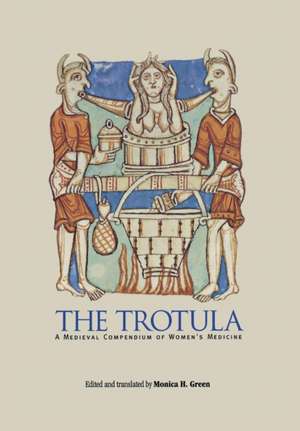
The Trotula
Editat de Monica H Greenen Limba Engleză Hardback – 16 apr 2001
Structura și metodologia acestui volum, editat de Monica H Green, redefinesc înțelegerea medicinei medievale prin deconstrucția mitului „Trotulei” ca autor unic. Descoperim aici că ceea ce istoria a considerat timp de secole a fi opera unei singure figuri legendare din Salerno este, în realitate, un ansamblu de trei tratate distincte: „On the Conditions of Women”, „On the Treatments for Women” și „On Women's Cosmetics”. Metodologia riguroasă aplicată de Green implică o ediție critică a textului latin standardizat în secolul al XIII-lea, oferind în paralel traducerea în limba engleză pentru a facilita accesul cercetătorilor la sursele primare. Remarcăm modul în care textele reflectă o sinteză culturală complexă, integrând teoriile și substanțele medicinale provenite din lumea arabă cu tradițiile empirice din sudul Italiei. Analiza evidențiază o dinamică de gen surprinzătoare: deși Trota din Salerno este confirmată ca autoare a tratatului despre tratamente, celelalte două secțiuni poartă amprenta autoratului masculin, indicând profesionalizarea timpurie a cunoștințelor despre corpul feminin. Această ediție din The Middle Ages Series a editurii University of Pennsylvania Press este prima care restabilește integritatea filologică a compendiului după mai bine de patru sute de ani. Lucrarea este comparabilă cu The Knowing of Woman's Kind in Childing de A. Barratt în rigurozitatea editării textelor ginecologice, dar actualizat pentru contextul tranziției de la medicina practică feminină la cea academică, dominată de bărbați. Față de studiile generale precum Arabian Medicine and its Influence on the Middle Ages: Volume I, volumul de față se concentrează strict pe intersecția dintre gen, traducerile din arabă și realitățile sociale ale Italiei secolului al XII-lea, oferind o perspectivă micro-istorică esențială.
Preț: 562.45 lei
Preț vechi: 631.97 lei
-11%
Carte tipărită la comandă
Livrare economică 03-17 decembrie
Specificații
ISBN-10: 0812235894
Pagini: 320
Ilustrații: 1
Dimensiuni: 164 x 244 x 28 mm
Greutate: 0.68 kg
Editura: University of Pennsylvania Press
Locul publicării:United States
V-ar putea interesa
-
 The DictatorsRichard Overy-17%Preț: 133.61 lei161.17 lei
 -
 Alexander and the East: The Tragedy of TriumphA.B. Bosworth-33%Preț: 636.35 lei946.99 lei
 -
 Paths of Glory: The French Army, 1914-18Anthony Clayton-27%Preț: 68.32 lei93.11 lei
 -
 Heinemann Advanced History: Mussolini & ItalyEdward TownleyPreț: 338.71 lei
 -
 Preț: 325.01 lei
 -
 The Crimean WarClive PontingPreț: 118.37 lei
 -
 April BloodLauro Martines-37%Preț: 76.81 lei121.73 lei
 -
 Reviewing the Cold War: Approaches, Interpretations, TheoryOdd Arne Westad-15%Preț: 427.82 lei503.31 lei
 -
 Anatomy of a Crusade, 1213-1221James M PowellPreț: 291.12 lei
 -
 The Hundred Years War, Volume 1Jonathan Sumption-19%Preț: 468.13 lei577.94 lei
 -
 Fallen BodiesDyan ElliottPreț: 293.04 lei
 -
 Maurice's StrategikonGeorge T. DennisPreț: 227.05 lei
 -
 The Medieval Craft of MemoryMary CarruthersPreț: 293.16 lei
 -
 The Royal Hunt in Eurasian HistoryThomas T Allsen-11%Preț: 514.68 lei578.30 lei
 -
 Preț: 432.37 lei
 -
 Preț: 348.21 lei
 -
 Eating Disorders in Contemporary French Women′s WritingLucille Cairns-27%Preț: 849.63 lei1163.87 lei
 -
 Preț: 232.01 lei
 -
 Feeling Sick – The Early Years of AIDS in SpainDean AllbrittonPreț: 379.91 lei
 -
 Reimagining the Human in Contemporary French Science FictionChristina Lord-27%Preț: 741.39 lei1015.61 lei
 -
 Preț: 70.83 lei
 -
 Peter WomersleyJacksonPreț: 279.98 lei
 -
 The CrusadesMichael Paine-30%Preț: 55.41 lei79.42 lei
De ce să citești această carte
Această ediție critică este indispensabilă pentru studenții și cercetătorii interesați de istoria medicinei și studiile de gen. Cititorul câștigă acces la cel mai influent compendiu medical despre femei din Europa medievală, beneficiind de traducerea modernă a Monicăi H Green. Este o resursă fundamentală care clarifică distincția dintre mitul autoarei Trota și realitatea producției de texte medicale în faimosul centru de învățare de la Salerno.