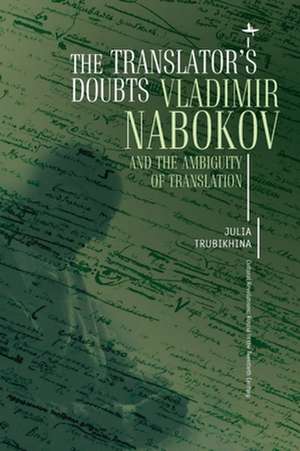
The Translator's Doubts: Vladimir Nabokov and the Ambiguity of Translation
Autor Julia Trubikhinaen Limba Engleză Hardback – 15 aug 2015
Preț: 502.50 lei
Preț vechi: 669.96 lei
-25%
Puncte Express: 754
Carte disponibilă
Livrare economică 23 octombrie-06 noiembrie
Livrare express 09-15 octombrie pentru 103.88 lei
Livrare prin curier în România Termenul estimat este afișat lângă disponibilitate.
Transport gratuit pentru acest produs Plată online sau ramburs, în funcție de opțiunile comenzii.
Retur gratuit în 14 zile Comandă securizată și suport în română.
Specificații
ISBN-13: 9781618112606
ISBN-10: 1618112600
Pagini: 252
Dimensiuni: 159 x 238 x 18 mm
Greutate: 0.53 kg
Editura: Academic Studies Press
Colecția Academic Studies Press
Locul publicării:Boston, MA, United States
ISBN-10: 1618112600
Pagini: 252
Dimensiuni: 159 x 238 x 18 mm
Greutate: 0.53 kg
Editura: Academic Studies Press
Colecția Academic Studies Press
Locul publicării:Boston, MA, United States
V-ar putea interesa
-
 Tolkien and the Great WarJohn GarthPreț: 78.74 lei
 -
 Preț: 77.76 lei
 -
 The Western Lit Survival KitSandra Newman-52%Preț: 57.23 lei119.15 lei
 -
 The Road to Middle-earthTom ShippeyPreț: 79.63 lei
 -
 The Art of DiscworldPaul Kidby-25%Preț: 119.25 lei159.24 lei
 -
 Raymond Chandler's Philip Marlowe: The Hard-Boiled Detective TransformedJohn Paul AthanasourelisPreț: 294.87 lei
 -
 Preț: 121.81 lei
 -
 London: An Illustrated Literary CompanionRosemary Gray-34%Preț: 55.39 lei84.54 lei
 -
 The Daphne Du Maurier CompanionDaphne du Maurier-26%Preț: 74.25 lei99.94 lei
 -
 Dannie AbseDannie AbsePreț: 107.81 lei
 -
 RomeGlyn Pursglove-22%Preț: 36.60 lei47.01 lei
 -
 DublinJohn Wyse Jackson-22%Preț: 36.60 lei47.01 lei
Recenzii
“An insightful and sophisticated examination of an important part of Nabokov’s legacy that sheds light on his entire oeuvre, written with elegance and wit.”
“Nabokov was repelled and fascinated by what he called “the parrot’s screech” and Trubikhina does his ambivalence justice in this highly informed analysis of the metaphysical dilemma played out over three crucial Nabokovian translations: the Russianizing of Alice in Wonderland, the Englishing (or refusal to English) of Eugene Onegin and the “cinemizing” of Lolita. Her dexterous fusing of translation studies and film studies—via theories of analogy and adaptation—builds fruitfully on Nabokov’s ever-evolving perspective to offer new vistas to both fields."
"The Translator’s Doubts is a striking departure from the traditional studies of Nabokov’s work as a translator. Not only does it mark a significant shift in critical perspective, but it also uses Nabokov as a means to a greater end — a meditation on “literary history and theory, philosophy and interpretation” (11) — with value far beyond the world of Nabokov criticism. . . .Each chapter, even taken separately, adds hugely to the corpus of Nabokov criticism, from philology and archival scholarship to new theoretical perspectives. [Trubikhina’s] sophisticated and insightful work will surely become one of the touchstone texts on Nabokov and translation for years to come."
“Nabokov was repelled and fascinated by what he called “the parrot’s screech” and Trubikhina does his ambivalence justice in this highly informed analysis of the metaphysical dilemma played out over three crucial Nabokovian translations: the Russianizing of Alice in Wonderland, the Englishing (or refusal to English) of Eugene Onegin and the “cinemizing” of Lolita. Her dexterous fusing of translation studies and film studies—via theories of analogy and adaptation—builds fruitfully on Nabokov’s ever-evolving perspective to offer new vistas to both fields."
"The Translator’s Doubts is a striking departure from the traditional studies of Nabokov’s work as a translator. Not only does it mark a significant shift in critical perspective, but it also uses Nabokov as a means to a greater end — a meditation on “literary history and theory, philosophy and interpretation” (11) — with value far beyond the world of Nabokov criticism. . . .Each chapter, even taken separately, adds hugely to the corpus of Nabokov criticism, from philology and archival scholarship to new theoretical perspectives. [Trubikhina’s] sophisticated and insightful work will surely become one of the touchstone texts on Nabokov and translation for years to come."
Cuprins
Acknowledgments
Introduction
Chapter 1: Nabokov’s Beginnings: “Ania” in Wonderland or “Does Asparagus Grow in a Pile of Manure?”
Chapter 2: The Novel on Translation and “über-Translation”: Nabokov’s Pale Fire and Eugene Onegin
Chapter 3: “Cinemizing” as Translation: Nabokov’s Screenplay of Lolita and Stanley Kubrick’s and Adrian Lyne’s Cinematic Versions
Conclusion: Vladimir Nabokov within the Russian and Western Traditions of Translation
Selected Bibliography
Index
Chapter 1: Nabokov’s Beginnings: “Ania” in Wonderland or “Does Asparagus Grow in a Pile of Manure?”
Chapter 2: The Novel on Translation and “über-Translation”: Nabokov’s Pale Fire and Eugene Onegin
Chapter 3: “Cinemizing” as Translation: Nabokov’s Screenplay of Lolita and Stanley Kubrick’s and Adrian Lyne’s Cinematic Versions
Conclusion: Vladimir Nabokov within the Russian and Western Traditions of Translation
Selected Bibliography
Index
Notă biografică
Julia Trubikhina received her PhD in Comparative Literature with a specialization in Slavic studies from New York University. She teaches in the Department of Classics and Oriental Studies at Hunter College, CUNY. In addition to articles and reviews in academic journals (most recently, "A Discrete Amalgam: New York Poets from the Former Soviet Union" in Canadian-American Slavic Studies), Julia Trubikhina (as Julia Trubikhina-Kunina) also published translations and contributed original poetry to Russian, European, and American anthologies and literary journals. She is currently working on two translation projects: a bilingual edition of poetry by Vladimir Aristov for Ugly Duckling Presse and a volume of poetry and prose by Elena Shvarts.