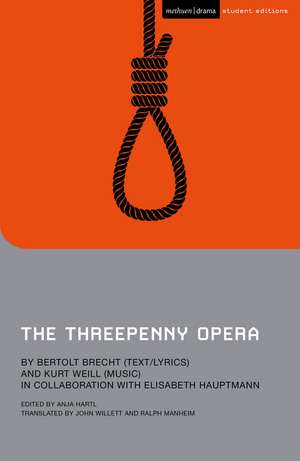
The Threepenny Opera: Student Editions
Autor Bertolt Brecht Editat de Anja Hartl Traducere de John Willett, Ralph Manheim Autor Kurt Weill Cu Elisabeth Hauptmannen Limba Engleză Paperback – 10 feb 2022
Based on the eighteenth-century The Beggar's Opera by John Gay, the play is a satire on the bourgeois society of the Weimar Republic, but set in a mock-Victorian Soho.
With Kurt Weill's music, which was one of the earliest and most successful attempts to introduce the jazz idiom into the theatre, it became a popular hit throughout the western world.
This new edition is published here in John Willett and Ralph Manhein's classic translation with commentary and notes by Anja Hartl.
Din seria Student Editions
-
 Preț: 43.16 lei
 - 10%
 Preț: 96.06 lei
 - 10%
 Preț: 80.75 lei
 - 13%
 Preț: 76.52 lei
 - 19%
 Preț: 66.51 lei
 - 11%
 Preț: 87.16 lei
 - 10%
 Preț: 80.99 lei
 - 13%
 Preț: 76.52 lei
 - 11%
 Preț: 80.02 lei
 - 11%
 Preț: 93.54 lei
 - 11%
 Preț: 80.45 lei
 - 11%
 Preț: 79.25 lei
 -
 Preț: 93.98 lei
 - 19%
 Preț: 78.85 lei
 - 11%
 Preț: 94.16 lei
 - 13%
 Preț: 90.86 lei
 - 12%
 Preț: 77.61 lei
 - 11%
 Preț: 94.88 lei
 - 11%
 Preț: 80.08 lei
 - 13%
 Preț: 90.90 lei
 - 10%
 Preț: 82.44 lei
 - 13%
 Preț: 76.33 lei
 - 9%
 Preț: 67.50 lei
 - 10%
 Preț: 66.28 lei
 - 10%
 Preț: 73.47 lei
 - 13%
 Preț: 90.63 lei
 - 16%
 Preț: 80.15 lei
 - 23%
 Preț: 74.01 lei
 - 36%
 Preț: 57.51 lei
 - 11%
 Preț: 80.62 lei
 - 12%
 Preț: 91.70 lei
 - 11%
 Preț: 80.51 lei
 - 10%
 Preț: 73.63 lei
 - 10%
 Preț: 66.44 lei
 - 16%
 Preț: 94.89 lei
 - 12%
 Preț: 91.31 lei
 - 11%
 Preț: 79.89 lei
 - 10%
 Preț: 66.68 lei
 - 11%
 Preț: 80.21 lei
 - 11%
 Preț: 80.42 lei
 -
 Preț: 348.35 lei
 - 18%
 Preț: 79.98 lei
 - 25%
 Preț: 76.98 lei
 - 24%
 Preț: 77.90 lei
 - 18%
 Preț: 79.98 lei
 - 16%
 Preț: 80.77 lei
Preț: 92.67 lei
Preț vechi: 107.80 lei
-14%
Puncte Express: 139
Carte disponibilă
Livrare economică 16-30 noiembrie
Livrare express 30 octombrie-05 noiembrie pentru 32.23 lei
Livrare prin curier în România Termenul estimat este afișat lângă disponibilitate.
Transport gratuit de la 400.00 lei Plată online sau ramburs, în funcție de opțiunile comenzii.
Retur gratuit în 14 zile Comandă securizată și suport în română.
Specificații
ISBN-13: 9781350205284
ISBN-10: 1350205281
Pagini: 152
Dimensiuni: 124 x 193 x 8 mm
Greutate: 0.15 kg
Editura: Bloomsbury Publishing
Colecția Methuen Drama
Seria Student Editions
Locul publicării:London, United Kingdom
ISBN-10: 1350205281
Pagini: 152
Dimensiuni: 124 x 193 x 8 mm
Greutate: 0.15 kg
Editura: Bloomsbury Publishing
Colecția Methuen Drama
Seria Student Editions
Locul publicării:London, United Kingdom
V-ar putea interesa
-
 Preț: 60.48 lei
 -
 Acting Out Loud: Christian Skits for All OccasionsS. E. Thomas M. a.Preț: 104.00 lei
 -
 Preț: 34.01 lei
 -
 Street MechanicPreacher's SonPreț: 52.46 lei
 -
 Written to ToilMusab MomanyPreț: 84.08 lei
 -
 The GravediggerJoseph ZettelmaierPreț: 81.68 lei
 -
 Voices from the ValleyGarcia Elementary School's 2013-2014 FouPreț: 96.76 lei
 -
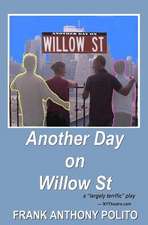 Another Day on Willow StFrank Anthony PolitoPreț: 51.89 lei
 -
 Preț: 98.72 lei
 -
 Where the Blood MixesKevin LoringPreț: 89.53 lei
 -
 Preț: 224.65 lei
 -
 The Brecht Yearbook / Das Brecht–Jahrbuch 48Markus WessendorfPreț: 405.19 lei
 -
 On EmotionMick Gordon-25%Preț: 74.70 lei99.86 lei
Cuprins
Chronology
Contexts
- Historical, social and cultural
- Political and social climate of the 1920s
- Cultural context: the Roaring '20s
- Significance of the play for Brecht and for political theatre
- 18th century context
- 20th century context
- Britain vs. Germany; London/East London
Genres
- Opera/music/theatre - a new theatrical genre
- Adaptation - John Gay, The Beggar's Opera
- Hybridity: low- and highbrow, emphasis on fun, entertainment in Brechtian theatre
- Satire
Themes
- Who is who? Bourgeois and/or beggar?
- Role of the institutions (police, royal family, state)
- Corruption, money
- Exploitation, human trade, poverty
- Morality, asocial vs. social
- Love and sexuality, prostitution
- Resistance and change
- Which opportunities for change are envisioned by the play?
Characters
Male characters
- Peachum empire
- Macheath
- Tigerbrown
Female characters and sexual politics of the play
- Mrs Peachum
- Polly
- Jenny
Play as performance
- Brechtian principles of theatre-making
> emphasis on dialectical theatre
> theatricality
> actor-audience relationship
> deus-ex-machina ending
- Music
> Kurt Weill's composition
> Brechtian opera
> The significance of the songs
Academic debate
- Central strands in scholarship (comparative readings, focus on music and operatic genre)
Production history
- German productions (Berliner Ensemble; new production announced for January 2021)
- English productions
- International success (and problems which ensued: misinterpretation, commercialisation, etc.)
- Der Dreigroschenprozess (The Threepenny Trial by Bertolt Brecht)
- Simon Stephens's recent new version at the National Theatre, UK
- Joachim Lang's film Mackie Messer - Brechts Dreigroschenfilm
Behind the scenes
Interview with playwright Simon Stephens
Further reading and viewing
THE THREEPENNY OPERA
Additional texts
Notes
Contexts
- Historical, social and cultural
- Political and social climate of the 1920s
- Cultural context: the Roaring '20s
- Significance of the play for Brecht and for political theatre
- 18th century context
- 20th century context
- Britain vs. Germany; London/East London
Genres
- Opera/music/theatre - a new theatrical genre
- Adaptation - John Gay, The Beggar's Opera
- Hybridity: low- and highbrow, emphasis on fun, entertainment in Brechtian theatre
- Satire
Themes
- Who is who? Bourgeois and/or beggar?
- Role of the institutions (police, royal family, state)
- Corruption, money
- Exploitation, human trade, poverty
- Morality, asocial vs. social
- Love and sexuality, prostitution
- Resistance and change
- Which opportunities for change are envisioned by the play?
Characters
Male characters
- Peachum empire
- Macheath
- Tigerbrown
Female characters and sexual politics of the play
- Mrs Peachum
- Polly
- Jenny
Play as performance
- Brechtian principles of theatre-making
> emphasis on dialectical theatre
> theatricality
> actor-audience relationship
> deus-ex-machina ending
- Music
> Kurt Weill's composition
> Brechtian opera
> The significance of the songs
Academic debate
- Central strands in scholarship (comparative readings, focus on music and operatic genre)
Production history
- German productions (Berliner Ensemble; new production announced for January 2021)
- English productions
- International success (and problems which ensued: misinterpretation, commercialisation, etc.)
- Der Dreigroschenprozess (The Threepenny Trial by Bertolt Brecht)
- Simon Stephens's recent new version at the National Theatre, UK
- Joachim Lang's film Mackie Messer - Brechts Dreigroschenfilm
Behind the scenes
Interview with playwright Simon Stephens
Further reading and viewing
THE THREEPENNY OPERA
Additional texts
Notes