
The Three Theban Plays
Autor Sophocles Traducere de F. Storren Limba Engleză Paperback
The Theban plays consist of three plays: Oedipus the King (also called Oedipus Tyrannus or by its Latin title Oedipus Rex), Oedipus at Colonus and Antigone. All three plays concern the fate of Thebes during and after the reign of King Oedipus. They have often been published under a single cover. Sophocles, however, wrote the three plays for separate festival competitions, many years apart. Not only are the Theban plays not a true trilogy (three plays presented as a continuous narrative) but they are not even an intentional series and contain some inconsistencies among them. He also wrote other plays having to do with Thebes, such as the Epigoni, of which only fragments have survived.
Subjects
Each of the plays relates to the tale of the mythological Oedipus, who killed his father and married his mother without knowledge that they were his parents. His family is fated to be doomed for three generations.
In Oedipus the King, Oedipus is the protagonist. Oedipus' infanticide is planned by his parents, Laius and Jocasta, to avert him fulfilling a prophecy; in truth, the servant entrusted with the infanticide passes the infant on through a series of intermediaries to a childless couple, who adopt him not knowing his history. Oedipus eventually learns of the Delphic Oracle's prophecy of him, that he would kill his father and marry his mother; Oedipus attempts to flee his fate without harming his parents (at this point, he does not know that he is adopted). Oedipus meets a man at a crossroads accompanied by servants; Oedipus and the man fought, and Oedipus killed the man. (This man was his father, Laius, not that anyone apart from the gods knew this at the time). He becomes the ruler of Thebes after solving the riddle of the sphinx and in the process, marries the widowed Queen, his mother Jocasta. Thus the stage is set for horror. When the truth comes out, following from another true but confusing prophecy from Delphi, Jocasta commits suicide, Oedipus blinds himself and leaves Thebes, and the children are left to sort out the consequences themselves (which provides the grounds for the later parts of the cycle of plays).
In Oedipus at Colonus, the banished Oedipus and his daughter Antigone arrive at the town of Colonus where they encounter Theseus, King of Athens. Oedipus dies and strife begins between his sons Polyneices and Eteocles.
In Antigone, the protagonist is Oedipus' daughter, Antigone. She is faced with the choice of allowing her brother Polyneices' body to remain unburied, outside the city walls, exposed to the ravages of wild animals, or to bury him and face death. The king of the land, Creon, has forbidden the burial of Polyneices for he was a traitor to the city. Antigone decides to bury his body and face the consequences of her actions. Creon sentences her to death. Eventually, Creon is convinced to free Antigone from her punishment, but his decision comes too late and Antigone commits suicide. Her suicide triggers the suicide of two others close to King Creon: his son, Haemon, who was to wed Antigone, and his wife, Eurydice, who commits suicide after losing her only surviving son.
Preț: 73.16 lei
Puncte Express: 110
Carte disponibilă
Livrare economică 17 noiembrie-01 decembrie
Livrare prin curier în România Termenul estimat este afișat lângă disponibilitate.
Transport gratuit de la 400.00 lei Plată online sau ramburs, în funcție de opțiunile comenzii.
Retur gratuit în 14 zile Comandă securizată și suport în română.
Specificații
ISBN-13: 9781507878057
ISBN-10: 1507878052
Pagini: 252
Dimensiuni: 152 x 229 x 14 mm
Greutate: 0.37 kg
Editura: CREATESPACE
ISBN-10: 1507878052
Pagini: 252
Dimensiuni: 152 x 229 x 14 mm
Greutate: 0.37 kg
Editura: CREATESPACE
V-ar putea interesa
-
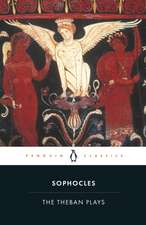 The Theban PlaysSophocles-20%Preț: 57.13 lei71.10 lei
-
 The Oresteian TrilogyAeschylus-32%Preț: 62.94 lei92.17 lei
-
 Electra and Other PlaysSophocles-30%Preț: 66.13 lei94.06 lei
-
 AntigoneSophocles-39%Preț: 17.44 lei28.47 lei
-
 Greek TragedyAeschylus-30%Preț: 65.03 lei93.40 lei
-
 The Oxford History of Greece and the Hellenistic WorldJohn Boardman-18%Preț: 100.06 lei122.62 lei
-
 -16%Preț: 55.22 lei65.92 lei
-
 -15%Preț: 31.82 lei37.26 lei
-
 Sophocles: A Very Short IntroductionEdith Hall-19%Preț: 57.96 lei71.42 lei
-
 The Metamorphosis and Other StoriesFranz KafkaPreț: 51.77 lei
-
 Antigone; Oedipus the King; ElectraSophocles-19%Preț: 52.51 lei64.47 lei
-
 Preț: 115.66 lei
-
 Preț: 114.92 lei
-
 Oedipus the KingSophoclesPreț: 76.50 lei
-
 Oedipus the King, Second EditionSophoclesPreț: 65.45 lei
-
 Preț: 176.89 lei
-
 Hell's AngelsHunter S. Thompson-25%Preț: 58.96 lei78.77 lei
-
 The Theban PlaysSophoclesPreț: 39.96 lei
-
 Rum DiaryHunter S. Thompson-27%Preț: 56.98 lei77.93 lei
-
 Oedipus RexSophoclesPreț: 52.99 lei
-
 Medea and Other PlaysEuripidesPreț: 43.30 lei
-
 Sophocles, the Oedipus CycleSophoclesPreț: 51.45 lei
-
 Shakespeare: Invention of the HumanHarold BloomPreț: 216.06 lei
-
 The Autobiography of Benvenuto CelliniBenvenuto Cellini-16%Preț: 82.03 lei97.28 lei
-
 The Sound And The FuryWilliam Faulkner-16%Preț: 92.03 lei109.87 lei
Notă biografică
Sophocles was born at Colonus, just outside Athens, in 496 BC, and lived ninety years. His long life spanned the rise and decline of the Athenian Empire; he was a friend of Pericles, and though not an active politician he held several public offices, both military and civil. The leader of a literary circle and friend of Herodotus, he was interested in poetic theory as well as practice, and he wrote a prose treatise On the Chorus. He seems to have been content to spend all his life at Athens, and is said to have refused several invitations to royal courts.Sophocles first won a prize for tragic drama in 468, defeating the veteran Aeschylus. He wrote over a hundred plays for the Athenian theater, and is said to have come first in twenty-four contests. Only seven of his tragedies are now extant, these being Ajax, Antigone, Oedipus the King, Women of Trachis, Electra, Philoctetes, and the posthumous Oedipus at Colonus. A substantial part of The Searches, a satyr play, was recovered from papyri in Egypt in modern times. Fragments of other plays remain, showing that he drew on a wide range of themes; he also introduced the innovation of a third actor in his tragedies. He died in 406 BC.
Robert Fagles (1933-2008) was Arthur W. Marks ’19 Professor of Comparative Literature, Emeritus, at Princeton University. He was the recipient of the 1997 PEN/Ralph Manheim Medal for Translation and a 1996 Award in Literature from the American Academy of Arts and Letters. His translations include Sophocles’s Three Theban Plays, Aeschylus’s Oresteia (nominated for a National Book Award), Homer’s Iliad (winner of the 1991 Harold Morton Landon Translation Award by The Academy of American Poets), Homer’s Odyssey, and Virgil's Aeneid.
Bernard Knox (1914-2010) was Director Emeritus of Harvard’s Center for Hellenic Studies in Washington, D.C. He taught at Yale University for many years. Among his numerous honors are awards from the National Institute of Arts and Letters and the National Endowment for the Humanities. His works include The Heroic Temper: Studies in Sophoclean Tragedy, Oedipus at Thebes: Sophocles’ Tragic Hero and His Time and Essays Ancient and Modern (awarded the 1989 PEN/Spielvogel-Diamonstein Award).
Cuprins
The Three Theban Plays - Sophocles Translated by Robert Fagles with Introductions and Notes by Bernard Knox Acknowledgments Translator's Preface Greece and the Theater
SOPHOCLES: THE THREE THEBAN PLAYSIntroduction to Antigone Antigone
Introduction to Oedipus the King Oedipus the King
Introduction to Oedipus at Colonus Oedipus at Colonus
A Note on the Text of Sophocles Textual Variants Notes on the Translation: Antigone, Oedipus the King, Oedipus at Colonus Select Bibliography The Genealogy of Oedipus Glossary