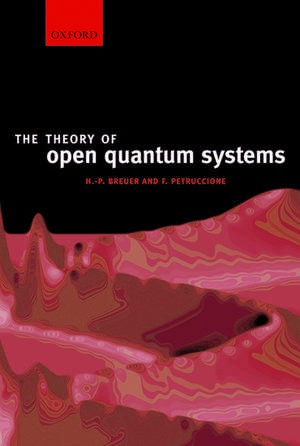
The Theory of Open Quantum Systems
Autor Heinz-Peter Breuer, Francesco Petruccioneen Limba Engleză Paperback – 25 ian 2007
Considerăm că The Theory of Open Quantum Systems reprezintă o resursă fundamentală care aduce în prim-plan o sinteză riguroasă între rigoarea matematică și aplicațiile fizice complexe, depășind abordările fragmentate din literatura de specialitate. Această lucrare se distinge prin faptul că nu se limitează la prezentarea ecuațiilor de bază, ci construiește un cadru teoretic complet, pornind de la interpretarea statistică a mecanicii cuantice și ajungând la metode moderne precum algoritmii Monte Carlo și funcționalele de influență. Găsim în acest volum o analiză detaliată a decoerenței induse de mediu, un element esențial pentru înțelegerea tranziției de la cuantic la clasic.
Apreciem în mod deosebit structura didactică: autorii Heinz-Peter Breuer și Francesco Petruccione introduc procesele stocastice în spațiul Hilbert, oferind instrumente practice pentru modelarea răcirii laser a atomilor sau a modelului Jaynes-Cummings amortizat. Acoperă aceeași arie tematică ca Open Quantum Systems de Subhashish Banerjee, dar cu o abordare mult mai extinsă asupra aspectelor non-Markoviene și a măsurătorilor relativiste, beneficiind de un aparat matematic mai dens, susținut de peste o sută de ilustrații tehnice.
În contextul operei autorului, lucrarea consolidează direcțiile explorate în Advances in Open Systems and Fundamental Tests of Quantum Mechanics, trecând de la testele fundamentale la o metodologie de lucru sistematică. Această ediție de la Oxford University Press rămâne o referință critică pentru curriculumul de fizică teoretică, fiind citată constant pentru claritatea cu care tratează distrugerea coerenței cuantice în electrodinamică.
Preț: 480.44 lei
Preț vechi: 686.93 lei
-30%
Carte disponibilă
Livrare economică 15-20 mai
Livrare express 30 aprilie-06 mai pentru 133.72 lei
Specificații
ISBN-10: 0199213909
Pagini: 640
Ilustrații: 117 line drawings and halftones
Dimensiuni: 156 x 233 x 32 mm
Greutate: 0.97 kg
Editura: Oxford University Press
Colecția OUP Oxford
Locul publicării:Oxford, United Kingdom
V-ar putea interesa
-
 Quantum InformationStephen Barnett-12%Preț: 306.72 lei347.72 lei
 -
 Core Maths for the BiosciencesMartin B. Reed-20%Preț: 382.43 lei478.65 lei
 -
 -21%Preț: 491.30 lei618.79 lei
 -
 -20%Preț: 468.50 lei583.11 lei
 -
 Quantum Mechanics: A New IntroductionKenichi Konishi-10%Preț: 356.24 lei393.69 lei
 -
 -11%Preț: 489.32 lei549.81 lei
 -
 -13%Preț: 316.54 lei363.76 lei
 -
 The Physics of Quantum MechanicsJames Binney-13%Preț: 287.53 lei330.88 lei
 -
 An Introduction to Grids, Graphs, and NetworksC. Pozrikidis-34%Preț: 693.13 lei1044.68 lei
 -
 Measuring the Quantum State of LightUlf Leonhardt-11%Preț: 397.06 lei446.13 lei
 -
 Applied Numerical Methods for Food and Agricultural EngineersPrabir K. Chandra-18%Preț: 2396.66 lei2922.75 lei
 -
 Fundamentals of Grid GenerationStanley Steinberg-18%Preț: 1972.03 lei2404.91 lei
 -
 Quantum Computation and Quantum InformationMichael A. Nielsen-8%Preț: 486.54 lei528.85 lei
 -
 Supervised Learning with Quantum ComputersMaria Schuld-18%Preț: 1071.02 lei1306.11 lei
 -
 DecoherenceMaximilian A. Schlosshauer-15%Preț: 631.92 lei743.44 lei
 -
 Statistical Structure of Quantum TheoryAlexander S. Holevo-18%Preț: 906.17 lei1105.08 lei
 -
 -15%Preț: 668.48 lei786.45 lei
 -
 -18%Preț: 917.56 lei1118.98 lei
 -
 Quantum OpticsD. F. Walls-15%Preț: 463.28 lei545.03 lei
 -
 Preț: 374.59 lei
 -
 Relativistic Quantum Measurement and DecoherenceHeinz-Peter BreuerPreț: 367.92 lei
 -
 PRINCIPLES OF QUANT COMPUTAT (V2)Benenti GiulianoPreț: 446.43 lei
 -
 PROB & SOL IN QUAN COMPUT & QUAN 3EDSteeb Willi-Hans-15%Preț: 546.32 lei642.73 lei
De ce să citești această carte
Această carte este esențială pentru cercetătorii și studenții care doresc să stăpânească formalismul sistemelor cuantice deschise. Cititorul câștigă o înțelegere profundă a modului în care sistemele cuantice interacționează cu mediul lor, dobândind tehnici de simulare stocastică și metode analitice aplicabile în optica cuantică și informatica cuantică. Este un instrument teoretic robust care face legătura între fundamentele mecanicii cuantice și experimentele moderne de laborator.
Despre autor
Heinz-Peter Breuer este un fizician de renume, profesor la Universitatea din Freiburg, specializat în dinamica sistemelor cuantice deschise și procese stocastice. Alături de Francesco Petruccione, a pus bazele unor metode inovatoare de investigare a sistemelor cuantice non-Markoviene. Expertiza sa se extinde de la fundamentele mecanicii cuantice până la aplicații în informatica cuantică, contribuind semnificativ la dezvoltarea teoriilor despre decoerență și măsurători cuantice în regim relativist.
Descriere
Recenzii
...very clearly written and essentially self-contained... not only a very good and thorough introduction to the subject, but also a precious reference for researchers.
'This book covers a large set of topics, normally not covered in standard physics curricula ... I recommend this book to physicists interested in widening their horizons in the directions covered by the book ... I do not know of any other source providing such a systematic and well written introduction into this area of research.'