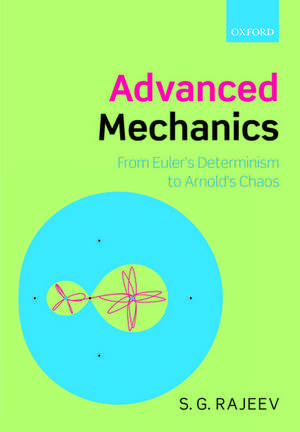
Advanced Mechanics: From Euler's Determinism to Arnold's Chaos
Autor S. G. Rajeeven Limba Engleză Paperback – 25 iul 2013
Preț: 346.22 lei
Preț vechi: 397.28 lei
-13%
Puncte Express: 519
Carte tipărită la comandă
Livrare economică 10-15 decembrie
Livrare prin curier în România Termenul estimat este afișat lângă disponibilitate.
Transport gratuit de la 400.00 lei Plată online sau ramburs, în funcție de opțiunile comenzii.
Retur gratuit în 14 zile Comandă securizată și suport în română.
Specificații
ISBN-13: 9780199670864
ISBN-10: 0199670862
Pagini: 184
Ilustrații: 18 b/w illustrations
Dimensiuni: 174 x 245 x 11 mm
Greutate: 0.33 kg
Editura: Oxford University Press
Colecția OUP Oxford
Locul publicării:Oxford, United Kingdom
ISBN-10: 0199670862
Pagini: 184
Ilustrații: 18 b/w illustrations
Dimensiuni: 174 x 245 x 11 mm
Greutate: 0.33 kg
Editura: Oxford University Press
Colecția OUP Oxford
Locul publicării:Oxford, United Kingdom
V-ar putea interesa
-
 Essential Ptc(r) MathCAD Prime(r) 3.0Brent MaxfieldPreț: 593.65 lei
 -
 Cryptography: A Very Short IntroductionFred PiperPreț: 65.28 lei
 -
 Core Maths for the BiosciencesMartin B. Reed-19%Preț: 428.97 lei527.88 lei
 -
 -18%Preț: 527.45 lei646.10 lei
 -
 Hurricane Climatology: A Modern Statistical Guide Using RJames B. Elsner-30%Preț: 820.09 lei1169.33 lei
 -
 A Mind for NumbersBarbara OakleyPreț: 114.43 lei
 -
 How Not to Be WrongJordan Ellenberg-28%Preț: 78.41 lei108.36 lei
 -
 A-Level Physics: Essential Maths SkillsCgp BooksPreț: 75.37 lei
 -
 Preț: 407.16 lei
 -
 Preț: 403.56 lei
Recenzii
The book appears to be well suited to serve the intended role of introducing physics students to mechanics and making clear to them the relevance of the subject for modern physics; but it will also be useful to mathematics students to understand that the subject is relevant and alive well beyond the classical realms of applications and/or abstract mathematical developments.
Sarada Rajeev has produced a masterpiece which is as steeped in tradition as it is modern in outlook. The book is a minimalist's dream, unleashing on the unsuspecting reader a treasure trove of novel results within its slender frame. The informal yet stimulating narrative, the excellent choice of topics, and the lucid explanations truly make the book a connoisseur's delight.
Rajeev approaches his choice of topics and organization from the point of view of one who is intimately familiar with modern physics. Although he starts from very elementary classical mechanics, he nevertheless does not shy away from sophisticated mathematical tools, such as elliptic functions, which he develops from scratch. This book should be of interest to many physics graduate students and researchers in physics, as well as to many mathematicians.
The book is elegant, concise, enjoyable and sprinkled with illuminating examples.
Sarada Rajeev has produced a masterpiece which is as steeped in tradition as it is modern in outlook. The book is a minimalist's dream, unleashing on the unsuspecting reader a treasure trove of novel results within its slender frame. The informal yet stimulating narrative, the excellent choice of topics, and the lucid explanations truly make the book a connoisseur's delight.
Rajeev approaches his choice of topics and organization from the point of view of one who is intimately familiar with modern physics. Although he starts from very elementary classical mechanics, he nevertheless does not shy away from sophisticated mathematical tools, such as elliptic functions, which he develops from scratch. This book should be of interest to many physics graduate students and researchers in physics, as well as to many mathematicians.
The book is elegant, concise, enjoyable and sprinkled with illuminating examples.
Notă biografică
Prof. Rajeev received his B.Sc. in Physics from the University of Kerala, Trivandrum, India (1979), and his Ph.D. in Physics from Syracuse University (1984). He was a postdoctoral fellow at the Massachusetts Institute of Technology (1984-87) before joining the University of Rochester as an Assistant Professor of Physics in 1987. He was promoted to Associate Professor in 1993 and to Professor in 2000. Prof. Rajeev has held visiting appointments at the Institute for Advanced Study, Princeton (1991), the Research Institute for Theoretical Physics, Helsinki (1991), and the Mittag-Leffler Institute, Stockholm (1998).