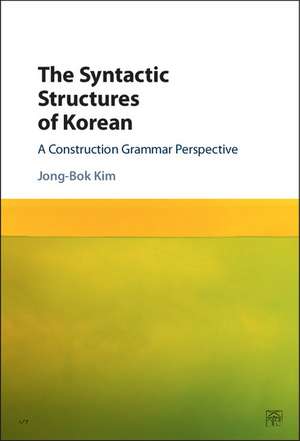
The Syntactic Structures of Korean
Autor Jong-Bok Kimen Limba Engleză Hardback – 28 iun 2016
Preț: 829.86 lei
Preț vechi: 964.96 lei
-14%
Puncte Express: 1245
Carte tipărită la comandă
Livrare economică 23 noiembrie-07 decembrie
Livrare prin curier în România Termenul estimat este afișat lângă disponibilitate.
Transport gratuit pentru acest produs Plată online sau ramburs, în funcție de opțiunile comenzii.
Retur gratuit în 14 zile Comandă securizată și suport în română.
Specificații
ISBN-13: 9781107103757
ISBN-10: 1107103754
Pagini: 360
Ilustrații: 3 b/w illus. 7 tables
Dimensiuni: 157 x 235 x 24 mm
Greutate: 0.67 kg
Editura: Cambridge University Press
Locul publicării:New York, United States
ISBN-10: 1107103754
Pagini: 360
Ilustrații: 3 b/w illus. 7 tables
Dimensiuni: 157 x 235 x 24 mm
Greutate: 0.67 kg
Editura: Cambridge University Press
Locul publicării:New York, United States
V-ar putea interesa
-
 The Complementizer Phase: Subjects and OperatorsE. Phoevos Panagiotidis-26%Preț: 426.34 lei575.24 lei
 -
 The Oxford Handbook of CompoundingRochelle Lieber-20%Preț: 366.02 lei456.25 lei
 -
 Rhetorical Style: The Uses of Language in PersuasionJeanne Fahnestock-21%Preț: 468.63 lei593.85 lei
 -
 Vocabulary: Applied Linguistic PerspectivesRonald CarterPreț: 412.99 lei
 -
 Case, Argument Structure, and Word OrderShigeru Miyagawa-18%Preț: 1314.99 lei1603.65 lei
 -
 Syntactic IslandsCedric Boeckx-20%Preț: 198.38 lei247.31 lei
 -
 A Grammar of SemelaiNicole KruspePreț: 381.35 lei
 -
 Analysing English GrammarLise FontainePreț: 371.28 lei
 -
 Modern SyntaxAndrew CarniePreț: 416.68 lei
 -
 The Cambridge Handbook of Generative SyntaxMarcel Den Dikken-23%Preț: 1238.07 lei1607.89 lei
 -
 MorphologyAntonio Fábregas-14%Preț: 179.22 lei208.46 lei
 -
 The Comment Clause in EnglishLaurel J. BrintonPreț: 325.67 lei
 -
 A Reference Grammar of RussianAlan Timberlake-19%Preț: 547.00 lei675.30 lei
 -
 FeaturesGreville G. CorbettPreț: 240.26 lei
 -
 Halliday's Introduction to Functional GrammarM. A. K. Halliday-8%Preț: 501.44 lei545.04 lei
Cuprins
1. Theoretical foundations; 1.1 Derivational vs constraint-based views; 1.2 Linguistic signs and feature structures; 1.3 Constructions and multiple inheritance hierarchy; 1.4 Korean phrase structure grammar; 1.5 Conclusion; 2. Noun phrases; 2.1 Basic properties; 2.2 Basic ordering restrictions; 2.3 Simple NP structures; 2.4 NPs with phrasal determinants; 2.5 Conclusion; 3. Case system; 3.1 Two basic issues; 3.2 Forming case-marked nominal expressions; 3.3 A construction-based case assignment system; 3.4 Complex case phenomena and predictions; 3.5 Case assignments in the auxiliary constructions; 3.6 Case assignments to the non-nominal expression; 3.7 Conclusion; 4. Auxiliary and complex predicate constructions; 4.1 Types of auxiliary verbs and morphosyntactic properties; 4.2 Three possible analyses; 4.3 Syntactic properties of complex predicates; 4.4 A construction-based analysis; 4.5 Conclusion; 5. Gerundive phrases and mixed categories; 5.1 Verbal and nominal properties; 5.2 Derivational analyses; 5.3 Inflectional treatment of the gerundive nominalizers; 5.4 A mixed-category analysis; 5.5 Consequences and further issues; 5.6 Conclusion; 6. Verbal nouns and light verb construction; 6.1 Basic properties; 6.2 On the properties of the light verb; 6.3 On the mixed properties of the verbal nouns; 6.4 Mixed properties within a multiple inheritance system; 6.5 Argument composition and syntactic structures; 6.6 Dissolving variations; 6.7 Conclusion; 7. Serial verb construction; 7.1 Serial verbs and general properties; 7.2 Grammatical properties of the SVCs; 7.3 Types of serial verb constructions; 7.4 A construction-based view; 7.5 Conclusion; 8. Negation and related phenomena; 8.1 Short form and long form negation; 8.2 Reviews on the derivational view; 8.3 Short form negation; 8.4 Long form negation; 8.5 Implications of the analysis; 8.6 Conclusion; 9. Coordination; 9.1 Two main types of nominal and verbal coordination; 9.2 Lexical properties of the coordinators; 9.3 More on the syntactic aspects; 9.4 Symmetric and asymmetric verbal coordination; 9.5 Conclusion; 10. Passive constructions; 10.1 Lexical vs syntactic passive; 10.2 Auxiliary syntactic passive; 10.3 A construction-based analysis; 10.4 Light-verb syntactic passive; 10.5 Inchoative and stative pseudo syntactic passive; 10.6 Conclusion; 11. Wh-questions; 11.1 Dependency between Wh-question and Q-particle; 11.2 Wh-questions and indefiniteness; 11.3 A construction-based analysis; 11.4 Key predictions; 11.5 Conclusion; 12. Topic and focus constructions; 12.1 Topic constructions; 12.2 Encoding focus; 12.3 Focus constructions; 12.4 Conclusion; 13. Relative clause constructions; 13.1 Some key properties; 13.2 Morpho-syntax of Korean relatives; 13.3 Standard relative clauses: externally headed; 13.4 Double relative clauses; 13.5 Internally headed relative clauses; 13.6 Pseudo-relative clauses; 13.7 Concluding remarks; 14. Honorification; 14.1 Basic properties of honorific agreement; 14.2 Honorification in a constraint-based grammar; 14.3 Conclusion.
Descriere
Jong-Bok Kim offers a remarkably broad yet in-depth overview of popular contemporary topics in Korean syntax and semantics.