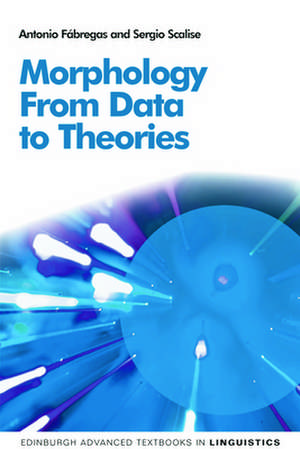
Morphology
Autor Antonio Fábregas, Sergio Scaliseen Limba Engleză Paperback – 11 mai 2012
Relevanța acestui volum pentru examenele de licență și masterat în filologie, precum și pentru acreditările academice în lingvistică, derivă din capacitatea sa de a sintetiza teorii complexe într-un format didactic riguros. În Morphology, descoperim o abordare care depășește prezentările tradiționale, concentrându-se pe tranziția „de la date la teorii”. Apreciem în mod deosebit modul în care Antonio Fábregas și Sergio Scalise recalibrează discuția despre Ipoteza Integrității Lexicale, integrând perspective moderne din Programul Minimalist și Gramatica Construcțiilor, elemente adesea omise de manualele standard. Comparabil cu Understanding Morphology de Martin Haspelmath în ceea ce privește rigoarea analitică, acest manual se diferențiază prin faptul că este actualizat pentru noile cadre teoretice care redefinesc locul morfologiei în arhitectura gramaticii. Dacă Understanding Morphology este ideal pentru un prim contact cu disciplina, volumul de față este construit special pentru studenții avansați, oferind instrumente pentru cercetare originală. Structura cărții este progresivă: începe cu definiții fundamentale și clase de morfeme, avansează către dezbaterea existenței morfemelor (analizând fenomene precum morfemele „cranberry” sau formarea cuvintelor de tip priscianic) și culminează cu motivarea structurilor morfologice. Poziționată în contextul operei autorului, Morphology extinde expertiza empirică demonstrată de Antonio Fábregas în The Routledge Handbook of Spanish Morphology către un cadru teoretic general aplicabil limbii engleze. Lucrarea nu se limitează la descriere, ci explorează interfața dintre morfologie, sintaxă și semantica lexicală, oferind o viziune integrată asupra modului în care unitățile de sens se asamblează în sistemul lingvistic.
Preț: 179.22 lei
Preț vechi: 208.46 lei
-14%
Carte disponibilă
Livrare economică 02-16 noiembrie
Specificații
ISBN-10: 0748643133
Pagini: 209
Ilustrații: black & white illustrations
Dimensiuni: 159 x 240 x 15 mm
Greutate: 0.37 kg
Editura: EDINBURGH UNIVERSITY PRESS
V-ar putea interesa
-
 A Latin GrammarJamesFellow MorwoodPreț: 68.14 lei
 -
 Latin: A Linguistic IntroductionRenato Oniga-12%Preț: 324.04 lei367.18 lei
 -
 Case in AfricaChrista König-33%Preț: 1299.17 lei1932.81 lei
 -
 -21%Preț: 421.88 lei534.37 lei
 -
 Case and Aspect in SlavicKylie R. Richardson-31%Preț: 603.21 lei873.48 lei
 -
 The Grammar of RomanianGabriela Panã Dindelegan-35%Preț: 1010.48 lei1560.83 lei
 -
 Rhetorical Style: The Uses of Language in PersuasionJeanne Fahnestock-21%Preț: 468.63 lei593.85 lei
 -
 Preț: 284.89 lei
 -
 Syntactic IslandsCedric Boeckx-20%Preț: 198.38 lei247.31 lei
 -
 Analysing English GrammarLise FontainePreț: 371.28 lei
 -
 SyntaxRobert FreidinPreț: 351.09 lei
 -
 Modern SyntaxAndrew CarniePreț: 416.68 lei
 -
 The Cambridge Handbook of Generative SyntaxMarcel Den Dikken-23%Preț: 1238.07 lei1607.89 lei
 -
 -20%Preț: 694.25 lei871.83 lei
 -
 -11%Preț: 177.79 lei199.02 lei
 -
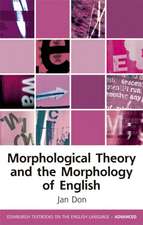 -21%Preț: 693.37 lei874.41 lei
 -
 Contemporary Morphological TheoriesThomas W Stewart-25%Preț: 564.55 lei757.33 lei
 -
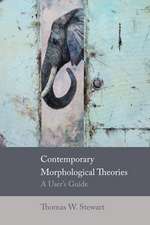 Contemporary Morphological TheoriesThomas W Stewart-17%Preț: 185.50 lei223.00 lei
 -
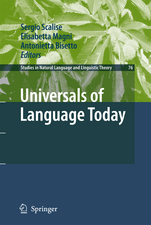 Universals of Language TodaySergio Scalise-18%Preț: 1228.13 lei1497.71 lei
 -
 The Bloomsbury Companion to SyntaxSilvia Luraghi-19%Preț: 287.21 lei354.50 lei
 -
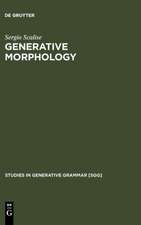 Generative MorphologySergio Scalise-23%Preț: 882.85 lei1146.55 lei
De ce să citești această carte
Recomandăm această carte studenților de la litere și cercetătorilor care doresc să înțeleagă morfologia nu doar ca pe o listă de prefixe și sufixe, ci ca pe un modul dinamic aflat la intersecția cu sintaxa. Cititorul câștigă o metodologie de analiză critică și acces la cele mai noi dezbateri teoretice, fiind un instrument esențial pentru pregătirea cursurilor de lingvistică avansată și pentru fundamentarea lucrărilor de cercetare.
Cuprins
Descriere scurtă
Descriere
A comprehensive guide to the latest developments in morphology