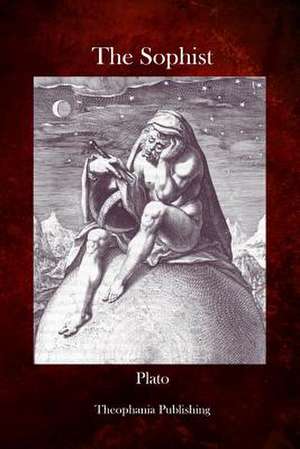
The Sophist
Autor Platoen Limba Engleză Paperback
Preț: 115.00 lei
Puncte Express: 173
Carte tipărită la comandă
Livrare economică 02-16 decembrie
Livrare prin curier în România Termenul estimat este afișat lângă disponibilitate.
Transport gratuit de la 400.00 lei Plată online sau ramburs, în funcție de opțiunile comenzii.
Retur gratuit în 14 zile Comandă securizată și suport în română.
Specificații
ISBN-13: 9781770833524
ISBN-10: 1770833528
Pagini: 184
Dimensiuni: 152 x 229 x 10 mm
Greutate: 0.25 kg
Editura: Theophania Publishing
ISBN-10: 1770833528
Pagini: 184
Dimensiuni: 152 x 229 x 10 mm
Greutate: 0.25 kg
Editura: Theophania Publishing
V-ar putea interesa
-
 RepublicPlatoPreț: 30.76 lei
 -
 SymposiumPlatoPreț: 27.61 lei
 -
 -24%Preț: 224.75 lei296.10 lei
 -
 Golden SonPierce BrownPreț: 93.02 lei
 -
 Great Dialogues of PlatoPlatoPreț: 54.11 lei
 -
 Six Great DialoguesPlatoPreț: 50.88 lei
 -
 A History of Western PhilosophyBertrand RussellPreț: 196.21 lei
 -
 Theaetetus. SophistPlatoPreț: 233.70 lei
 -
 Preț: 229.26 lei
 -
 -14%Preț: 515.26 lei599.14 lei
 -
 Preț: 66.00 lei
 -
 Why Plato Matters NowAngie Hobbs-25%Preț: 92.31 lei122.47 lei
 -
 -24%Preț: 72.11 lei95.34 lei
 -
 -23%Preț: 74.50 lei96.76 lei
 -
 PhaedrusPlatoPreț: 43.00 lei
 -
 ParmenidesPlatoPreț: 43.40 lei
 -
 ProtagorasPlatoPreț: 39.22 lei
 -
 MetaphysicsAristotlePreț: 64.88 lei
 -
 TheaetetusPlatoPreț: 46.76 lei
 -
 PhaedoPlatoPreț: 43.59 lei
 -
 -18%Preț: 127.45 lei154.50 lei
 -
 Preț: 58.13 lei
Descriere
Descriere de la o altă ediție sau format:
This is an English translation of Plato presenting a new conception of the Theory of Forms. Socrates and others discuss the epistemological and metaphysical puzzles of the Parmenides, with aims to define the meaning of the Sophist. The glossary of key terms is a unique addition to Platonic literature by which concepts central to each dialogue are discussed and cross-referenced as to their occurrences throughout the work. In such a way students are encouraged to see beyond the words into concepts.
Focus Philosophical Library translations are close to and are non-interpretative of the original text, with the notes and a glossary intending to provide the reader with some sense of the terms and the concepts as they were understood by Plato’s immediate audience.
Recenzii
This translation of one of Plato's most challenging dialogues is so unpretentiously honest that it risks undercutting its own significant merits. As far as I can judge, it will prove most helpful not only to students of classical studies and philosophy, but to anybody who is interested in the questions treated by the Sophist. Clarity seems to be the editor and translator's aim, and it is well achieved in: (a) an introduction which without philosophical arm-twisting brings in the views of some modern philosophers on negative and false statement (as inconclusive as Plato's), (b) a select bibliography and a summary of the arguments which students will find useful, and (c) a translation of the text in civilized modern English. Space forbids the adduction of parallel passages. However, I do not hesitate to claim that in terms of accuracy and credible conversational style, the translation will stand comparision with those of A.E. Taylor and F.M. Cornford. --David Rankin, in The Classical Review
Notă biografică
Plato was an ancient Greek philosopher born in Athens during the Classical period in Ancient Greece. In Athens, Plato founded the Academy, a philosophical school where he taught the philosophical doctrines that would later become known as Platonism. Plato (or Platon) was a pen name derived, apparently, from the nickname given to him by his wrestling coach - allegedly a reference to his physical broadness. According to Alexander of Miletus quoted by Diogenes of Sinope his actual name was Aristocles, son of Ariston, of the deme Collytus (Collytus being a district of Athens).Plato was an innovator of the written dialogue and dialectic forms in philosophy. He raised problems for what later became all the major areas of both theoretical philosophy and practical philosophy. His most famous contribution is the Theory of forms, which has been interpreted as advancing a solution to what is now known as the problem of universals. He is also the namesake of Platonic love and the Platonic solids.His own most decisive philosophical influences are usually thought to have been, along with Socrates, the pre-Socratics Pythagoras, Heraclitus, and Parmenides, although few of his predecessors' works remain extant and much of what we know about these figures today derives from Plato himself.[a]Along with his teacher, Socrates, and his student, Aristotle, Plato is a central figure in the history of philosophy.[b] Unlike the work of nearly all of his contemporaries, Plato's entire body of work is believed to have survived intact for over 2,400 years.[6] Although their popularity has fluctuated, Plato's works have consistently been read and studied. Through Neoplatonism Plato also greatly influenced both Christian and Islamic philosophy (through e.g. Al-Farabi). In modern times, Alfred North Whitehead famously said: "the safest general characterization of the European philosophical tradition is that it consists of a series of footnotes to Plato.