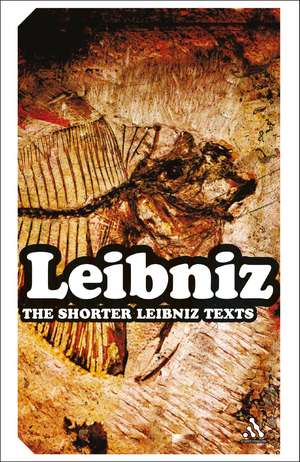
The Shorter Leibniz Texts: A Collection of New Translations: Continuum Impacts
Traducere de Dr Lloyd Stricklanden Limba Engleză Paperback – 15 oct 2006
Observăm în The Shorter Leibniz Texts o abordare editorială care prioritizează interdisciplinaritatea inerentă gândirii lui Gottfried Wilhelm Leibniz, facilitând accesul la intersecția dintre metafizică, logică și teologie filosofică. Această antologie, publicată în seria Continuum Impacts, reușește să transforme un corpus vast și adesea intimidant într-un instrument de lucru precis pentru mediul academic. Apreciem în mod deosebit efortul depus de Dr Lloyd Strickland de a aduce în spațiul anglofon peste 60 de texte, multe dintre ele traduse acum pentru prima dată, oferind o perspectivă proaspătă asupra evoluției ideilor leibniziene între anii 1677 și 1716.
Remarcăm că volumul extinde cadrul propus de Philosophical Papers and Letters de G.W. Leibniz cu date noi extrase din corespondența privată și notele marginale ale filosofului. În timp ce edițiile clasice tind să se concentreze pe lucrări canonice precum „Monadologia”, selecția de față oferă texte mai scurte și mai „prietenoase” cu studenții, fără a sacrifica rigoarea. Această lucrare se înscrie organic în opera lui Dr Lloyd Strickland, completând temele explorate în Leibniz on God and Religion și Leibniz Reinterpreted, unde autorul a demontat interpretările greșite ale teoriei „celei mai bune dintre lumile posibile”.
Structura volumului este organizată tematic, debutând cu o secțiune densă de Metafizică ce explorează originile lucrurilor și principiile cunoașterii umane, urmată de o analiză a dualității minte-corp. Această progresie logică, susținută de o introducere substanțială de 55 de pagini, permite cititorului să urmărească modul în care Leibniz își rafinează conceptele de substanță și adevăr. Spre deosebire de Discourse on Metaphysics and Other Writings, care se limitează la prezentările mature ale sistemului său, antologia de față oferă o privire de ansamblu asupra laboratorului de idei al filosofului german.
Din seria Continuum Impacts
-
 Preț: 335.23 lei
 - 42%
 Preț: 118.14 lei
 - 45%
 Preț: 112.93 lei
 - 10%
 Preț: 172.22 lei
 - 42%
 Preț: 142.59 lei
 - 41%
 Preț: 127.67 lei
 - 47%
 Preț: 96.07 lei
 - 42%
 Preț: 317.17 lei
 - 46%
 Preț: 132.07 lei
 - 23%
 Preț: 237.70 lei
 - 42%
 Preț: 123.99 lei
 - 39%
 Preț: 190.23 lei
 - 46%
 Preț: 97.08 lei
 - 42%
 Preț: 133.62 lei
 - 18%
 Preț: 162.08 lei
 - 47%
 Preț: 184.28 lei
 - 43%
 Preț: 204.26 lei
 - 50%
 Preț: 125.97 lei
 - 43%
 Preț: 198.66 lei
 - 43%
 Preț: 126.82 lei
 - 48%
 Preț: 143.03 lei
 - 37%
 Preț: 149.94 lei
 - 41%
 Preț: 151.00 lei
 - 42%
 Preț: 1166.43 lei
 - 41%
 Preț: 132.03 lei
 - 27%
 Preț: 227.61 lei
 - 42%
 Preț: 132.86 lei
 - 43%
 Preț: 111.50 lei
 - 42%
 Preț: 108.75 lei
 - 36%
 Preț: 179.03 lei
 - 18%
 Preț: 195.70 lei
 - 42%
 Preț: 117.73 lei
 - 45%
 Preț: 108.16 lei
 - 45%
 Preț: 124.48 lei
 - 42%
 Preț: 119.14 lei
 - 43%
 Preț: 97.38 lei
 - 46%
 Preț: 117.77 lei
 - 41%
 Preț: 131.90 lei
 - 42%
 Preț: 128.18 lei
 -
 Preț: 226.88 lei
 - 48%
 Preț: 317.74 lei
 - 45%
 Preț: 168.08 lei
 - 40%
 Preț: 198.53 lei
Preț: 204.00 lei
Preț vechi: 246.52 lei
-17%
Carte tipărită la comandă
Livrare economică 11-25 noiembrie
Specificații
ISBN-10: 0826489516
Pagini: 208
Ilustrații: black & white illustrations
Dimensiuni: 126 x 196 x 14 mm
Greutate: 0.21 kg
Editura: Bloomsbury Publishing
Colecția Continuum
Seria Continuum Impacts
Locul publicării:London, United Kingdom
V-ar putea interesa
-
 -10%Preț: 320.27 lei357.39 lei
 -
 Gilles Deleuze and Félix Guattari - Intersecting LivesFrancois DossePreț: 329.90 lei
 -
 BlizzardVladimir Sorokin-27%Preț: 56.00 lei77.10 lei
 -
 Sex in the Ancient World from A to ZJohn Younger-18%Preț: 927.87 lei1131.56 lei
 -
 Stone: An Ecology of the InhumanJeffrey Jerome CohenPreț: 175.10 lei
 -
 World TreeProfessor David WojahnPreț: 105.47 lei
 -
 Poemas de amor / Love PoemsIdea VilariñoPreț: 104.44 lei
 -
 ExterraneanPhillip John UsherPreț: 261.82 lei
 -
 The Non-Philosophy of Gilles DeleuzeGregg Lambert-22%Preț: 468.62 lei598.94 lei
 -
 Kierkegaard: A Guide for the PerplexedClare Carlisle-23%Preț: 176.92 lei228.53 lei
 -
 Language of the Third Reich: LTI: Lingua Tertii ImperiiVictor Klemperer-18%Preț: 195.70 lei239.57 lei
 -
 Preț: 263.51 lei
 -
 AnimaJames HillmanPreț: 118.73 lei
 -
 £6.99 (formerly £9.99)Frédéric Beigbeder-17%Preț: 78.75 lei94.93 lei
 -
 The Five Senses: A Philosophy of Mingled BodiesProfessor Michel Serres-25%Preț: 172.58 lei230.14 lei
 -
 Urban HorrorErin Y HuangPreț: 251.00 lei
 -
 Preț: 277.74 lei
 -
 Benjamin, Barthes and the Singularity of PhotographyDr. Kathrin Yacavone-26%Preț: 200.71 lei269.56 lei
 -
 T. S. Eliot: A Guide for the PerplexedProfessor Steve Ellis-14%Preț: 643.66 lei748.44 lei
 -
 FLOWER POLLENNovalisPreț: 107.70 lei
 -
 Preț: 105.36 lei
 -
 SAMUEL BECKETT GOES INTO THE SILENCEJeremy Mark RobinsonPreț: 104.22 lei
 -
 Old Puglia: A Cultural Companion to South-Eastern ItalyDesmond Seward-18%Preț: 77.24 lei93.66 lei
 -
 A Life Without EndFrederic Beigbeder-18%Preț: 77.09 lei93.56 lei
 -
 Clara Rilke-WesthoffMarina Bohlmann-ModersohnPreț: 82.99 lei
 -
 Giovanni BelliniJohannes Grave-15%Preț: 628.95 lei742.67 lei
De ce să citești această carte
Această ediție este esențială pentru studenții și cercetătorii care doresc să depășească lectura tratatelor clasice ale lui Leibniz. Prin cele 60 de traduceri noi, volumul oferă acces la fațete mai puțin cunoscute ale metafizicii sale, prezentate într-un format concis și clar. Cititorul câștigă o înțelegere profundă a sistemului leibnizian prin texte care sunt reprezentative, dar accesibile, beneficiind de expertiza unuia dintre cei mai importanți specialiști contemporani în domeniu.
Descriere
Contains more than 60 original translations of papers written by the German philosopher Gottfried Wilhelm Leibniz (1646-1716). By focusing on Leibniz's shorter philosophical writings rather than his lengthy and/or impenetrable pieces, this volume aims to be more 'student friendly' than rival anthologies of Leibniz's work.
Cuprins
Bibliography
Introduction
A note on the translations
Part I. Metaphysics
1. On first truths (middle - end 1680)
3. On the ultimate origination of things (23 November 1697)4. Letter to Johann Christian Schulenburg (29 March 1698)
1. On the perfect concept of substances (1677?)
2. The principle of human knowledge (winter 1685/1686?)
3. Remarks on Mr Arnauld's letter concerning my proposition: that the individual concept of each person includes once and for all everything that will ever happen to him (May 1686)
4. Letter to Antoine Arnauld (4/14 July 1686)
5. Logical-metaphysical principles (spring - autumn 1689?)
1. Difficulties concerning the nature and origin of souls (summer 1683 - winter 1684/1685)
3. On the creation of souls and the origin of minds (summer 1683 - winter 1684/1685)
4. On the souls of men and beasts (1710)
1. On the system of occasional causes (March 1689 - March 1690?)
1. Letter to Electress Sophie (4 November 1696)
2. Letter to Electress Sophie (6 February 1706)
1. On free will (summer 1678 - winter 1680/1?)
1. Middle knowledge (November 1677)
2. On freedom from necessity in choosing (summer 1680 - summer 1684)
3. A note on freedom and necessity (1680-4)
4. On contingency (spring - autumn 1689)
5. Notes on Pierre Bayle's Reply to the Questions from a Provincial (1706)
1. Demonstration against atoms taken from the contact of atoms (23-4 October 1690)
2. Whether the essence of body consists in extension (18 June 1691)
4. Letter to Thomas Burnett (1699)
5. Letter to Burcher de Volder (24 March/3 April 1699)
6. Letter to Burcher de Volder (30 June 1704)
1. On a general principle useful in explaining the laws of nature through a consideration of the divine wisdom (1687)
2. Letter to Pierre Bayle (1702)
3. Letter to Bernard le Bovier de Fontenelle (7 April 1703)
1. On the origin of fossils (early 1680s?)
2. Protogaea (selections) (1690-1)
3. Letter from G. W. Leibniz (1710)
1. Preface to the Diplomatic Code of People's Rights (1693)2. On the death penalty (after 10 July 1697)
3. Expiation (1707-10)
1. On generosity (1686-7)
1. On the happy life (spring - autumn 1676)
1. On the reality of truth (August 1677)
2. On necessary or eternal truths (August 1677)
4. Letter to the editor of the Journal de Trévoux (1701)
1. The elements of true piety (early 1677 - early 1678?)
2. On the continuous increase in the perfection of the world (March 1689 - March 1690?)
3. Whether the world increases in perfection (1694-6?)
4. Letter to André Morell (29 September 1698)
6. Letter to Louis Bourguet (mid-to-late March 1716)
7. Letter to Louis Bourguet (3 April 1716)
8. Letter to Louis Bourguet (2 July 1716)
1. On sin and original sin (April - October 1686?)
2. Can the bad outcomes of wicked actions be ascribed to wickedness? (1696-7)
3. Letter to Isaac Jacquelot (6 October 1706)
Index
Recenzii
"The introduction is a clear, informative guide to the organization of the Leibniz short texts that follow. The rest of the book consists of those texts, a translated collection of letters, and notes spanning Leibniz's life. They are particularly useful because this important thinker did not provide a book that covers his vast interests or a systematic philosophical position. The Shorter Leibniz Texts provides a most valuable contribution for Leibniz scholars." Summing Up: Highly Recommended.
'Strickland's excellent collection not only provides a highly accessible entry point to students approaching Leibniz for the first time, but also constitutes a significant contribution to Leibniz scholarship; the selections are fresh and interesting, and succeed in revealing the breadth and depth of Leibniz's philosophy.' Vernon Pratt, Senior Lecturer in Philosophy, Lancaster University
'Since no one or two of Leibniz's works capture the breadth of his thought, Strickland's anthology is a happy solution and fills a neglected niche in hitherto published anthologies.' Daniel J. Cook, Professor Emeritus of Philosophy, Brooklyn College, CUNY
This book first presents a 55-page introduction by Strickland (Lancaster Univ., UK), a recognized scholar on Leibniz. The introduction is a clear, informative guide to the organization of the Leibniz short texts that follow. The rest of the book consists of those texts, a translated collection of letters, and notes spanning Leibniz's life. They are particularly useful because this important thinker did not provide a book that covers his vast interests or a systematic philosophical position. The closest articulation of that position is New Essays on Human Understanding, written in 1704 but not published until 1765. Strickland organizes the book's topics as follows: "Metaphysics," "Mind, Body and Soul," "Free Will and Necessity," "Science," "Law and Ethics," and "Theology." Strickland posts English translations of works by Leibniz (including some previously untranslated ones) on his Web site Leibniz Translations.com (http://www.leibniz-translations.com/). The Shorter Leibniz Texts provides a most valuable contribution for Leibniz scholars. Summing Up: Highly recommended. Upper-level undergraduates through faculty/researchers.