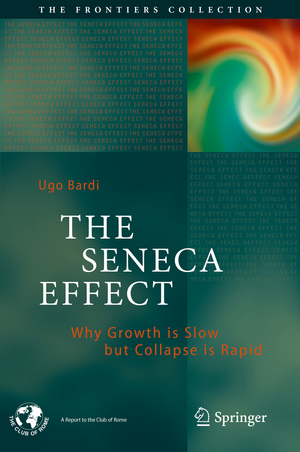
The Seneca Effect
Autor Ugo Bardien Limba Engleză Hardback – 7 sep 2017
Adresat studenților în științe sistemice, cercetătorilor din domeniul sustenabilității și practicienilor din politici publice, The Seneca Effect oferă un cadru analitic riguros pentru înțelegerea modului în care sistemele complexe se dezintegrează. Remarcăm efortul autorului Ugo Bardi de a transforma o observație filosofică stoică într-un model matematic și fizic valid, explicând de ce prăbușirea este adesea bruscă și neașteptată. Cartea nu este doar o trecere în revistă a dezastrelor, ci o explorare a mecanismelor de feedback care accelerează declinul. Structura volumului este una progresivă: începe cu „fizica ruperii” și analiza rețelelor, trece prin dinamica piețelor financiare și ajunge la macro-sisteme precum imperiile și ecosistemul planetar. Un capitol esențial analizează „Tragedia bunurilor comune” și modelele mondiale de prăbușire, oferind o perspectivă tehnică asupra limitelor creșterii. Această lucrare completează perspectiva oferită de The Collapse of Complex Societies de Joseph A. Tainter, adăugând o dimensiune modernă bazată pe dinamica sistemelor și simulări computerizate pe care Tainter nu le-a explorat în detaliu în 1988. Poziționăm acest titlu ca o sinteză teoretică a operei lui Bardi; dacă în The Limits to Growth Revisited autorul reevalua predicțiile anilor '70, iar în The Empty Sea se concentra pe resursele marine, The Seneca Effect reprezintă „teoria unificată” a autorului asupra rezilienței și fragilității. Recomandăm această ediție Springer pentru rigoarea cu care tratează subiecte adesea abordate senzaționalist, oferind în schimb pârghii pentru gestionarea schimbării.
Preț: 607.34 lei
Preț vechi: 714.51 lei
-15%
Carte tipărită la comandă
Livrare economică 05-19 decembrie
Specificații
ISBN-10: 3319572067
Pagini: 228
Ilustrații: XVIII, 210 p. 57 illus., 21 illus. in color.
Dimensiuni: 160 x 241 x 18 mm
Greutate: 0.46 kg
Ediția:1st edition 2017
Editura: Springer
Locul publicării:Cham, Switzerland
V-ar putea interesa
-
 Complexity: A Very Short IntroductionJohn H. Holland-20%Preț: 56.65 lei70.82 lei
 -
 Nonlinear SystemsShankar Sastry-15%Preț: 682.48 lei802.92 lei
 -
 Preț: 325.10 lei
 -
 Pattern Formation and Dynamics in Nonequilibrium SystemsMichael Cross-14%Preț: 828.27 lei963.10 lei
 -
 Preț: 454.49 lei
 -
 Toward Analytical Chaos in NonAlbert C J Luo-9%Preț: 838.76 lei921.71 lei
 -
 The Limits to Growth RevisitedUgo Bardi-15%Preț: 502.29 lei590.92 lei
 -
 Mathematical Methods in Biology and NeurobiologyJürgen Jost-15%Preț: 488.29 lei574.46 lei
 -
 Isospectral TransformationsLeonid BunimovichPreț: 402.24 lei
 -
 Henri Poincaré, 1912-2012Bertrand Duplantier-18%Preț: 812.88 lei991.31 lei
 -
 Dynamics of Quasi-Stable Dissipative SystemsIgor ChueshovPreț: 397.95 lei
 -
 Preț: 346.73 lei
De ce să citești această carte
Recomandăm această carte oricărui cititor interesat de viitorul civilizației care dorește să depășească retorica alarmistă în favoarea unei înțelegeri științifice. Veți câștiga o perspectivă clară asupra modului în care funcționează feedback-ul în sistemele economice și ecologice. Este un instrument esențial pentru a înțelege că prăbușirea nu este un eveniment extern, ci un proces intrinsec sistemelor supraîncărcate, oferind soluții pentru adaptare prin acceptarea schimbării.
Despre autor
Ugo Bardi este profesor de chimie fizică la Universitatea din Florența, în cadrul Departamentului de Științe ale Pământului. Expertiza sa acoperă dinamica sistemelor aplicată în economie, resursele minerale și energia regenerabilă. Ca membru al prestigiosului Club de la Roma și al comitetului științific ASPO, Bardi este o voce autoritară în studiul „vârfului petrolului” și al limitelor resurselor. Activitatea sa editorială la Frontiers in Energy Systems și contribuțiile pe platforme precum Resilience reflectă angajamentul său pentru fundamentarea științifică a politicilor de mediu, teme centrale în întreaga sa operă.
Cuprins
Recenzii
Notă biografică
Textul de pe ultima copertă
he concept of "feedback." From this foundation, Bardi applies the theory to real-world systems, from the mechanics of fracture and the collapse of large structures to financial collapses, famines and population collapses, the fall of entire civilizations, and the most dreadful collapse we can imagine: that of the planetary ecosystem generated by overexploitation and climate change. The final objective of the book is to describe a conclusion that the ancient stoic philosophers had already discovered long ago, but that modern system science has rediscovered today. If you want to avoid collapse you need to embrace change, not fight it. Neither a book about doom and gloom nor a cornucopianist's dream, The Seneca Effect goes to the heart of the challenges that we are facing today, helping us to manage our future rather than be managed by it.
"The Seneca Effect" is probably the most important contribution to our understanding of societal collapse since Jo
seph Tainter's 1988 masterpiece, "The Collapse of Complex Societies." Since we live in a society that is just in the process of rounding the curve from growth to decline, this is information that should be of keen interest to every intelligent person. Richard Heinberg, Senior Fellow, Post Carbon Institute, Author, The End of Growth
Why do human societies collapse? With today's environmental, social and political challenges it is a question that is more than academic. What can we learn from history? How can we avoid the pitfalls? In this fascinating, well written book, Ugo Bardi provides many of the answers. Here is a book to feast on, to devour and be stimulated by, a book packed full of insights and ideas which will leave the reader satisfied, curious and stimulated. Simply wonderful.
Graeme Maxton, Secretary General of the Club of Rome