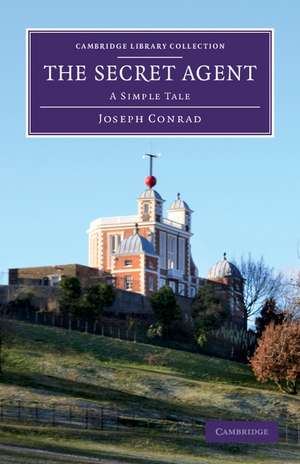
The Secret Agent: A Simple Tale: Cambridge Library Collection - Fiction and Poetry
Autor Joseph Conraden Limba Engleză Hardback – 8 mai 2013


Preț: 682.91 lei
Preț vechi: 843.09 lei
-19%
Puncte Express: 1024
Carte tipărită la comandă
Livrare economică 02-16 decembrie
Livrare prin curier în România Termenul estimat este afișat lângă disponibilitate.
Transport gratuit pentru acest produs Plată online sau ramburs, în funcție de opțiunile comenzii.
Retur gratuit în 14 zile Comandă securizată și suport în română.
Specificații
ISBN-13: 9781108060394
ISBN-10: 1108060390
Pagini: 454
Dimensiuni: 140 x 216 x 29 mm
Greutate: 0.72 kg
Editura: Cambridge University Press
Colecția Cambridge University Press
Seria Cambridge Library Collection - Fiction and Poetry
Locul publicării:Cambridge, United Kingdom
ISBN-10: 1108060390
Pagini: 454
Dimensiuni: 140 x 216 x 29 mm
Greutate: 0.72 kg
Editura: Cambridge University Press
Colecția Cambridge University Press
Seria Cambridge Library Collection - Fiction and Poetry
Locul publicării:Cambridge, United Kingdom
V-ar putea interesa
-
 And Then There Were NoneAgatha ChristiePreț: 61.56 lei
 -
 Hardy, Conrad and the SensesHugh Epstein-17%Preț: 188.22 lei225.74 lei
 -
 Almayer?s FollyJoseph ConradPreț: 65.03 lei
 -
 Heart of Darkness and NostromoJoseph ConradPreț: 139.56 lei
 -
 Le Negre Du NarcisseJoseph ConradPreț: 86.12 lei
 -
 Das Herz Der Finsternis (Grossdruck)Joseph ConradPreț: 57.89 lei
 -
 The Mirror of the Sea Memories and ImpressionsJoseph ConradPreț: 44.99 lei
 -
 To MorrowJoseph ConradPreț: 87.06 lei
 -
 Twixt Land and Sea TalesJoseph ConradPreț: 99.70 lei
 -
 The InheritorsJoseph ConradPreț: 50.02 lei
 -
 Preț: 177.30 lei
 -
 Preț: 223.20 lei
 -
 LéonneTbdPreț: 176.70 lei
 -
 Preț: 177.51 lei
 -
 Preț: 176.46 lei
 -
 Preț: 192.04 lei
 -
 Preț: 101.31 lei
 -
 Preț: 207.95 lei
 -
 Preț: 207.73 lei
 -
 Preț: 87.38 lei
 -
 A Historical Sketch of Hamilton College, Clinton, New YorkCharles Elmer AllisonPreț: 144.00 lei
 -
 Beautiful HomesHenry T. WilliamsPreț: 235.55 lei
 -
 Seven Dozen GemsJ. P ThorndykePreț: 174.46 lei
 -
 Seven ConventionsAugustus W. ClasonPreț: 152.71 lei
 -
 Grover ClevelandJames Lowry WhittlePreț: 185.39 lei
 -
 Raum 22 Erinnerungen treiben und schweifen umherJürgen TimmPreț: 81.84 lei
Notă biografică
Joseph Conrad (1857 - 1924) was a Polish-British writer regarded as one of the greatest novelists to write in the English language. He joined the British merchant marine in 1878, and was granted British citizenship in 1886. Though he did not speak English fluently until his twenties, he was a master prose stylist who brought a non-English sensibility into English literature. He wrote stories and novels, many with a nautical setting, that depict trials of the human spirit in the midst of an impassive, inscrutable universe.
Conrad is considered an early modernist, though his works still contain elements of 19th-century realism. His narrative style and anti-heroic characters have influenced numerous authors and many films have been adapted from, or inspired by, his works.
Writing in the heyday of the British Empire, Conrad drew on his native Poland's national experiences and his own experiences in the French and British merchant navies, to create short stories and novels that reflect aspects of a European-dominated world-including imperialism and colonialism-and that profoundly explore the human psyche.
Descriere
Originally published in 1907, this classic novel is an exploration of terrorism and anarchism in late nineteenth-century London.
Textul de pe ultima copertă
At first, Joseph Conrad did not dare to call this book a novel. He traveled to Montpellier in February 1906 with his small family, telling himself that he was composing a short story, entitled 'Verloc', the name of the central character. As always, he wrote slowly, in a stubborn mood of exasperation an uncertainty, laboring in a foreign language.
Recenzii
The Secret Agent is set in the seedy world of Adolf Verloc, a storekeeper and double agent in late-Victorian London who pretends to sympathize with a group of international anarchists but reports on their activities to both the Russian embassy and the British government. As he is drawn further into a terrorist bombing plot, his family also becomes involved, with devastating consequences. Based on a real-life failed anarchist plot, The Secret Agent is both intimately engaged with its historical moment and profoundly relevant today.
This new Broadview Edition helps to recreate the historical context that informed Conrad’s preoccupations with global terrorism, human degeneration, the relativity of time, and the position of women.
“Tanya Agathocleous’s edition of Joseph Conrad’s The Secret Agent, a tale of espionage in the age of ennui, is an excellent, important, and timely addition to the Broadview list. In the first decade of the twenty-first century, the novel uncannily speaks to a range of concerns that continue to preoccupy us—metropolitanism and cosmopolitanism, political terror, degeneracy and the “ends” of history, the collapse of boundaries between domestic and public life, the State’s intrusion into the lives of its citizens—issues that insist on a deep and careful understanding of their historical antecedents. Professor Agathocleous has judiciously selected materials from Conrad’s moment that will effectively immerse students in the social, political, and intellectual milieu of Conrad’s novel.” — Joseph McLaughlin, Ohio University
“An outstanding edition. First-time readers will welcome the eloquent introductory essay, which places The Secret Agent in the context of both Victorianism and modernism, as well as the very useful supplementary materials on anarchism and degeneration. And those already familiar with the novel will be prompted to re-read it in light of Agathocleous’s claim that Conrad, along with his New Woman contemporaries, is exploring marriage and the condition of women as well.” — Amanda Claybaugh, Columbia University
This new Broadview Edition helps to recreate the historical context that informed Conrad’s preoccupations with global terrorism, human degeneration, the relativity of time, and the position of women.
“Tanya Agathocleous’s edition of Joseph Conrad’s The Secret Agent, a tale of espionage in the age of ennui, is an excellent, important, and timely addition to the Broadview list. In the first decade of the twenty-first century, the novel uncannily speaks to a range of concerns that continue to preoccupy us—metropolitanism and cosmopolitanism, political terror, degeneracy and the “ends” of history, the collapse of boundaries between domestic and public life, the State’s intrusion into the lives of its citizens—issues that insist on a deep and careful understanding of their historical antecedents. Professor Agathocleous has judiciously selected materials from Conrad’s moment that will effectively immerse students in the social, political, and intellectual milieu of Conrad’s novel.” — Joseph McLaughlin, Ohio University
“An outstanding edition. First-time readers will welcome the eloquent introductory essay, which places The Secret Agent in the context of both Victorianism and modernism, as well as the very useful supplementary materials on anarchism and degeneration. And those already familiar with the novel will be prompted to re-read it in light of Agathocleous’s claim that Conrad, along with his New Woman contemporaries, is exploring marriage and the condition of women as well.” — Amanda Claybaugh, Columbia University