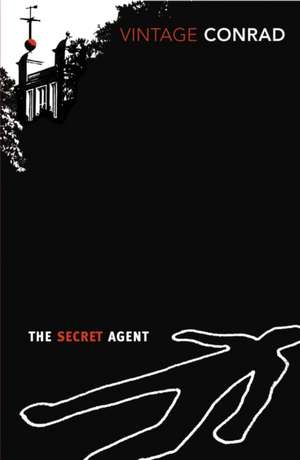
The Secret Agent
Autor Joseph Conraden Limba Engleză Paperback – 6 sep 2007
Read the world's first political thriller.
London is under threat. It has become a haven for political exiles and anarchists. Frequent bomb threats and disturbances interrupt the lives of the city's inhabitants, who live in fear of the terrorists in their midst. One such terrorist is Verloc. He is the secret agent who is given the mission to strike right at the heart of London's pride by blowing up Greenwich Observatory. But his decision to drag his innocent family into the plot leads to tragic consequences on a more personal than political level.
WITH AN INTRODUCTION BY GILES FODEN
Preț: 48.56 lei
Preț vechi: 65.50 lei
-26%
Puncte Express: 73
Carte disponibilă
Livrare economică 19-25 noiembrie
Livrare express 03-07 noiembrie pentru 38.18 lei
Livrare prin curier în România Termenul estimat este afișat lângă disponibilitate.
Transport gratuit de la 400.00 lei Plată online sau ramburs, în funcție de opțiunile comenzii.
Retur gratuit în 14 zile Comandă securizată și suport în română.
Specificații
ISBN-13: 9780099511533
ISBN-10: 0099511533
Pagini: 320
Dimensiuni: 129 x 197 x 22 mm
Greutate: 0.24 kg
Editura: Vintage Publishing
ISBN-10: 0099511533
Pagini: 320
Dimensiuni: 129 x 197 x 22 mm
Greutate: 0.24 kg
Editura: Vintage Publishing
V-ar putea interesa
-
 And Then There Were NoneAgatha ChristiePreț: 61.56 lei
 -
 Hardy, Conrad and the SensesHugh Epstein-17%Preț: 188.22 lei225.74 lei
 -
 Almayer?s FollyJoseph ConradPreț: 65.03 lei
 -
 Heart of Darkness and NostromoJoseph ConradPreț: 139.56 lei
 -
 Le Negre Du NarcisseJoseph ConradPreț: 86.12 lei
 -
 Das Herz Der Finsternis (Grossdruck)Joseph ConradPreț: 57.89 lei
 -
 The Mirror of the Sea Memories and ImpressionsJoseph ConradPreț: 44.99 lei
 -
 To MorrowJoseph ConradPreț: 87.06 lei
 -
 Twixt Land and Sea TalesJoseph ConradPreț: 99.70 lei
 -
 The InheritorsJoseph ConradPreț: 50.02 lei
 -
 Preț: 177.30 lei
 -
 Preț: 223.20 lei
 -
 LéonneTbdPreț: 176.70 lei
 -
 Preț: 177.51 lei
 -
 Preț: 176.46 lei
 -
 Preț: 192.04 lei
 -
 Preț: 101.31 lei
 -
 Preț: 207.95 lei
 -
 Preț: 207.73 lei
 -
 Preț: 90.21 lei
 -
 A Historical Sketch of Hamilton College, Clinton, New YorkCharles Elmer AllisonPreț: 144.00 lei
 -
 Beautiful HomesHenry T. WilliamsPreț: 235.55 lei
 -
 Seven Dozen GemsJ. P ThorndykePreț: 174.46 lei
 -
 Seven ConventionsAugustus W. ClasonPreț: 152.71 lei
 -
 Grover ClevelandJames Lowry WhittlePreț: 185.39 lei
 -
 Raum 22 Erinnerungen treiben und schweifen umherJürgen TimmPreț: 81.84 lei
Recenzii
"Perenially fascinating... When Joseph Conrad wrote The Secret Agent he was responding imaginatively to a real botched bomb attack on Greenwich, at a time when there was real panic about anarchist extremism throughout Europe" Guardian "An astonishing book" -- Ford Madox Ford "This damp, dark thriller dances about on satirical feet, from its opening paragraph to the very last, where it suddenly plunges like Chernobyl's core to our own apocalyptic times, seamed with petit-bourgeois envy and crazed fundamentalist dreams. Whether attacking the former or the latter, Conrad never lets go of his grim, twitchy smile." -- Adam Thorpe Guardian "One of the two unquestionable classics of the first order that [Conrad] added to the English novel" -- F.R. Leavis
Notă biografică
Józef Teodor Konrad Nalecz Korzeniowski was born in the Ukraine on 3 December 1857. His parents were Polish and had both died in exile by the time Conrad was eleven. His uncle then became his guardian and looked after him in Krakow until he was sixteen when he went to sea and sailed on French and British ships. He was made British citizen in 1886 and changed his name to Joseph Conrad. In 1889 Conrad visited the Congo and his experiences there inspired Heart of Darkness. In 1894 he published his first novel, Almayer's Folly and went on to write nineteen more as well as many short stories, essays and a memoir. In 1896 he married Jessie George and they later had two sons. Conrad died on 3 August 1924.
Textul de pe ultima copertă
At first, Joseph Conrad did not dare to call this book a novel. He traveled to Montpellier in February 1906 with his small family, telling himself that he was composing a short story, entitled 'Verloc', the name of the central character. As always, he wrote slowly, in a stubborn mood of exasperation an uncertainty, laboring in a foreign language.
Descriere
Descriere de la o altă ediție sau format:
The Secret Agent is set in the seedy world of Adolf Verloc, a storekeeper and double agent in late-Victorian London who pretends to sympathize with a group of international anarchists but reports on their activities to both the Russian embassy and the British government. As he is drawn further into a terrorist bombing plot, his family also becomes involved, with devastating consequences. Based on a real-life failed anarchist plot, The Secret Agent is both intimately engaged with its historical moment and profoundly relevant today.
This new Broadview Edition helps to recreate the historical context that informed Conrad’s preoccupations with global terrorism, human degeneration, the relativity of time, and the position of women.
The Secret Agent is set in the seedy world of Adolf Verloc, a storekeeper and double agent in late-Victorian London who pretends to sympathize with a group of international anarchists but reports on their activities to both the Russian embassy and the British government. As he is drawn further into a terrorist bombing plot, his family also becomes involved, with devastating consequences. Based on a real-life failed anarchist plot, The Secret Agent is both intimately engaged with its historical moment and profoundly relevant today.
This new Broadview Edition helps to recreate the historical context that informed Conrad’s preoccupations with global terrorism, human degeneration, the relativity of time, and the position of women.
Cuprins
Acknowledgements
Introduction
Joseph Conrad: A Brief Chronology
A Note on the Text
Author’s Note
The Secret Agent
Appendix A: London
Introduction
Joseph Conrad: A Brief Chronology
A Note on the Text
Author’s Note
The Secret Agent
Appendix A: London
- From Charles Dickens, Bleak House (1853)
- From Ford Madox Hueffer, The Soul of London: A Survey of a Modern City (1905)
- From The Times (16 February 1894)
- From Isabel Meredith, A Girl Among the Anarchists (1903)
- From Joseph Conrad, a letter to R.B. Cunninghame Graham (20 December 1897)
- From Joseph Conrad, a letter to R.B. Cunninghame Graham (7 October 1907)
- From Peter Kropotkin, “Anarchism,” Encyclopaedia Britannica (1910)
- Peter Kropotkin, “The Scientific Bases of Anarchy” (1887)
- From Report of the Royal Commission on Alien Immigration (1903)
- From The Saturday Review (9 June 1906)
- From Charles Darwin, Expression of the Emotions in Man and Animal (1872)
- From E. Ray Lankester, Degeneration: A Chapter in Darwinism (1880)
- From Cesare Lombroso, “Illustrative Studies in Criminal Anthropology: The Physiognomy of the Anarchists” (1890)
- From Max Nordau, Degeneration (1892)
- From William Thomson, “On a Universal Tendency in Nature to the Dissipation of Mechanical Energy” (1852)
- From William Thomson, “On the Age of the Sun’s Heat” (1862)
- From Algernon Charles Swinburne, “The Garden of Proserpine” (1866)
- From Balfour Stewart and J. Norman Lockyer, “The Sun as a Type of the Material Universe” (1868)
- From Coventry Patmore, “The Angel in the House” (1863)
- From John Ruskin, Sesame and Lilies (1865)
- From Mona Caird, “Marriage” (1888)
- From Sarah Grand, “The New Aspect of the Woman Question” (1894)
- From Hugh E.M. Stutfield, “The Psychology of Feminism” (1897)
- Country Life (21 September 1907)
- E.V. Lucas, Times Literary Supplement (20 September 1907)
- New York Times Book Review (21 September 1907)
- Edward Garnett, The Nation (26 September 1907)
- William Morton Payne, The Dial (16 October 1907)
- Glasgow News (3 October 1907)
- John Galsworthy, Fortnightly Review (1 April 1908)