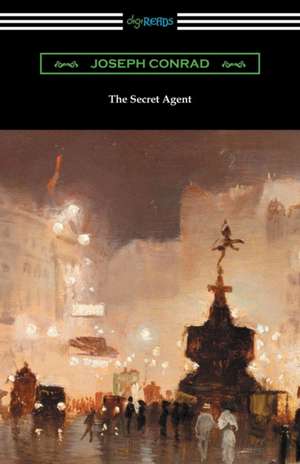
The Secret Agent
Autor Joseph Conraden Limba Engleză Paperback – 18 sep 2018
Preț: 75.56 lei
Puncte Express: 113
Carte tipărită la comandă
Livrare economică 03-17 decembrie
Livrare prin curier în România Termenul estimat este afișat lângă disponibilitate.
Transport gratuit de la 400.00 lei Plată online sau ramburs, în funcție de opțiunile comenzii.
Retur gratuit în 14 zile Comandă securizată și suport în română.
Specificații
ISBN-13: 9781420958997
ISBN-10: 1420958992
Pagini: 190
Dimensiuni: 140 x 216 x 11 mm
Greutate: 0.25 kg
Editura: Digireads.com
ISBN-10: 1420958992
Pagini: 190
Dimensiuni: 140 x 216 x 11 mm
Greutate: 0.25 kg
Editura: Digireads.com
V-ar putea interesa
-
 And Then There Were NoneAgatha ChristiePreț: 61.56 lei
 -
 Hardy, Conrad and the SensesHugh Epstein-17%Preț: 188.22 lei225.74 lei
 -
 Almayer?s FollyJoseph ConradPreț: 65.03 lei
 -
 Heart of Darkness and NostromoJoseph ConradPreț: 139.56 lei
 -
 Le Negre Du NarcisseJoseph ConradPreț: 86.12 lei
 -
 Das Herz Der Finsternis (Grossdruck)Joseph ConradPreț: 57.89 lei
 -
 The Mirror of the Sea Memories and ImpressionsJoseph ConradPreț: 44.99 lei
 -
 To MorrowJoseph ConradPreț: 87.06 lei
 -
 Twixt Land and Sea TalesJoseph ConradPreț: 99.70 lei
 -
 The InheritorsJoseph ConradPreț: 50.02 lei
 -
 Preț: 177.30 lei
 -
 Preț: 223.20 lei
 -
 LéonneTbdPreț: 176.70 lei
 -
 Preț: 177.51 lei
 -
 Preț: 176.46 lei
 -
 Preț: 192.04 lei
 -
 Preț: 101.31 lei
 -
 Preț: 207.95 lei
 -
 Preț: 207.73 lei
 -
 Preț: 87.38 lei
 -
 A Historical Sketch of Hamilton College, Clinton, New YorkCharles Elmer AllisonPreț: 144.00 lei
 -
 Beautiful HomesHenry T. WilliamsPreț: 235.55 lei
 -
 Seven Dozen GemsJ. P ThorndykePreț: 174.46 lei
 -
 Seven ConventionsAugustus W. ClasonPreț: 152.71 lei
 -
 Grover ClevelandJames Lowry WhittlePreț: 185.39 lei
 -
 Raum 22 Erinnerungen treiben und schweifen umherJürgen TimmPreț: 81.84 lei
Notă biografică
Joseph Conrad (1857-1924) was a Polish-born British novelist widely regarded as one of the greatest writers in the English language. After a long career at sea in the British merchant marine, Conrad turned to writing and produced a series of influential novels exploring imperialism, morality, and the complexities of human character. His major works include Heart of Darkness, Lord Jim, and Nostromo. Known for his rich prose and psychological insight, Conrad's fiction often examines the darker aspects of human nature and the moral ambiguities of modern life.
Textul de pe ultima copertă
At first, Joseph Conrad did not dare to call this book a novel. He traveled to Montpellier in February 1906 with his small family, telling himself that he was composing a short story, entitled 'Verloc', the name of the central character. As always, he wrote slowly, in a stubborn mood of exasperation an uncertainty, laboring in a foreign language.
Recenzii
The Secret Agent is set in the seedy world of Adolf Verloc, a storekeeper and double agent in late-Victorian London who pretends to sympathize with a group of international anarchists but reports on their activities to both the Russian embassy and the British government. As he is drawn further into a terrorist bombing plot, his family also becomes involved, with devastating consequences. Based on a real-life failed anarchist plot, The Secret Agent is both intimately engaged with its historical moment and profoundly relevant today.
This new Broadview Edition helps to recreate the historical context that informed Conrad’s preoccupations with global terrorism, human degeneration, the relativity of time, and the position of women.
“Tanya Agathocleous’s edition of Joseph Conrad’s The Secret Agent, a tale of espionage in the age of ennui, is an excellent, important, and timely addition to the Broadview list. In the first decade of the twenty-first century, the novel uncannily speaks to a range of concerns that continue to preoccupy us—metropolitanism and cosmopolitanism, political terror, degeneracy and the “ends” of history, the collapse of boundaries between domestic and public life, the State’s intrusion into the lives of its citizens—issues that insist on a deep and careful understanding of their historical antecedents. Professor Agathocleous has judiciously selected materials from Conrad’s moment that will effectively immerse students in the social, political, and intellectual milieu of Conrad’s novel.” — Joseph McLaughlin, Ohio University
“An outstanding edition. First-time readers will welcome the eloquent introductory essay, which places The Secret Agent in the context of both Victorianism and modernism, as well as the very useful supplementary materials on anarchism and degeneration. And those already familiar with the novel will be prompted to re-read it in light of Agathocleous’s claim that Conrad, along with his New Woman contemporaries, is exploring marriage and the condition of women as well.” — Amanda Claybaugh, Columbia University
This new Broadview Edition helps to recreate the historical context that informed Conrad’s preoccupations with global terrorism, human degeneration, the relativity of time, and the position of women.
“Tanya Agathocleous’s edition of Joseph Conrad’s The Secret Agent, a tale of espionage in the age of ennui, is an excellent, important, and timely addition to the Broadview list. In the first decade of the twenty-first century, the novel uncannily speaks to a range of concerns that continue to preoccupy us—metropolitanism and cosmopolitanism, political terror, degeneracy and the “ends” of history, the collapse of boundaries between domestic and public life, the State’s intrusion into the lives of its citizens—issues that insist on a deep and careful understanding of their historical antecedents. Professor Agathocleous has judiciously selected materials from Conrad’s moment that will effectively immerse students in the social, political, and intellectual milieu of Conrad’s novel.” — Joseph McLaughlin, Ohio University
“An outstanding edition. First-time readers will welcome the eloquent introductory essay, which places The Secret Agent in the context of both Victorianism and modernism, as well as the very useful supplementary materials on anarchism and degeneration. And those already familiar with the novel will be prompted to re-read it in light of Agathocleous’s claim that Conrad, along with his New Woman contemporaries, is exploring marriage and the condition of women as well.” — Amanda Claybaugh, Columbia University
Descriere
Descriere de la o altă ediție sau format:
The Secret Agent is set in the seedy world of Adolf Verloc, a storekeeper and double agent in late-Victorian London who pretends to sympathize with a group of international anarchists but reports on their activities to both the Russian embassy and the British government. As he is drawn further into a terrorist bombing plot, his family also becomes involved, with devastating consequences. Based on a real-life failed anarchist plot, The Secret Agent is both intimately engaged with its historical moment and profoundly relevant today.
This new Broadview Edition helps to recreate the historical context that informed Conrad’s preoccupations with global terrorism, human degeneration, the relativity of time, and the position of women.
The Secret Agent is set in the seedy world of Adolf Verloc, a storekeeper and double agent in late-Victorian London who pretends to sympathize with a group of international anarchists but reports on their activities to both the Russian embassy and the British government. As he is drawn further into a terrorist bombing plot, his family also becomes involved, with devastating consequences. Based on a real-life failed anarchist plot, The Secret Agent is both intimately engaged with its historical moment and profoundly relevant today.
This new Broadview Edition helps to recreate the historical context that informed Conrad’s preoccupations with global terrorism, human degeneration, the relativity of time, and the position of women.
Cuprins
Acknowledgements
Introduction
Joseph Conrad: A Brief Chronology
A Note on the Text
Author’s Note
The Secret Agent
Appendix A: London
Introduction
Joseph Conrad: A Brief Chronology
A Note on the Text
Author’s Note
The Secret Agent
Appendix A: London
- From Charles Dickens, Bleak House (1853)
- From Ford Madox Hueffer, The Soul of London: A Survey of a Modern City (1905)
- From The Times (16 February 1894)
- From Isabel Meredith, A Girl Among the Anarchists (1903)
- From Joseph Conrad, a letter to R.B. Cunninghame Graham (20 December 1897)
- From Joseph Conrad, a letter to R.B. Cunninghame Graham (7 October 1907)
- From Peter Kropotkin, “Anarchism,” Encyclopaedia Britannica (1910)
- Peter Kropotkin, “The Scientific Bases of Anarchy” (1887)
- From Report of the Royal Commission on Alien Immigration (1903)
- From The Saturday Review (9 June 1906)
- From Charles Darwin, Expression of the Emotions in Man and Animal (1872)
- From E. Ray Lankester, Degeneration: A Chapter in Darwinism (1880)
- From Cesare Lombroso, “Illustrative Studies in Criminal Anthropology: The Physiognomy of the Anarchists” (1890)
- From Max Nordau, Degeneration (1892)
- From William Thomson, “On a Universal Tendency in Nature to the Dissipation of Mechanical Energy” (1852)
- From William Thomson, “On the Age of the Sun’s Heat” (1862)
- From Algernon Charles Swinburne, “The Garden of Proserpine” (1866)
- From Balfour Stewart and J. Norman Lockyer, “The Sun as a Type of the Material Universe” (1868)
- From Coventry Patmore, “The Angel in the House” (1863)
- From John Ruskin, Sesame and Lilies (1865)
- From Mona Caird, “Marriage” (1888)
- From Sarah Grand, “The New Aspect of the Woman Question” (1894)
- From Hugh E.M. Stutfield, “The Psychology of Feminism” (1897)
- Country Life (21 September 1907)
- E.V. Lucas, Times Literary Supplement (20 September 1907)
- New York Times Book Review (21 September 1907)
- Edward Garnett, The Nation (26 September 1907)
- William Morton Payne, The Dial (16 October 1907)
- Glasgow News (3 October 1907)
- John Galsworthy, Fortnightly Review (1 April 1908)