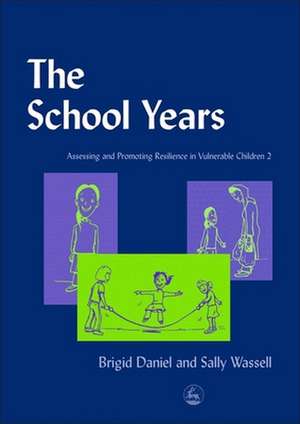
The School Years: Assessing and Promoting Resilience in Vulnerable Children 2
Autor Brigid Daniel, Sally Wassellen Limba Engleză Paperback – 15 iul 2002
They discuss nurturing factors relevant to children across the school years age range, such as moral reasoning and empathy, awareness of other people's intentions and the ability to see situations from different perspectives. The authors describe techniques for drawing out such positive behaviour in discussion and observation, through stories, questions and activities. With a strong emphasis on application and encouragement, this workbook is ideal for the busy social or family worker who wants practical guidance on evaluation, intervention and ongoing support.
This workbook stands alone but also forms part of a set along with two other resilience resources on The Early Years and Adolescence.
Preț: 140.79 lei
Preț vechi: 176.97 lei
-20%
Puncte Express: 211
Carte disponibilă
Livrare economică 11-25 mai
Specificații
ISBN-13: 9781843100188
ISBN-10: 1843100185
Pagini: 160
Ilustrații: Illustrations
Dimensiuni: 210 x 296 x 9 mm
Greutate: 0.45 kg
Editura: JESSICA KINGSLEY PUBLISHERS
Colecția Jessica Kingsley Publishers
Locul publicării:London, United Kingdom
ISBN-10: 1843100185
Pagini: 160
Ilustrații: Illustrations
Dimensiuni: 210 x 296 x 9 mm
Greutate: 0.45 kg
Editura: JESSICA KINGSLEY PUBLISHERS
Colecția Jessica Kingsley Publishers
Locul publicării:London, United Kingdom
V-ar putea interesa
-
 Kith: The Riddle of the ChildscapeJay GriffithsPreț: 115.95 lei
 -
 -28%Preț: 500.10 lei698.72 lei
 -
 TasunkaDonald F. MontileauxPreț: 112.88 lei
 -
 Great Myths of Child DevelopmentStephen HuppPreț: 139.53 lei
 -
 Preț: 356.32 lei
 -
 Children's Emotions in Policy and PracticeMatej BlazekPreț: 381.92 lei
 -
 Media and the Sexualization of ChildhoodBarrie GunterPreț: 347.23 lei
 -
 -22%Preț: 390.85 lei501.09 lei
 -
 -21%Preț: 139.35 lei176.09 lei
 -
 -26%Preț: 207.53 lei280.80 lei
 -
 -45%Preț: 207.15 lei377.64 lei
 -
 Child Well-Being: Understanding Children's LivesSylda Langford-25%Preț: 233.09 lei312.76 lei
 -
 -22%Preț: 364.48 lei467.62 lei
 -
 -26%Preț: 188.12 lei253.64 lei
 -
 -40%Preț: 156.41 lei260.14 lei
 -
 -27%Preț: 203.35 lei278.11 lei
 -
 -26%Preț: 232.69 lei312.44 lei
Recenzii
(Review for the 3 Volume Set)
'Designed to be used by practitioners in their work with complex people and their families and carers, these excellent workbooks provide some of the best materials I have seen for experienced and not so experienced practitioners. They should be on the shelves of every department working with vulnerable young people.'
The workbooks are easy to read and use the same format in each volume. They explain resilience theory and encourage practitioners to place intervention and assessment within ecological framework. This entails considering what resources might be available to the child at each of three levels: child, family relations and wider community... The workbooks would be invaluable to parents/carers/foster families and those practitioners who have little child development knowledge. For students and occupational therapists who are new to working with children, they would be a very useful adjunct to learning, to the advanced practitioner they would be a refreshing revisit to child development in relation to occupational lifestyle.
These three workbooks are a welcome and important addition to the tools available to childcare social workers, foster carers, residential workers and others involved in assessment and direct work with children and young people. Each book stands alone and could be used to inform and illuminate work with a particular child. Taken as a set they are a rich and lasting resource.
'Designed to be used by practitioners in their work with complex people and their families and carers, these excellent workbooks provide some of the best materials I have seen for experienced and not so experienced practitioners. They should be on the shelves of every department working with vulnerable young people.'
The workbooks are easy to read and use the same format in each volume. They explain resilience theory and encourage practitioners to place intervention and assessment within ecological framework. This entails considering what resources might be available to the child at each of three levels: child, family relations and wider community... The workbooks would be invaluable to parents/carers/foster families and those practitioners who have little child development knowledge. For students and occupational therapists who are new to working with children, they would be a very useful adjunct to learning, to the advanced practitioner they would be a refreshing revisit to child development in relation to occupational lifestyle.
These three workbooks are a welcome and important addition to the tools available to childcare social workers, foster carers, residential workers and others involved in assessment and direct work with children and young people. Each book stands alone and could be used to inform and illuminate work with a particular child. Taken as a set they are a rich and lasting resource.
Cuprins
Acknowledgements 1. Introduction to Resilience. 2. When and How to use Workbook. 3. Secure Base. 4. Education. 5. Friendships. 6. Talents and Interests. 7. Positive Values. 8. Social Competencies. 9. Intervention. 10. Case Studies. Appendix. Bibliography. Index.