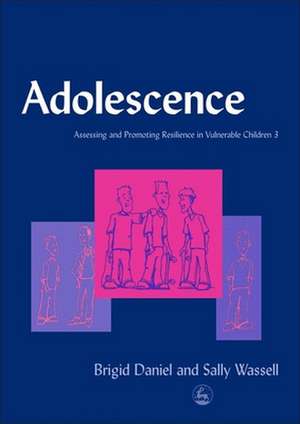
Adolescence: Assessing and Promoting Resilience in Vulnerable Children 3
Autor Sally Wassell, Brigid Danielen Limba Engleză Paperback – 15 iul 2002
Focusing on different areas in which resilience can be cultivated, this practical guide offers an applied perspective on procedures of need assessment and intervention. Grounded in theory and developed through work within real cases, it offers guidance for continuing support and will be an invaluable source of encouragement and instruction for social workers working with young people in troubled circumstances.
Preț: 216.74 lei
Preț vechi: 290.20 lei
-25%
Puncte Express: 325
Carte disponibilă
Livrare economică 09-23 noiembrie
Livrare prin curier în România Termenul estimat este afișat lângă disponibilitate.
Transport gratuit de la 400.00 lei Plată online sau ramburs, în funcție de opțiunile comenzii.
Retur gratuit în 14 zile Comandă securizată și suport în română.
Specificații
ISBN-13: 9781843100195
ISBN-10: 1843100193
Pagini: 176
Ilustrații: black & white illustrations
Dimensiuni: 211 x 296 x 10 mm
Greutate: 0.49 kg
Ediția:3
Editura: JESSICA KINGSLEY PUBLISHERS
Colecția Jessica Kingsley Publishers
Locul publicării:London, United Kingdom
ISBN-10: 1843100193
Pagini: 176
Ilustrații: black & white illustrations
Dimensiuni: 211 x 296 x 10 mm
Greutate: 0.49 kg
Ediția:3
Editura: JESSICA KINGSLEY PUBLISHERS
Colecția Jessica Kingsley Publishers
Locul publicării:London, United Kingdom
V-ar putea interesa
-
 Go Ask AliceAnonymous-20%Preț: 62.44 lei77.99 lei
 -
 Preț: 392.94 lei
 -
 The Good TeenRichard M. LernerPreț: 95.82 lei
 -
 Adolescent Sleep PatternsMary A. Carskadon-5%Preț: 289.14 lei304.36 lei
 -
 Adolescence: Continuity, Change, and DiversityNancy J. Cobb-27%Preț: 1283.46 lei1758.16 lei
 -
 Grow the Tree You GotTom SturgesPreț: 134.57 lei
 -
 -20%Preț: 145.53 lei181.98 lei
 -
 -20%Preț: 147.05 lei182.91 lei
 -
 Preț: 258.27 lei
 -
 -25%Preț: 199.69 lei265.85 lei
 -
 -39%Preț: 163.35 lei268.85 lei
 -
 -26%Preț: 212.38 lei286.88 lei
 -
 -21%Preț: 107.70 lei136.21 lei
Recenzii
(Review for the 3 Volume Set)
'The workbooks are easy to read and use the same format in each volume. They explain resilience theory and encourage practitioners to place intervention and assessment within ecological framework. This entails considering what resources might be available to the child at each of three levels: child, family relations and wider community... The workbooks would be invaluable to parents/carers/foster families and those practitioners who have little child development knowledge. For students and occupational therapists who are new to working with children, they would be a very useful adjunct to learning, to the advanced practitioner they would be a refreshing revisit to child development in relation to occupational lifestyle.'
These three workbooks are a welcome and important addition to the tools available to childcare social workers, foster carers, residential workers and others involved in assessment and direct work with children and young people. Each book stands alone and could be used to inform and illuminate work with a particular child. Taken as a set they are a rich and lasting resource.
This is a very easy to read and understand book. The assessment section sets out the theory behind an area that resilience can be fostered, i.e. social competence or education, in an easily understandable way and then provides a framework for assessing resilience in that area through questions and practical methods. All is done within Brofenbrenner's ecological framework, which gives a good sociological context to the work. Interventions are given as practical examples and principles of the work.
It forms an accessible workbook for those working with young people in difficult family and personal circumstances.
'The workbooks are easy to read and use the same format in each volume. They explain resilience theory and encourage practitioners to place intervention and assessment within ecological framework. This entails considering what resources might be available to the child at each of three levels: child, family relations and wider community... The workbooks would be invaluable to parents/carers/foster families and those practitioners who have little child development knowledge. For students and occupational therapists who are new to working with children, they would be a very useful adjunct to learning, to the advanced practitioner they would be a refreshing revisit to child development in relation to occupational lifestyle.'
These three workbooks are a welcome and important addition to the tools available to childcare social workers, foster carers, residential workers and others involved in assessment and direct work with children and young people. Each book stands alone and could be used to inform and illuminate work with a particular child. Taken as a set they are a rich and lasting resource.
This is a very easy to read and understand book. The assessment section sets out the theory behind an area that resilience can be fostered, i.e. social competence or education, in an easily understandable way and then provides a framework for assessing resilience in that area through questions and practical methods. All is done within Brofenbrenner's ecological framework, which gives a good sociological context to the work. Interventions are given as practical examples and principles of the work.
It forms an accessible workbook for those working with young people in difficult family and personal circumstances.
Cuprins
Acknowledgements 1. Introduction to Resilience. 2. When and How to use Workbook. 3. Secure Base. 4. Education. 5. Friendships. 6. Talents and Interests. 7. Positive Values. 8. Social Competencies. 9. Intervention. 10. Case Studies. Appendix. Bibliography. Index