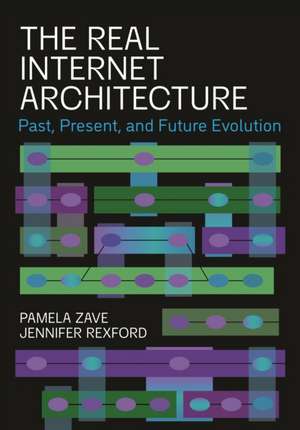
The Real Internet Architecture
Autor Pamela Zave, Jennifer Rexforden Limba Engleză Paperback – 6 aug 2024
Prin parcurgerea lucrării The Real Internet Architecture, cititorul va implementa o înțelegere structurală modernă a modului în care funcționează rețelele globale astăzi, dincolo de limitările teoretice ale modelului OSI. Subliniem faptul că abordarea propusă de Pamela Zave și Jennifer Rexford reprezintă o schimbare de paradigmă: trecerea de la modelul clasic cu cinci straturi, considerat de autoare un obstacol în cercetarea modernă, către „arhitectura de rețea compozițională”. Această structură nouă permite o analiză precisă a modului în care Internetul a evoluat pentru a integra servicii complexe de securitate, mobilitate și multicast. Remarcăm echilibrul atent între rigoarea formală și aplicabilitatea practică. Deși volumul are la bază un model conceptual abstract, acesta este ancorat în realitate prin sute de exemple contemporane. Spre deosebire de Network Analysis and Architecture, care se concentrează pe planificarea și integrarea tehnologiilor pentru rețele de mari dimensiuni, lucrarea de față redefinesște însăși fundamentul arhitectural. Abordarea diferă de Next-Generation Internet prin faptul că este mai puțin axată pe protocoale de transmisie fizică și mai mult pe arhitectura serviciilor — modul în care rețeaua susține interacțiunea utilizatorilor. Apreciem în mod deosebit claritatea cu care sunt explicate tendințele actuale în distribuția de conținut și confidențialitatea datelor, transformând o temă tehnică aridă într-o hartă logică a infrastructurii digitale moderne. Este un instrument de referință publicat de Princeton University Press, esențial pentru a înțelege de ce Internetul actual nu mai seamănă cu cel din manualele vechi.
Preț: 222.38 lei
Preț vechi: 277.98 lei
-20%
Carte disponibilă
Livrare economică 06-20 noiembrie
Livrare express 23-29 octombrie pentru 68.46 lei
Specificații
ISBN-10: 0691255806
Pagini: 256
Dimensiuni: 176 x 251 x 16 mm
Greutate: 0.54 kg
Editura: Princeton University Press
V-ar putea interesa
-
 Computer Networks: A Systems ApproachLarry L. Peterson-41%Preț: 558.53 lei941.05 lei
 -
 Designing Real-World Multi-domain NetworksDhrumil Prajapati-20%Preț: 348.92 lei436.14 lei
 -
 Networking Essentials Companion Guide v3Cisco Networking Academy-20%Preț: 589.99 lei737.48 lei
 -
 TubesAndrew Blum-20%Preț: 67.53 lei84.42 lei
 -
 Declaring Independence in CyberspaceMilton L. Mueller-20%Preț: 307.09 lei383.86 lei
 -
 READMEW. Patrick Mccray-20%Preț: 243.01 lei303.76 lei
 -
 The Internet StackAmrit Tiwana-20%Preț: 86.12 lei107.66 lei
 -
 TCP/IP IllustratedKevin Fall-20%Preț: 403.13 lei503.92 lei
 -
 Computer Architecture: A Quantitative ApproachJohn L. Hennessy-39%Preț: 534.37 lei882.55 lei
 -
![Computer Networking [Global Edition]](https://i1.books-express.ro/bt/9781292405469/computer-networking-global-edition.jpg) Computer Networking [Global Edition]James Kurose-20%Preț: 566.68 lei708.35 lei
Computer Networking [Global Edition]James Kurose-20%Preț: 566.68 lei708.35 lei -
 Networking All-In-One for DummiesDoug Lowe-20%Preț: 258.11 lei322.63 lei
 -
 Preț: 123.51 lei
 -
 The Dark Forest Theory of the InternetBogna KoniorPreț: 87.00 lei
 -
 -20%Preț: 432.49 lei540.61 lei
 -
 -20%Preț: 335.34 lei419.18 lei
 -
 The Internet ConCory DoctorowPreț: 84.06 lei
 -
 Networked SystemsSalem Lahlou-20%Preț: 996.76 lei1245.95 lei
 -
 Computer Networks in Packet Tracer for BeginnersDamian Strojek-20%Preț: 260.25 lei325.32 lei
De ce să citești această carte
Recomandăm această carte profesioniștilor IT și studenților la masterat care vor să depășească teoria învechită a straturilor de rețea. Cititorul câștigă o perspectivă actualizată asupra arhitecturii compoziționale, învățând să analizeze serviciile moderne de securitate și mobilitate. Este o lectură esențială pentru a înțelege cum s-a transformat Internetul dintr-o infrastructură de transport într-un ecosistem complex de servicii.
Descriere
"This book offers a description of the architecture of the Internet as it actually exists now. It is a revolutionary description, based on a completely new model of network architecture, explaining how the Internet has evolved from its origins and how it is still evolving, and exposing previously unarticulated patterns and trends in network architecture. Essentially all discussion of the Internet is still dominated by the "classic" (five-layer) model put forth by its originators. This model is so outdated that it is a hindrance to understanding Internet evolution, as well as to teaching and doing effective research on networking. This book replaces it with a new model of networking called "compositional network architecture." This model has been formalized, but the book does not use the formal model; rather, the book relies on the model's accuracy and precision as a foundation for a convincing informal explanation, accessible to a much broader audience than a formal model would be (the formal model will be available on a companion website, along with teaching material). Many scholars and practitioners, seeing the Internet only through the lens of the classic Internet architecture, complain that the Internet has not evolved past its original architecture. Compositional network architecture is a general model for describing many architectures, and it shows clearly how the Internet has evolved since the early 1990s, and how it continues to evolve. Though the book is based on a conceptual model and is therefore a relatively abstract treatment, it is illustrated with hundreds of contemporary Internet examples, so there is no lack of concrete detail or grounding in reality. Compared to older works on networking, the book is also more concerned with network services-how a network helps users communicate. This is a natural outgrowth of the Internet as subject matter. Performance and scalability are the usual themes of Internet literature, as they were certainly the most important challenges of the Internet's early years. Since the 1990s, however, progress on performance and scalability has been steady and incremental. The major motivation for Internet evolution since then has been the need for enhanced services, including mobility, multicast, security, privacy, reliability, and support for content distribution, and the book will engage with these themes. It will serve as a reference for anyone dealing with internet architecture, and as a graduate textbook for networking courses"--