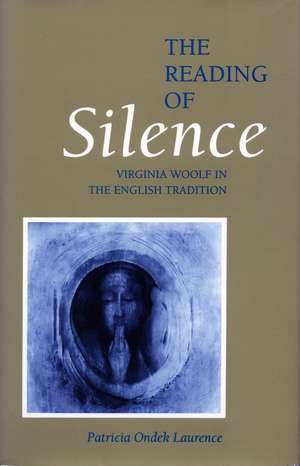
The Reading of Silence: Virginia Woolf in the English Tradition
Autor Patricia Laurenceen Limba Engleză Paperback – aug 1993
This is a study of Virginia Woolf's lifelong preoccupation with silence and the barrier between the sayable and the unsayable.
Preț: 164.50 lei
Nou
Puncte Express: 247
Preț estimativ în valută:
29.11€ • 34.14$ • 25.53£
29.11€ • 34.14$ • 25.53£
Carte disponibilă
Livrare economică 05-19 ianuarie 26
Preluare comenzi: 021 569.72.76
Specificații
ISBN-13: 9780804721790
ISBN-10: 0804721793
Pagini: 256
Dimensiuni: 152 x 229 x 18 mm
Greutate: 0.36 kg
Ediția:1
Editura: Stanford University Press
Colecția Stanford University Press
ISBN-10: 0804721793
Pagini: 256
Dimensiuni: 152 x 229 x 18 mm
Greutate: 0.36 kg
Ediția:1
Editura: Stanford University Press
Colecția Stanford University Press
V-ar putea interesa
-
 -9%Preț: 335.99 lei369.61 lei
 -
 -24%Preț: 360.85 lei474.60 lei
 -
 Short Oxford History of English LiteratureAndrew Sanders-11%Preț: 352.00 lei393.83 lei
 -
 Preț: 44.16 lei
 -
 Silas Marner: York Notes GCSE - for 2026, 2027 examsClare FindlayPreț: 44.62 lei
 -
 The Catcher in the Rye. InterpretationshilfeNigel TookeyPreț: 44.27 lei
 -
 The Material Image: Art and the Real in FilmBrigitte PeuckerPreț: 187.25 lei
 -
 A Question of Tradition: Women Poets in Yiddish, 1586-1987Kathryn Hellerstein-19%Preț: 467.84 lei577.58 lei
 -
 Semites: Race, Religion, LiteratureGil AnidjarPreț: 137.12 lei
 -
 Warped Mourning: Stories of the Undead in the Land of the UnburiedAlexander EtkindPreț: 191.30 lei
 -
 Preț: 193.40 lei
 -
 Butterfly Valley: A RequiemInger ChristensenPreț: 68.12 lei
 -
 Expanded Science Fiction Worlds of Forrest J Ackerman & Friends PlusForrest J. AckermanPreț: 83.45 lei
 -
 The TempestWilliam ShakespearePreț: 27.22 lei
Recenzii
"Laurence's groundbreaking study teaches us how to read Virginia Woolf's psychological, social, historical, philosophical, rhythmic, and structural silences as it weaves multi-colored threads into a shimmering whole: Woolf's novels; the major works in Woolf criticism; the English literary tradition, male and female; surrealist painting and contemporary music; philosophy, psychoanalysis, and linguistics; and structuralism, post-structuralism, deconstruction, reader response, and feminism. It suggests new directions for Woolf criticism . . . Lawrence's writing style is remarkably readable, clear, and careful."—English Language Notes
"Using a wide range of thinkers from Kierkegaard to Kristeva and Derrida, Laurence demonstrates convincingly that Woolf was the rst modern woman novelist to practice silence in her writing and that, in so doing, she created a new language of the mind . . . and changed the metaphor of silence from one of absence or oppression to one of presence and strength."—Belles Lettres
Textul de pe ultima copertă
"Laurence's groundbreaking study teaches us how to read Virginia Woolf's psychological, social, historical, philosophical, rhythmic, and structural silences as it weaves multi-colored threads into a shimmering whole: Woolf's novels; the major works in Woolf criticism; the English literary tradition, male and female; surrealist painting and contemporary music; philosophy, psychoanalysis, and linguistics; and structuralism, post-structuralism, deconstruction, reader response, and feminism. It suggests new directions for Woolf criticism. . . . Lawrence's writing style is remarkably readable, clear, and careful."—English Language Notes
“Using a wide range of thinkers from Kierkegaard to Kristeva and Derrida, Laurence demonstrates convincingly that Woolf was the ¹rst modern woman novelist to practice silence in her writing and that, in so doing, she created a new language of the mind . . . and changed the metaphor of silence from one of absence or oppression to one of presence and strength."—Belles Lettres
“Using a wide range of thinkers from Kierkegaard to Kristeva and Derrida, Laurence demonstrates convincingly that Woolf was the ¹rst modern woman novelist to practice silence in her writing and that, in so doing, she created a new language of the mind . . . and changed the metaphor of silence from one of absence or oppression to one of presence and strength."—Belles Lettres