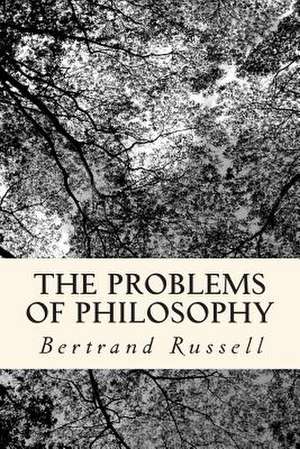
The Problems of Philosophy
Autor Bertrand Russellen Limba Engleză Paperback
Preț: 51.45 lei
Puncte Express: 77
Carte disponibilă
Livrare economică 18 mai-01 iunie
Specificații
ISBN-13: 9781506190129
ISBN-10: 150619012X
Pagini: 98
Dimensiuni: 152 x 229 x 5 mm
Greutate: 0.14 kg
Editura: CreateSpace Independent Publishing Platform
ISBN-10: 150619012X
Pagini: 98
Dimensiuni: 152 x 229 x 5 mm
Greutate: 0.14 kg
Editura: CreateSpace Independent Publishing Platform
V-ar putea interesa
-
 RepublicPlatoPreț: 29.30 lei
 -
 Modern PhilosophyRoger ScrutonPreț: 109.78 lei
 -
 Russell: A Very Short IntroductionA. C. Grayling-21%Preț: 53.56 lei67.81 lei
 -
 Think: A Compelling Introduction to PhilosophySimon Blackburn-20%Preț: 68.84 lei85.91 lei
 -
 Preț: 222.12 lei
 -
 Philosophy: A Very Short IntroductionEdward Craig-21%Preț: 53.28 lei67.68 lei
 -
 Knowledge: A Very Short IntroductionJennifer Nagel-21%Preț: 53.41 lei67.74 lei
 -
 MeditationsMarcus AureliusPreț: 31.49 lei
 -
 A History of Western PhilosophyBertrand RussellPreț: 177.73 lei
 -
 Why I Am Not a ChristianBertrand RussellPreț: 102.06 lei
 -
 An Introduction to the Theory of KnowledgeDan O'BrienPreț: 153.30 lei
 -
 The Philosophy of Logical AtomismImmanuel KantPreț: 125.73 lei
 -
 Western PhilosophyJohn G. CottinghamPreț: 300.54 lei
 -
 Philosophy 101Peter GibsonPreț: 93.06 lei
 -
 Preț: 62.73 lei
 -
 The Great Philosophers: RussellRay Monk-29%Preț: 28.42 lei40.28 lei
 -
 A History of Philosophy: The Condensed CoplestonAnthony Carroll-50%Preț: 129.08 lei260.06 lei
 -
 MetaphysicsAristotlePreț: 64.88 lei
 -
 RumorsMladen DolarPreț: 80.82 lei
 -
 Introducing Bertrand RussellDave RobinsonPreț: 54.77 lei
Descriere
Descriere de la o altă ediție sau format:
Bertrand Russell was one of the greatest logicians since Aristotle, and one of the most important philosophers of the past two hundred years. As we approach the 125th anniversary of the Nobel laureate's birth, his works continue to spark debate, resounding with unmatched timeliness and power. The Problems of Philosophy, one of the most popular works in Russell's prolific collection of writings, has become core reading in philosophy. Clear and accessible, this little book is an intelligible and stimulating guide to those problems of philosophy which often mistakenly lead to its status as too lofty and abstruse for the lay mind. Focusing on problems he believes will provoke positive and constructive discussion, Russell concentrates on knowledge rather than metaphysics, steering the reader through his famous 1910 distinction between "knowledge by acquaintance and knowledge by description," and introducing important theories of Descartes, Kant, Hegel, Hume, Locke, Plato, and others to lay the foundation for philosophical inquiry by general readers and scholars alike. With a new introduction by John Perry, this valuable work is a perfect introduction to the field and will continue to stimulate philosophical discussion as it has done for nearly forty years.
Bertrand Russell was one of the greatest logicians since Aristotle, and one of the most important philosophers of the past two hundred years. As we approach the 125th anniversary of the Nobel laureate's birth, his works continue to spark debate, resounding with unmatched timeliness and power. The Problems of Philosophy, one of the most popular works in Russell's prolific collection of writings, has become core reading in philosophy. Clear and accessible, this little book is an intelligible and stimulating guide to those problems of philosophy which often mistakenly lead to its status as too lofty and abstruse for the lay mind. Focusing on problems he believes will provoke positive and constructive discussion, Russell concentrates on knowledge rather than metaphysics, steering the reader through his famous 1910 distinction between "knowledge by acquaintance and knowledge by description," and introducing important theories of Descartes, Kant, Hegel, Hume, Locke, Plato, and others to lay the foundation for philosophical inquiry by general readers and scholars alike. With a new introduction by John Perry, this valuable work is a perfect introduction to the field and will continue to stimulate philosophical discussion as it has done for nearly forty years.
Notă biografică
Bertrand Arthur William Russell, 3rd Earl Russell, (18 May 1872 - 2 February 1970) was a British philosopher, logician, mathematician, historian, writer, essayist, social critic, political activist, and Nobel laureate. At various points in his life, Russell considered himself a liberal, a socialist and a pacifist, although he also confessed that his sceptical nature had led him to feel that he had "never been any of these things, in any profound sense. Russell was born in Monmouthshire into one of the most prominent aristocratic families in the United Kingdom
In the early 20th century, Russell led the British "revolt against idealism" He is considered one of the founders of analytic philosophy along with his predecessor Gottlob Frege, colleague G. E. Moore and protégé Ludwig Wittgenstein. He is widely held to be one of the 20th century's premier logicians.[67] With A. N. Whitehead he wrote Principia Mathematica, an attempt to create a logical basis for mathematics, the quintessential work of classical logic. His philosophical essay "On Denoting" has been considered a "paradigm of philosophy".[71] His work has had a considerable influence on mathematics, logic, set theory, linguistics, artificial intelligence, cognitive science, computer science (see type theory and type system) and philosophy, especially the philosophy of language, epistemology and metaphysics.
Russell was a prominent anti-war activist and he championed anti-imperialism. Occasionally, he advocated preventive nuclear war, before the opportunity provided by the atomic monopoly had passed and he decided he would "welcome with enthusiasm" world government.[74] He went to prison for his pacifism during World War I. Later, Russell concluded that war against Adolf Hitler's Nazi Germany was a necessary "lesser of two evils" and criticised Stalinist totalitarianism, attacked the involvement of the United States in the Vietnam War and was an outspoken proponent of nuclear disarmament. In 1950, Russell was awarded the Nobel Prize in Literature "in recognition of his varied and significant writings in which he champions humanitarian ideals and freedom of thought"
In the early 20th century, Russell led the British "revolt against idealism" He is considered one of the founders of analytic philosophy along with his predecessor Gottlob Frege, colleague G. E. Moore and protégé Ludwig Wittgenstein. He is widely held to be one of the 20th century's premier logicians.[67] With A. N. Whitehead he wrote Principia Mathematica, an attempt to create a logical basis for mathematics, the quintessential work of classical logic. His philosophical essay "On Denoting" has been considered a "paradigm of philosophy".[71] His work has had a considerable influence on mathematics, logic, set theory, linguistics, artificial intelligence, cognitive science, computer science (see type theory and type system) and philosophy, especially the philosophy of language, epistemology and metaphysics.
Russell was a prominent anti-war activist and he championed anti-imperialism. Occasionally, he advocated preventive nuclear war, before the opportunity provided by the atomic monopoly had passed and he decided he would "welcome with enthusiasm" world government.[74] He went to prison for his pacifism during World War I. Later, Russell concluded that war against Adolf Hitler's Nazi Germany was a necessary "lesser of two evils" and criticised Stalinist totalitarianism, attacked the involvement of the United States in the Vietnam War and was an outspoken proponent of nuclear disarmament. In 1950, Russell was awarded the Nobel Prize in Literature "in recognition of his varied and significant writings in which he champions humanitarian ideals and freedom of thought"
Recenzii
Treats its subject in a way that will arouse the interest of any one who has any latent ability to become interested in it.
After all these decades, still the simplest, clearest introduction to problems of metaphysics and epistemology.
After all these decades, still the simplest, clearest introduction to problems of metaphysics and epistemology.