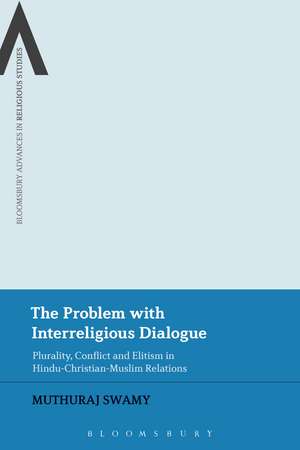
The Problem with Interreligious Dialogue: Plurality, Conflict and Elitism in Hindu-Christian-Muslim Relations: Bloomsbury Advances in Religious Studies
Autor Dr Muthuraj Swamyen Limba Engleză Paperback – 21 sep 2017
Offering a critique of the idea of 'dialogue' as it has been advanced by its proponents such as religious leaders and theologians whose aims are to promote inter-religious conversation and understanding, the author argues that this approach is 'elitist' and that in reality, people do not make sharp distinctions between religions, nor do they separate political, economic, social and cultural beliefs and practices from their religious traditions.
Case studies from villages in southern India explore how Hindu, Muslim and Christian communities interact in numerous ways that break the neat categories often used to describe each religion. Swamy argues that those who promote dialogue are ostensibly attempting to overcome the separate identities of religious practitioners through understanding, but in fact, they re-enforce them by encouraging a false sense of separation. The Problem with Interreligious Dialogue: Plurality, Conflict and Elitism in Hindu-Christian-Muslim Relations provides an innovative approach to a central issue confronting Religious Studies, combining both theory and ethnography.
Din seria Bloomsbury Advances in Religious Studies
- 16%
 Preț: 276.77 lei
 - 16%
 Preț: 281.81 lei
 - 16%
 Preț: 278.68 lei
 - 16%
 Preț: 256.34 lei
 -
 Preț: 282.53 lei
 - 16%
 Preț: 278.37 lei
 - 15%
 Preț: 279.55 lei
 - 26%
 Preț: 214.23 lei
 - 25%
 Preț: 215.34 lei
 - 28%
 Preț: 210.44 lei
 - 26%
 Preț: 216.27 lei
 - 26%
 Preț: 215.98 lei
 - 26%
 Preț: 216.72 lei
 - 28%
 Preț: 208.69 lei
 - 28%
 Preț: 208.46 lei
 - 26%
 Preț: 207.83 lei
 - 26%
 Preț: 207.60 lei
 - 28%
 Preț: 208.89 lei
 - 28%
 Preț: 208.04 lei
 - 26%
 Preț: 206.57 lei
 - 26%
 Preț: 207.53 lei
 - 26%
 Preț: 206.87 lei
 - 32%
 Preț: 551.58 lei
 - 32%
 Preț: 551.39 lei
Preț: 256.63 lei
Preț vechi: 304.26 lei
-16%
Puncte Express: 385
Carte tipărită la comandă
Livrare economică 18 noiembrie-02 decembrie
Livrare prin curier în România Termenul estimat este afișat lângă disponibilitate.
Transport gratuit de la 400.00 lei Plată online sau ramburs, în funcție de opțiunile comenzii.
Retur gratuit în 14 zile Comandă securizată și suport în română.
Specificații
ISBN-13: 9781350048591
ISBN-10: 1350048593
Pagini: 248
Dimensiuni: 154 x 232 x 16 mm
Greutate: 0.35 kg
Ediția:NIPPOD
Editura: Bloomsbury Publishing
Colecția Bloomsbury Academic
Seria Bloomsbury Advances in Religious Studies
Locul publicării:London, United Kingdom
ISBN-10: 1350048593
Pagini: 248
Dimensiuni: 154 x 232 x 16 mm
Greutate: 0.35 kg
Ediția:NIPPOD
Editura: Bloomsbury Publishing
Colecția Bloomsbury Academic
Seria Bloomsbury Advances in Religious Studies
Locul publicării:London, United Kingdom
V-ar putea interesa
-
 Was Jesus God?Richard Swinburne-19%Preț: 57.89 lei71.20 lei
 -
 -11%Preț: 361.35 lei408.22 lei
 -
 Fortunate Fallibility: Kierkegaard and the Power of SinJason A. Mahn-32%Preț: 348.72 lei511.73 lei
 -
 -13%Preț: 274.53 lei313.87 lei
 -
 The Phenomenology of Religious LifeMartin HeideggerPreț: 181.44 lei
 -
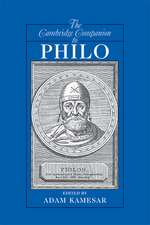 The Cambridge Companion to PhiloAdam KamesarPreț: 249.71 lei
 -
 -25%Preț: 1169.06 lei1550.90 lei
 -
 And Man Created GodRobert BanksPreț: 70.71 lei
 -
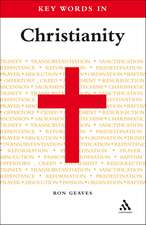 Key Words in ChristianityProfessor Ron Geaves-19%Preț: 167.08 lei205.94 lei
 -
 Key Words in Religious StudiesProfessor Ron Geaves-12%Preț: 170.86 lei194.22 lei
 -
 Reformation Divided: Catholics, Protestants and the Conversion of EnglandProfessor Eamon Duffy-40%Preț: 163.64 lei273.22 lei
 -
 The Secular Contract: The Politics of EnlightenmentDr. Alex SchulmanPreț: 277.79 lei
 -
 God's Final Victory: A Comparative Philosophical Case for UniversalismProfessor John Kronen-25%Preț: 278.18 lei369.61 lei
 -
 Preț: 427.78 lei
 -
 The Godseeker's GuideLionel Blue-52%Preț: 58.05 lei120.93 lei
Cuprins
Introduction
Part 1: The Problem: The Concept and Practice of Dialogue
1. Dialogue in Post-Colonial India: A Brief Survey
2. The Practice of Dialogue: A Case from Kanyakumari District
Part 2: Limitations of Religious Plurality, Conflict and Elitism
3. 'Religion' and 'World Religions': Some Contemporary Approaches
4. Religious Plurality and Dialogue
5. Are Religions in Conflict?
6. Dialogue and the Myth of Religious Conflicts: A Case Study
7. Dialogue as Elitist
Part 3: Multiple Identities as a Challenger
8. Religion, Multiple Identities and Everyday Relations among Ordinary People
9. After Dialogue
Conclusion
Bibliography
Index
Part 1: The Problem: The Concept and Practice of Dialogue
1. Dialogue in Post-Colonial India: A Brief Survey
2. The Practice of Dialogue: A Case from Kanyakumari District
Part 2: Limitations of Religious Plurality, Conflict and Elitism
3. 'Religion' and 'World Religions': Some Contemporary Approaches
4. Religious Plurality and Dialogue
5. Are Religions in Conflict?
6. Dialogue and the Myth of Religious Conflicts: A Case Study
7. Dialogue as Elitist
Part 3: Multiple Identities as a Challenger
8. Religion, Multiple Identities and Everyday Relations among Ordinary People
9. After Dialogue
Conclusion
Bibliography
Index
Recenzii
In a style that is accessible, yet not reductionist, Swamy has successfully shown that most conflicts termed "religious" are anything but that.This work encourages academics and social scientists to undertake similar researches in other areas of religious studies, where many centuries-old constructs have been blindly followed.
A well-grounded study that raises important questions for the future of interreligious dialogue . I warmly recommend the book for those interested in interreligious dialogue, as well as interreligious relations and lived religion in India.
A detailed and thorough critique . Swamy's writing style is clear and his overall argument diligently signposted throughout . The book is a salutary and provocative addition to the literature concerning interreligious dialogue, and a good read for those interested in the politics of religion in India (and elsewhere) in all its discursive messiness.
Stripping away the overgrowth and debris that hid the inherent promise and ongoing potential of interreligious dialogue, and carefully, creatively, provocatively yet committedly using case studies and displaying mastery over a huge amount of literature, the author reopens and interrogates the meaning, limitations, and potential of dialogue in our messy 21st century. Just when one thinks that certain influential ideas and movements have run their course and reached an impasse, mainly because of faulty starting-points and overly simplistic assumptions about that catch-all word "religion", this is a book which skillfully forces us to confront our suppositions and reboot our commitments.
A well-grounded study that raises important questions for the future of interreligious dialogue . I warmly recommend the book for those interested in interreligious dialogue, as well as interreligious relations and lived religion in India.
A detailed and thorough critique . Swamy's writing style is clear and his overall argument diligently signposted throughout . The book is a salutary and provocative addition to the literature concerning interreligious dialogue, and a good read for those interested in the politics of religion in India (and elsewhere) in all its discursive messiness.
Stripping away the overgrowth and debris that hid the inherent promise and ongoing potential of interreligious dialogue, and carefully, creatively, provocatively yet committedly using case studies and displaying mastery over a huge amount of literature, the author reopens and interrogates the meaning, limitations, and potential of dialogue in our messy 21st century. Just when one thinks that certain influential ideas and movements have run their course and reached an impasse, mainly because of faulty starting-points and overly simplistic assumptions about that catch-all word "religion", this is a book which skillfully forces us to confront our suppositions and reboot our commitments.
Notă biografică
Muthuraj Swamy is Assistant Professor and Head of the Department of Christian Theology & Ethics in the Union Biblical Seminary, Pune, India.