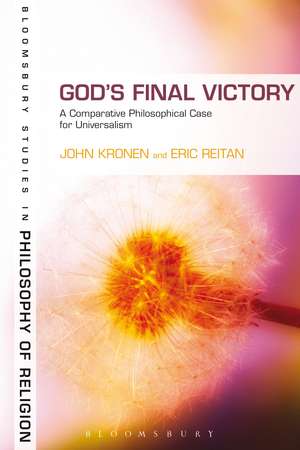
God's Final Victory: A Comparative Philosophical Case for Universalism: Bloomsbury Studies in Philosophy of Religion
Autor Professor John Kronen, Professor Eric Reitanen Limba Engleză Paperback – 6 iun 2013
Descoperim în God's Final Victory o monografie academică de o rigoare excepțională, dedicată uneia dintre cele mai vechi și disputate dileme ale teismului creștin: reconcilierea unui Dumnezeu iubitor cu existența damnării eterne. Publicat în seria Bloomsbury Studies in Philosophy of Religion, volumul semnat de Professor John Kronen și Professor Eric Reitan nu este doar o pledoarie teologică, ci un exercițiu de filozofie analitică aplicată asupra fundamentelor credinței. Suntem de părere că forța acestui text rezidă în structura sa comparativă, care refuză simplificările dogmatice în favoarea unei examinări critice a premiselor metafizice.
Structura este logică și progresivă, pornind de la definirea speciilor de „hellism” și universalism, trecând prin analiza sensului literal al Scripturii și culminând cu evaluarea conceptelor de justiție divină și har. Apreciem în mod deosebit capitolele dedicate libertății umane, unde autorii demonstrează că mântuirea universală nu trebuie să nege liberul arbitru, ci poate fi văzută ca un rezultat final rațional al acestuia. Comparabil cu The Problem of Hell de Joel Buenting în ceea ce privește rigoarea academică, volumul de față se distinge prin faptul că oferă o sinteză actualizată, mutând accentul de la simpla expunere a problemei răului către o soluție argumentată în favoarea universalismului.
Față de alte lucrări similare, precum Swinburne's Hell and Hick's Universalism de Lindsey Hall, care se concentrează pe dezbaterea istorică dintre doi gânditori, God's Final Victory construiește un caz filozofic independent. Autorii reușesc să integreze datele din metafizică și etică pentru a oferi un răspuns coerent la întrebarea dacă un Dumnezeu perfect ar putea permite alienarea eternă a creaturilor sale. Este o lectură densă, dar clară, esențială pentru înțelegerea evoluției eshatologiei contemporane.
Din seria Bloomsbury Studies in Philosophy of Religion
- 25%
 Preț: 206.77 lei
 - 16%
 Preț: 274.60 lei
 - 25%
 Preț: 252.29 lei
 - 14%
 Preț: 259.70 lei
 -
 Preț: 279.17 lei
 - 16%
 Preț: 276.38 lei
 - 16%
 Preț: 245.67 lei
 - 33%
 Preț: 897.11 lei
 -
 Preț: 277.68 lei
 -
 Preț: 280.26 lei
 -
 Preț: 275.39 lei
 - 27%
 Preț: 233.91 lei
 - 25%
 Preț: 242.70 lei
 - 33%
 Preț: 623.59 lei
 - 28%
 Preț: 208.67 lei
 - 28%
 Preț: 207.19 lei
 - 25%
 Preț: 213.53 lei
 - 32%
 Preț: 551.25 lei
 - 32%
 Preț: 553.87 lei
 - 18%
 Preț: 681.08 lei
Preț: 278.18 lei
Preț vechi: 369.61 lei
-25%
Carte tipărită la comandă
Livrare economică 02-16 decembrie
Specificații
ISBN-10: 1623568498
Pagini: 256
Ilustrații: black & white illustrations
Dimensiuni: 152 x 232 x 16 mm
Greutate: 0.36 kg
Editura: Bloomsbury Publishing
Colecția Bloomsbury Academic
Seria Bloomsbury Studies in Philosophy of Religion
Locul publicării:New York, United States
V-ar putea interesa
-
 There Is a GodAntony FlewPreț: 91.08 lei
 -
 Rocks Of AgesSj GouldPreț: 114.82 lei
 -
 The Horrors and Absurdities of ReligionArthur Schopenhauer-20%Preț: 45.47 lei56.75 lei
 -
 Essays on Religion and EducationR. M. Hare-28%Preț: 357.61 lei500.01 lei
 -
 Theism, Atheism, and Big Bang CosmologyWilliam Lane Craig-28%Preț: 478.89 lei668.83 lei
 -
 Plotinus: An Introduction to the EnneadsDominic J. O'Meara-29%Preț: 374.77 lei525.76 lei
 -
 -28%Preț: 441.60 lei614.40 lei
 -
 Theology and Marxism in Eagleton and ZizekO. Sigurdson-15%Preț: 643.87 lei757.49 lei
 -
 Reshaping Natural TheologyM. WahlbergPreț: 405.27 lei
 -
 The Cambridge Companion to PhiloAdam KamesarPreț: 249.71 lei
 -
 -25%Preț: 1169.06 lei1550.90 lei
 -
 Evanescence and FormC. InouyePreț: 402.26 lei
 -
 Philosophy of Religion for AS LevelDr. Michael B. WilkinsonPreț: 122.26 lei
De ce să citești această carte
Această monografie este esențială pentru studenții și cercetătorii în filozofia religiei care doresc să exploreze validitatea logică a universalismului creștin. Cititorul câștigă o perspectivă profundă asupra modului în care conceptele de libertate, justiție și har pot fi armonizate fără a sacrifica rigoarea intelectuală. Este o recomandare solidă pentru cei care caută un fundament rațional pentru speranța mântuirii tuturor, dincolo de simpla interpretare confesională.
Descriere
Would the just and loving God of traditional Christianity ever cause or allow some creatures to endure hell, that is, eternal alienation from both God and the blessed? Many think the answer is yes. Some defend this answer by arguing that God is not only loving but also just, and that eternal damnation is sometimes the only way God can meet the demands of justice with respect to sin. Others argue that, out of respect for creatures, God affords them the freedom to choose their destiny-and some choose eternal alienation from God. God's Final Victory examines the presuppositions underlying both lines of argument and finds that, once understood in their most defensible form, they offer good reason to suppose God would save all if He could and no compelling reason to suppose that He would or could not. As such, even conservative Christians should believe in universal salvation.
Cuprins
Recenzii
'...The overall quality of the work overshadows any critique of form. The historical breadth and depth of analysis will make this volume helpful for researchers and for graduate-level courses in philosophy of religion.'-Choice Magazine
"In their comparative case for Christian universalism entitled God's Final Victory, John Kronen and Eric Reitan display an exhaustive knowledge of the relevant philosophical and theological literature; and even though they make no claim of completeness for their study, they may in fact have produced the most complete discussion to date of the relevant philosophical and theological issues. No philosopher or theologian who in the future addresses the issue of universalism will be able to ignore the arguments of this book, and even many parishioners in the pew, however impatient they may be with finely drawn philosophical distinctions, will benefit greatly from it. The final chapter in particular will be of interest to the Christian community as a whole, because it includes an easy to digest summary of the overall argument and also addresses the issue of evangelism as well as other practical Christian concerns.The book's most important contribution to the contemporary discussion lies in a sustained and powerful critique of the so-called Argument from Freedom, the argument that, for all we know, God cannot save all sinners without violating their freedom in inappropriate ways. Kronen and Reitan demonstrate first how, given the traditional Christian understanding of his nature, God is in a position to confer efficacious grace on anyone, or on any combination of persons, without violating the rational autonomy of any individual. But they also have an additional surprise, albeit one that Reitan has articulated in previous papers, for those who insist that salvation requires an undetermined libertarian free choice that could have gone the other way. For as they also argue, the assumption that sinners retain their libertarian freedom indefinitely together with the Christian doctrine of the preservation of the saints yields the following result: We can be just as confident that God will eventually win over all sinners (and do so without causally determining their choices) as we can be that that a fair coin will land heads up at least once in a trillion tosses. One can hardly expect everyone to find such arguments as persuasive as I do; but even those who remain unpersuaded will at least find in them a formidable challenge to be met." -- Thomas Talbott, Professor Emeritus of Philosophy, Willamette University, USA