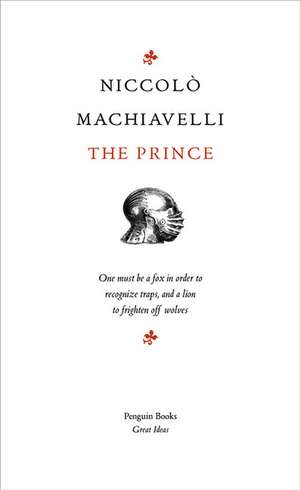
The Prince
Autor Nicolas Machiavel Traducere de George Bullen Limba Engleză Paperback – 6 sep 2005
Observăm că, în ciuda abundenței de tratate etice din perioada Renașterii, literatura academică a vremii suferea de o lacună majoră: absența unei analize pragmatice a puterii, decuplată de moralitatea creștină. The Prince a venit să umple acest gol, devenind fundamentul filosofiei politice moderne prin prioritizarea rezultatelor concrete în fața idealurilor abstracte. Suntem de părere că această ediție din seria Collins Classics reușește să păstreze forța brută a argumentației lui Niccolo Machiavelli, oferind cititorului acces direct la mecanismele conducerii de stat. Textul extinde cadrul propus de Machiavelli: Selected Political Writings cu date noi din contextul istoric al Italiei secolului al XVI-lea, punând accent pe distincția dintre conducerea prin „virtù” și cea dobândită prin noroc sau „cruzime criminală”. Remarcăm structura riguroasă a capitolelor, care deconstruiește calitățile necesare unui principe — de la gestionarea armatelor până la arta de a fi temut fără a fi urât. Această lucrare se raportează la Discourses on Livy (Discorsi) ca o piesă complementară: dacă în Discorsi autorul își exprima preferința pentru republică, în The Prince el analizează anatomia monarhiei și a statelor noi, tratând ambele forme de guvernare ca structuri de putere ce necesită prudență și calcul strategic. Stilul este unul tăios, cu o logică liniară ce refuză eufemismele, reflectând experiența diplomatică a autorului în misiuni pentru Republica Florentină. Față de alte ediții, precum The Prince (Special Student Edition), volumul de față se concentrează pe textul clasic, oferind o poartă de intrare esențială în studiul științelor politice și al constituționalismului european.
Preț: 73.59 lei
Carte disponibilă
Livrare economică 07-21 noiembrie
Specificații
ISBN-10: 0143036335
Pagini: 128
Dimensiuni: 112 x 179 x 9 mm
Greutate: 0.1 kg
Editura: Penguin Publishing Group
V-ar putea interesa
-
 The PrinceNiccolo MachiavelliPreț: 28.01 lei
 -
 The Art of WarSun TzuPreț: 28.01 lei
 -
 The Art of RhetoricAristotlePreț: 28.01 lei
 -
 Animal FarmGeorge OrwellPreț: 28.01 lei
 -
 The TempestWilliam ShakespearePreț: 28.01 lei
 -
 Letters from a StoicLucius Annaeus SenecaPreț: 58.15 lei
 -
 Letters from a StoicLucius SenecaPreț: 29.76 lei
 -
 RepublicPlatoPreț: 30.76 lei
 -
 Fire and Blood: TV Tie-InGeorge R. R. MartinPreț: 60.59 lei
 -
 The DiscoursesNicolas Machiavel-17%Preț: 78.43 lei94.91 lei
 -
 The PlagueAlbert Camus-19%Preț: 58.02 lei71.63 lei
 -
 RebelAlbert Camus-26%Preț: 58.75 lei79.02 lei
 -
 Machiavelli: A Very Short IntroductionQuentin Skinner-20%Preț: 56.19 lei70.53 lei
 -
 BreathJames Nestor-18%Preț: 65.20 lei79.63 lei
 -
 The Hobbit Classic HardbackJ.R.R. TolkienPreț: 159.17 lei
 -
 -26%Preț: 57.69 lei78.14 lei
 -
 MeditationsMarcus AureliusPreț: 34.00 lei
 -
 The Will to PowerFriedrich NietzschePreț: 71.58 lei
 -
 Marx and the Robots: Networked Production, AI, and Human LabourFlorian ButolloPreț: 201.61 lei
 -
 The Essential Writings of MachiavelliNicolas Machiavel-10%Preț: 100.91 lei112.44 lei
 -
 The Prince: The Original ClassicNiccolo MachiavelliPreț: 73.44 lei
 -
 Machiavelli: Selected Political WritingsNiccolo Machiavelli-17%Preț: 128.23 lei155.31 lei
 -
 Preț: 94.39 lei
 -
 The Prince (Signature Editions): and The Art of WarNiccolo Machiavelli-30%Preț: 92.82 lei132.56 lei
 -
 -36%Preț: 52.44 lei81.74 lei
 -
 -19%Preț: 69.09 lei85.66 lei
 -
 The ThroneFranco BerniniPreț: 71.93 lei
 -
 The Prince (Hero Classics)Niccolo Machiavelli-12%Preț: 55.79 lei63.44 lei
 -
 Preț: 41.78 lei
 -
 The PrinceNiccolò MachiavelliPreț: 33.48 lei
De ce să citești această carte
Recomandăm această carte oricărui student la științe politice sau lider în devenire care dorește să înțeleagă rădăcinile realismului politic. Prin The Prince, cititorul câștigă o perspectivă lucidă asupra modului în care se exercită influența și autoritatea, învățând să distingă între imaginea publică și necesitatea strategică. Este o lectură fundamentală pentru a înțelege cum s-a format gândirea politică occidentală modernă, dincolo de mitul „machiavelismului” vulgar.
Despre autor
Niccolo Machiavelli (1469-1527) a fost un diplomat, filosof și istoric florentin, considerat astăzi părintele științei politice moderne. Cariera sa în serviciul public al Florenței i-a permis să observe direct manevrele politice ale unor figuri precum Cesare Borgia sau Ludovic al XII-lea, experiențe care au cristalizat viziunea sa asupra pragmatismului de stat. După revenirea familiei Medici la putere, Machiavelli s-a retras la ferma sa, unde a redactat cele mai importante lucrări ale sale, inclusiv The Prince și Discorsi, redefinind pentru totdeauna modul în care societatea raportează etica la exercițiul puterii.
Descriere scurtă
Now, Penguin brings you the works of the great thinkers, pioneers, radicals and visionaries whose ideas shook civilization, and helped make us who we are. Penguin's Great Ideas series features twelve groundbreaking works by some of history's most prodigious thinkers, and each volume is beautifully packaged with a unique type-drive design that highlights the bookmaker's art. Offering great literature in great packages at great prices, this series is ideal for those readers who want to explore and savor the Great Ideas that have shaped the world.
Rejecting the traditional values of political theory, Machiavelli drew upon his own experiences of office in the turbulent Florentine republic to write his celebrated treatise on statecraft. While Machiavelli was only one of the many Florentine “prophets of force,” he differed from the ruling elite in recognizing the complexity and fluidity of political life.
Notă biografică
George Bull is an author and journalist who has translated six volumes for the Penguin Classics: Benvenuto Cellini’s Autobiography, The Book of the Courtier by Castiglione, Vasari’s Lives of the Artists (two volumes), The Prince by Machiavelli and Pietro Aretino’s Selected Letters. He is also Consultant Editor to the Penguin Business Series. After reading history at Brasenose College, Oxford, George Bull worked for the Financial Times, McGraw-Hill World News, and for the Director magazine, of which he was Editor-in-Chief until 1984. His other books include Vatican Politics; Bid for Power (with Anthony Vice), a history of take-over bids; Renaissance Italy, a book for children; Venice: The Most Triumphant City; and Inside the Vatican.
Extras
How many kinds of principality there are and the ways in which they are acquired All the states, all the dominions under whose authority men have lived in the past and live now have been and are either republics or principalities. Principalities are hereditary, with their prince's family long established as rulers, or they are new. The new are completely new, as was Milan to Francesco Sforza, or they are like limbs joined to the hereditary state of the prince who acquires them, as is the kingdom of Naples in relation to the king of Spain. Dominions so acquired are accustomed to be under a prince, or used to freedom; a prince wins them either with the arms of others or with his own, either by fortune or by prowess.
Recenzii
Cuprins
Descriere
Drawing upon his own experiences of political office in the turbulent Florentine republic, Machiavelli wrote what would become his celebrated treatise on statecraft. Includes a chronology and map.