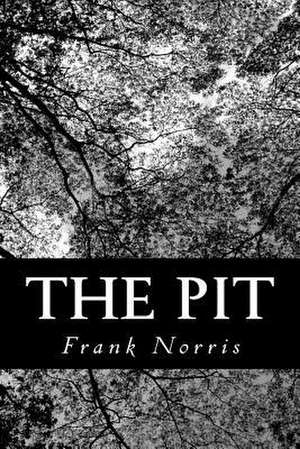
The Pit
Autor Frank Norrisen Limba Engleză Paperback
Preț: 115.55 lei
Puncte Express: 173
Carte disponibilă
Livrare economică 18 decembrie 26 - 01 ianuarie 27
Livrare prin curier în România Termenul estimat este afișat lângă disponibilitate.
Transport gratuit de la 400.00 lei Plată online sau ramburs, în funcție de opțiunile comenzii.
Retur gratuit în 14 zile Comandă securizată și suport în română.
Specificații
ISBN-13: 9781481076005
ISBN-10: 1481076000
Pagini: 294
Dimensiuni: 152 x 229 x 17 mm
Greutate: 0.44 kg
Editura: CREATESPACE
V-ar putea interesa
-
 The Lehman TrilogyStefano MassiniPreț: 82.73 lei
-
 Against the DayThomas PynchonPreț: 89.94 lei
-
 The GodfatherMario Puzo-22%Preț: 63.35 lei81.19 lei
-
 Keep the Aspidistra FlyingGeorge Orwell-26%Preț: 53.28 lei71.65 lei
-
 TyrantConn IgguldenPreț: 127.23 lei
-
 The Grapes of WrathJohn Steinbeck-23%Preț: 56.02 lei73.18 lei
-
 McTeagueFrank NorrisPreț: 49.10 lei
-
 Heart of DarknessJoseph Conrad-18%Preț: 23.45 lei28.58 lei
-
 In the ValleyRon RashPreț: 104.47 lei
-
 The JungleUpton SinclairPreț: 50.75 lei
-
 Sister CarrieTheodore DreiserPreț: 46.50 lei
-
 God's Little AcreErskine CaldwellPreț: 135.14 lei
-
 Smiley, J: Some LuckJane Smiley-32%Preț: 90.34 lei133.79 lei
-
 Business AdventuresJohn Brooks-25%Preț: 81.35 lei108.23 lei
-
 Preț: 80.42 lei
-
 Take Me to the RiverVicky AllanPreț: 146.25 lei
-
 The Ragged Trousered PhilanthropistsRobert TressellPreț: 28.01 lei
-
 Preț: 146.10 lei
-
 The Literary BusinessPeter FinchPreț: 145.09 lei
-
 The Great Gatsby: 100th Anniversary Edition (The Original 1925 Classic)F. Scott Fitzgerald-13%Preț: 19.96 lei22.82 lei
Notă biografică
Frank Norris (1870-1902) was an American novelist and journalist associated with literary naturalism. His works include McTeague, The Octopus, The Pit, and Moran of the Lady Letty.The conditions of the writer's period are important to an understanding of the work. Questions about the individual and society, including the roles of education, work, belief, and public institutions, repeatedly enter the literature and intellectual debates of the era. The historical setting should not be confused with a modern retelling: the language and assumptions of these works belong to their original moment.Norris studied art in Paris and attended the University of California and Harvard before working as a journalist. His interest in the naturalist fiction of Émile Zola encouraged him to dramatize the effects of economic institutions and environment on individuals. McTeague portrayed ambition and deterioration in San Francisco, while The Octopus examined the conflict between California wheat growers and railroad power. The Pit was planned as the second part of The Epic of the Wheat, a trilogy that would follow grain from production through speculation to consumption. Set against Chicago's grain trade, it combines economic pressures with domestic and psychological tensions. The novel was published after Norris's death in 1902; the projected final volume, The Wolf, was never completed. Norris's abbreviated career nevertheless helped shape American naturalist fiction through its energetic narrative style and its ambition to portray the large systems affecting ordinary lives.For readers of The Pit, this biographical and publication context matters because the book addresses questions that were visible to its first audience but may be less familiar today. Understanding the author's working circumstances, intended genre, and intellectual environment can clarify the choices made in the text without treating its incidents as literal autobiography.In The Pit, the writer turns to american naturalist novel to develop a particular subject. The posthumously published second part of Frank Norris's projected Epic of the Wheat. Its achievement is best understood in connection with the author's established body of writing and the literary conventions through which the subject is presented.Readers approaching this work today can appreciate its historical frame alongside its literary ambitions. Its treatment of character, perspective, society, or argument offers insight into the concerns that shaped its original audience. Where names, dates, or the original author's identity are uncertain, those details should be resolved through the edition and bibliographical record rather than supplied by conjecture.